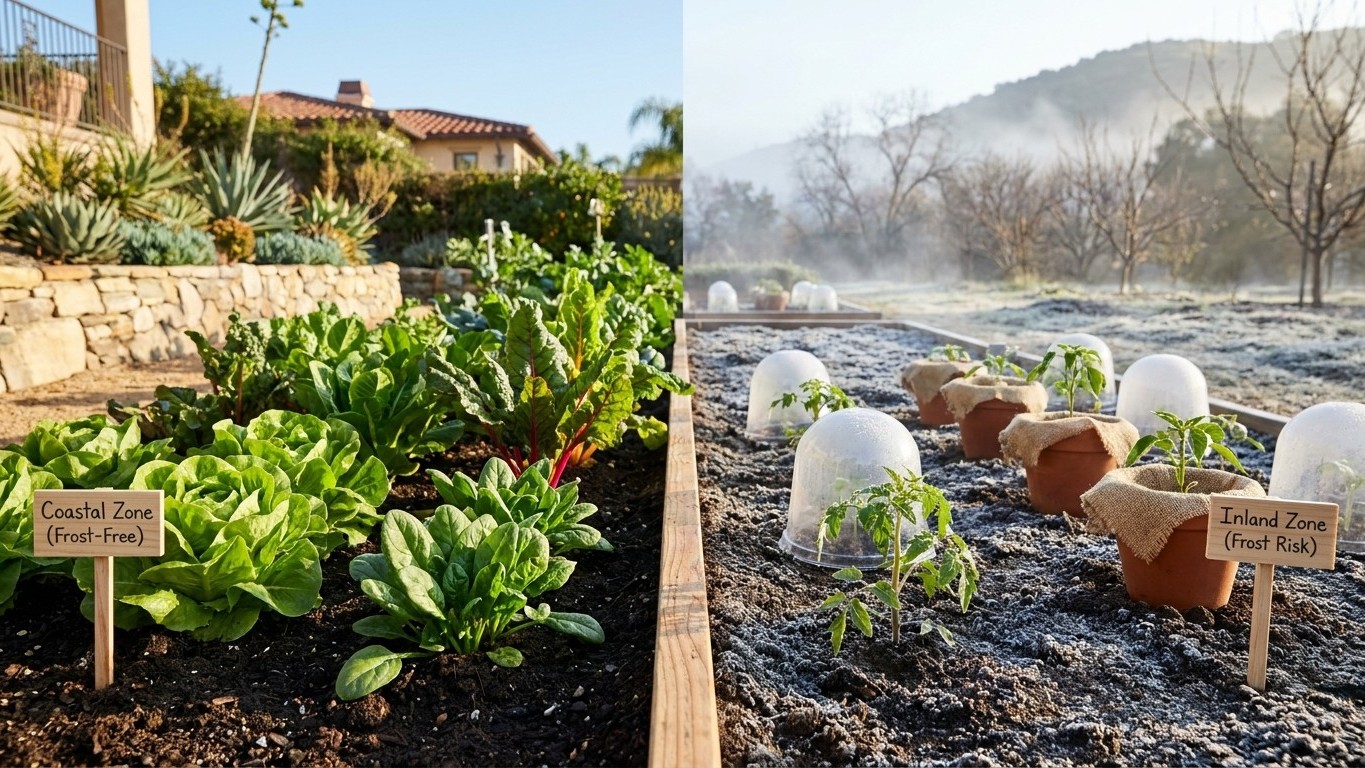

March is the hinge month for California gardens: coastal and southern zones are frost-free year-round, so the limit isn’t cold, it’s whether the soil has warmed enough for warm-season roots. Inland valleys and the Sierra foothills still carry frost risk, which means the safe planting list depends far more on where you garden than on the date on the calendar.
What goes in the ground in March

The state splits into two very different gardens this month. Along the coast and through Southern California, the NOAA climate record for the Los Angeles area shows zero days at or below 32 F across three decades of data, and the frost-free season is listed at 365 days. There is no last-frost date to plan around here because there’s effectively no frost to plan around. That changes the whole question: the limiting factor isn’t cold, it’s soil temperature and water. Cool-season crops like lettuce, spinach, chard, beets, carrots, radishes and peas go into the ground now without hesitation. Onion and garlic sets that missed the fall window can still be tucked in where the soil is loose and workable.
Warm-season crops are a different call. Tomatoes, peppers, eggplant, squash and beans can technically survive outdoors in a frost-free coastal or Southern California garden in March, but cool marine-layer soil often sits too cold for their roots to do much. Transplanting into ground that hasn’t warmed is the classic way to end up with a stalled, yellowing plant that a June-planted neighbor overtakes within weeks. In warmer inland pockets of Southern California, soil often comes up to speed by late March, which is when transplanting these crops starts to make sense.
The Central Valley, the Sierra foothills and Northern California are a different story. These regions do freeze, and the facts available here don’t carry a specific frost-free date for them the way they do for the coast. That means the safe bet is hardy stock: peas, fava beans, onions, garlic, spinach, lettuce and brassica transplants (broccoli, cabbage, kale) can go in, ideally with row cover on hand for a cold snap. Warm-season starts stay indoors or under protection until local frost risk has clearly passed, which your county extension office can confirm better than any statewide date.
What to start under cover
For gardeners in frost-prone inland and northern regions, the arithmetic runs backward from your local last-frost window, not from this page. Tomatoes, peppers and eggplant typically need six to eight weeks under lights or on a warm windowsill before they’re sturdy enough to go outside, so count back from whenever your area’s frost risk usually clears and start seed at that point. Since a specific frost date for the Central Valley or Sierra isn’t published in the data behind this article, check it directly with your local UC Cooperative Extension office rather than guessing.
Coastal and Southern California gardeners face a gentler version of the same math. There’s no frost deadline forcing the countdown, but soil temperature still sets the pace: starting tomato and pepper seed indoors in March means transplants are ready right as inland and valley soil crosses into the 60s F, typically through April. Melons, cucumbers and summer squash are quick enough from seed that many California gardeners direct-sow them later rather than starting under cover at all.
Two mistakes show up every season. Start too early and you’re babysitting leggy, rootbound tomato seedlings on a windowsill for six extra weeks with nowhere to put them. Start too late in a short-season inland or mountain garden and warm-season crops never get enough heat units to ripen before fall cools things down again. Splitting a tray, sowing half now and half in two or three weeks, hedges against guessing wrong on either end.
What is ready to pick
California’s mild winters mean the harvest never fully stops the way it does in colder states, and March leans on that advantage. Citrus is a headline crop here: navel oranges, lemons and mandarins planted in past seasons are often still hanging on the tree, and the fruit holds well without dropping, so there’s no rush to pick it all at once. Winter brassicas planted in fall, kale, chard, broccoli and cabbage, are typically at peak size and flavor now, especially after a few cool nights have sweetened them.
Artichokes planted in prior seasons often start their first flush of buds this month in milder coastal gardens. Fava beans sown in fall or early winter are usually setting pods. Overwintered lettuce and spinach beds, if they were protected from slugs and heavy rain, are ready for cut-and-come-again harvests.
In colder inland and mountain gardens where the ground has been locked up, the picture is thinner: stored winter squash, potatoes and onions from last season are the main food coming out of the house rather than the garden. Check them now. A soft spot on a squash, sprouting eyes on potatoes, or a papery onion that’s gone soft at the neck all mean use it soon rather than let it spread rot to the rest of the bin.
The jobs that matter this month
Water and soil come first
California’s rainy season is winding down through March in most years, and that’s the real deadline behind several jobs. Check drip lines and irrigation timers now, before the dry months arrive and a cracked emitter turns into a dead plant instead of a puddle. Mulch beds heavily while the soil is still moist, locking in that moisture before the state’s dry season starts pulling it back out. Work compost into beds that are between crops; roots that go in over the next few weeks will use it all season.
Pruning, pests and planning
Dormant pruning of deciduous fruit trees, roses and cane berries should be finishing up in colder inland and mountain gardens right as buds start to swell; prune too late and you cut off the season’s growth along with the wood. Citrus, by contrast, generally wants pruning after harvest is done rather than now. Start scouting for aphids and snails on new growth; both multiply fast as temperatures climb, and catching them on a handful of leaves beats fighting a colony later. Stake peas and sweet peas before they sprawl into a tangle that’s nearly impossible to sort out once the vines are established. If seed catalogs are still open for the season, order now: popular tomato and pepper varieties sell out of stock well before planting time in warmer zones.
What not to do in March
The most common misstep is trusting the air temperature instead of the soil. A run of warm, sunny days in February or early March can feel like summer, but the ground underneath, especially in clay soil or shaded beds, often lags weeks behind. Planting tomatoes or peppers into soil that’s still cold sets them back rather than getting them ahead; a soil thermometer pushed a few inches down is a better guide than how the afternoon feels.
In frost-prone inland and mountain gardens, the mirror mistake is pulling row covers or cold frames off too soon after a mild stretch. California’s temperature swings can bring a sharp cold night right behind a run of 70-degree days, and tender transplants that were hardening off outdoors have no buffer if that happens.
Feeding citrus and fruit trees too early is another classic. Nitrogen applied before root activity has really picked up mostly leaches away before the plant can use it, and it can push soft new growth that’s more vulnerable to a late cold snap in the colder parts of the state. Wait until you see clear new growth starting before the first feeding.
Last, with the dry season approaching, this is the wrong month to overplant water-hungry crops without a watering plan. Many California communities have water-use rules that tighten through summer, and a bed planted heavy on thirsty crops in March can become a problem by July.
Checking this against your own county
California runs from USDA hardiness zone 5a in the high Sierra to 11a along the warmest coastal and desert edges, a spread wide enough that “plant this in March” means something entirely different in Eureka, Fresno, Palm Springs and South Lake Tahoe. Elevation and distance from the coast move planting windows by weeks, sometimes months, in either direction. Treat everything above as a starting point, then check it against your county’s actual conditions through the University of California Agriculture and Natural Resources extension network, which maintains local planting guidance tuned to your specific region.
Common questions
Is California frost-free in March?
Coastal and Southern California are frost-free in an average year, based on NOAA climate data showing zero freeze days recorded over three decades near Los Angeles. The Central Valley, Sierra foothills and Northern California are a different climate entirely and do experience frost, so check local conditions before planting tender crops there.
Can I plant tomatoes in California in March?
In frost-free coastal and Southern California gardens, tomatoes can go outdoors in March if the soil has warmed, though many gardeners wait until inland soil temperatures climb further into spring for stronger growth. In colder inland and mountain regions, tomatoes should stay under cover until local frost risk has passed.
What vegetables can I harvest in California in March?
Citrus, overwintered brassicas like kale and broccoli, fava beans, artichokes in milder coastal areas, and cut-and-come-again lettuce and spinach are typically ready this month. Colder inland gardens rely more on stored squash, potatoes and onions until fresh harvests pick back up.
What is the biggest planting mistake in California in March?
Judging soil readiness by air temperature instead of actual soil temperature. A warm afternoon doesn’t mean the ground has caught up, and transplanting warm-season crops into still-cold soil, especially clay soil, sets plants back rather than giving them a head start.