
Carrots don’t ring a bell when they’re ready. The tell is at soil level: the tops of the roots push up and show their shoulders, and those shoulders thicken to somewhere around 3/4 inch to 1 inch across. That’s the signal to pull one and check. The days-from-seeding window runs from about 65 to 100 days depending on which extension figure you’re using and how warm the soil ran. Once pulled, cut the tops immediately and refrigerate near freezing with high humidity.
When carrots are ready in California
Forget the calendar for a second. Carrots don’t tell time, they tell size, and the way you read that is by brushing back a little soil from the top of a root and looking at the shoulder, the widest part just below where the greens meet the root. When it’s reached a diameter you’d call a finger’s width, roughly 3/4 to 1 inch, that carrot is ready to come out. Pull one, snap it, taste it. If it’s sweet and not woody, the rest of the row is probably close behind.
The timing question is where California gets tricky, because the state doesn’t have one climate, it has a dozen. A coastal fog belt garden in Half Moon Bay and a Central Valley plot outside Fresno are not running on the same clock, and a high-desert bed near Bishop is on a different one again. No single frost date works across a state that stretches from sea-level valleys to alpine passes, so instead of pinning this to a date, lean on the seed-to-harvest window. 70 to 100 days is what Utah State University Extension gives as the general span from seeding to harvest, and it moves depending on variety and how warm the soil was when the seed went in. Clemson Cooperative Extension, working from Southeastern conditions, puts harvest at roughly 65 to 75 days after planting. Treat those as two data points on the same curve rather than a contradiction: cooler soil and a longer-season variety push you toward the Utah State figure, warmer soil and a quick variety land closer to the Clemson one.
One thing carrots won’t do is die back on schedule the way some root crops do. The foliage often stays green and upright well past the point where the root underneath is already oversized and starting to crack or turn woody. Waiting for the tops to look “finished” is a common way to miss the window. Checking shoulder width every week or two once you’re past the 65-day mark is the more reliable habit, and it costs nothing but a minute with a trowel.
Since a published frost date for the state as a whole isn’t something that can be given honestly, the days-from-seeding window is the number to actually track on the calendar, backed up by the physical check at soil level. That combination, a rough date range plus a visible signal, is what tells you a bed is ready rather than one or the other alone.
Keeping them, and for how long
Getting carrots out of the ground is only half the job. Clemson Cooperative Extension’s Home & Garden Information Center lays out the numbers plainly: carrots are harvested about 65 to 75 days after planting, and once out of the ground they need to go into storage at 33 °F and high humidity to keep them from wilting. Bunched carrots, meaning the whole plant with the leafy tops still attached, keep for about 10 to 14 days under those conditions.
That last figure is easy to misread as a general storage life for carrots. It’s not. It’s specifically what happens when you leave the tops on. Leaves keep drawing moisture out of the root long after the plant is out of the ground, which is exactly why bunched carrots fade in under two weeks while the same roots, trimmed of their tops right at harvest, hold up for months in the right conditions. Cutting the greens isn’t a cosmetic step, it’s the single move that separates a two-week shelf life from a long-term one. Leave an inch of stem if you like, but get the leafy growth off before the carrots go anywhere near storage.
The 33 °F figure is also worth sitting with, because it’s colder than most people assume “cool storage” means. That’s a few degrees above freezing, not the 40-something degrees of a typical home refrigerator’s warmer zones, and definitely not the range of a mudroom or an unheated porch. High humidity matters just as much as the cold. Carrots stored cold but dry will still shrivel, since a root crop loses moisture through its skin constantly, and dry air just speeds that up.
None of this is a guarantee. Clemson’s figures describe a maximum under close to ideal conditions, not a promise that every carrot will make it that long. A root that got nicked by a fork during harvest, or one that sat in the sun for an hour before going into the cold, is already on a shorter clock than the rest of the batch. Sort out the damaged ones and eat those first; save the clean, unbruised roots for the long haul.
Where in the house that actually is
Translating 33 °F and high humidity into an actual room in an actual house rules out more places than it allows. A standard kitchen refrigerator runs colder in some spots than others, and the main compartment often sits well below what a root vegetable wants, sometimes cold enough to risk chill damage over time. The crisper drawer, the one built to hold onto moisture, is the closest match most homes have to the conditions Clemson describes, since it runs a touch warmer than the open shelves and traps humidity instead of losing it to the fridge’s dry air.
A garage or an unheated back room doesn’t get you there in most of California. Outside of the true high country, garages here swing with the outside air, running warm through long stretches of fall and never reliably cold enough through winter to approximate 33 °F for weeks on end. A basement root cellar, the classic answer to this problem in colder states, isn’t a fixture in most California homes to begin with, and even where one exists, the state’s mild winters mean it rarely holds a steady near-freezing temperature the way a cellar in a harder-winter climate does.
That leaves the refrigerator crisper drawer as the practical answer for most households here, with one qualification: not every crisper drawer actually holds the temperature it’s supposed to. Set a thermometer inside the drawer for a day and check the actual reading rather than trusting the dial. If it’s running closer to 40 °F than 33 °F, the carrots will still keep, just not for as long as the Clemson figures describe. A perforated plastic bag or a layer of damp paper towels inside the drawer helps hold the humidity side of the equation, since an open drawer full of dry fridge air will dehydrate trimmed roots faster than the cold alone would suggest.
What goes wrong here
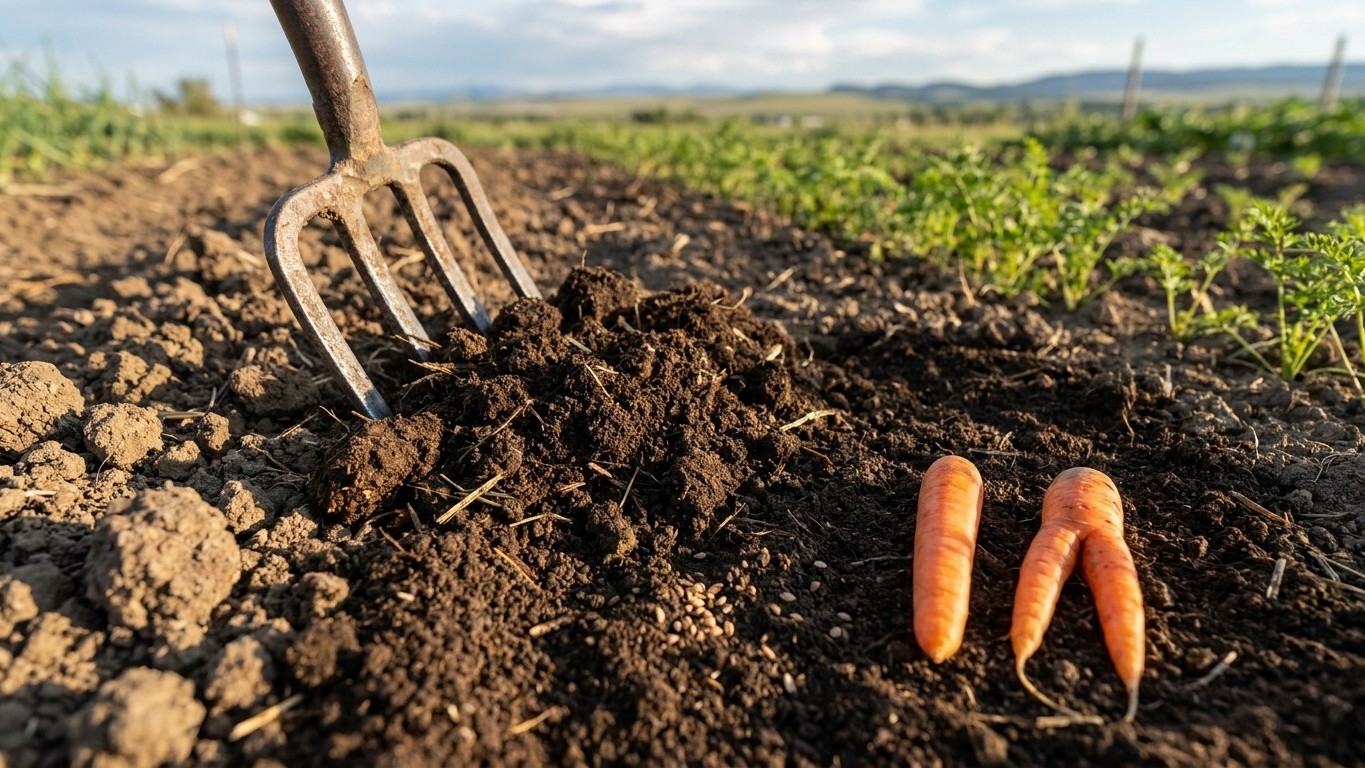
California’s own state soil offers a useful, if imperfect, warning about one of the most common carrot failures: forking. The San Joaquin series, named the official state soil by California law, is a moderately well-drained Alfisol running about 18 percent clay, 32 percent silt and 51 percent sand at the surface, with a slightly acid pH near 6.1. That’s not a bad soil overall, but it leans heavier than what Utah State University Extension recommends for carrots, which want deep, sandy, well-drained ground rich in organic matter. Heavy or rocky soil makes the root fork instead of running straight down, and Utah State’s fix is plenty of compost worked in and double digging the bed, not switching varieties. The San Joaquin series is a representative statewide figure, not a description of any one garden, so a home soil test is what actually settles whether a given bed needs that treatment.
The second failure shows up right at harvest, when a hot, dry stretch, common across much of California in late summer and early fall, dries out roots sitting exposed in the sun before they ever reach the fridge. Pulled carrots left on a tarp or in a bucket in the yard for an hour lose moisture fast in that kind of heat, and they arrive at storage already behind schedule on the shelf-life clock.
UC Agriculture and Natural Resources documents several pests relevant to a vegetable garden here, and for carrots the ones worth watching are aphids, including melon aphid, root-knot nematodes in warm, sandy soils, and slugs and snails working at soil level where the shoulders sit exposed. Nematode damage in particular shows up as stunted or forked roots that can look identical to a soil-texture problem, which is another reason a soil test, rather than a guess, is the right first move when roots keep coming up misshapen.
Common questions
Can I tell carrots are ready without pulling one?
Not reliably. Brushing soil away from the top of a root to check the shoulder width is quick and doesn’t damage anything if you’re gentle, and it’s the closest thing carrots have to a visible readiness signal since the foliage above ground often stays green well past harvest time.
Do I need to wash carrots before storing them?
Trim the tops off right away, since that’s the step that actually extends storage life, but hold off on washing until you’re ready to use them. Extra surface moisture from washing can encourage the rot and softening that cold, humid storage is otherwise meant to prevent.
Why do my carrots keep coming out forked or stubby?
Heavy or rocky soil is the usual cause, according to Utah State University Extension, which points to working in compost and double digging as the remedy rather than changing which variety you plant. Root-knot nematodes, documented in California by UC Agriculture and Natural Resources, can produce a similar stunted, forked look, so a soil test is worth doing before assuming it’s purely a texture problem.
Is it better to store carrots in the ground until I need them?
That works in climates with a hard, dry freeze that keeps the ground cold and stable, but it’s not a good fit for most of California, where fall and winter soil temperatures swing too much and stay too warm in many regions to match the near-freezing, high-humidity conditions Clemson Cooperative Extension recommends. Pulling and refrigerating gives you more control over both variables.