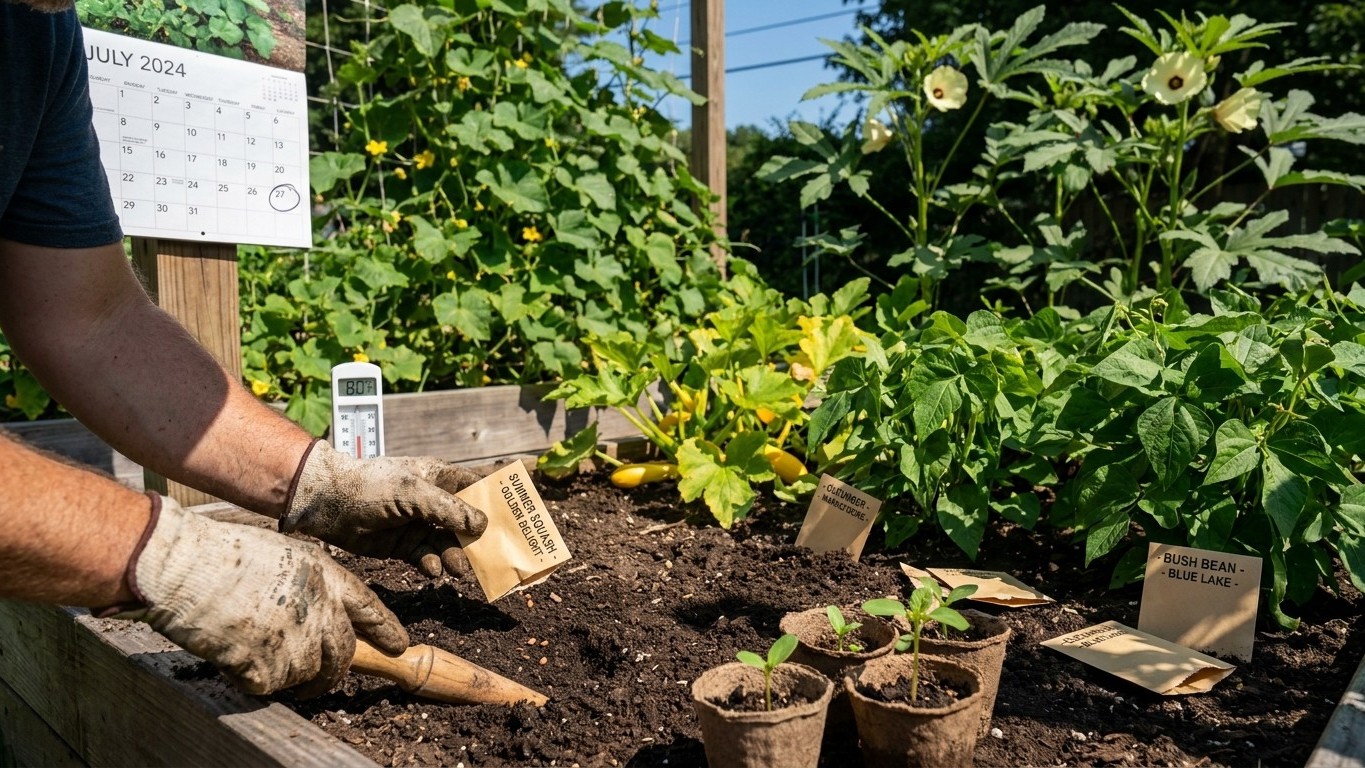

Delaware gardeners plant fast-maturing summer crops early in July (bush beans, cucumbers, summer squash, okra) and start counting backward for fall: brassica and lettuce seeds go into trays now, and root crops like carrots and beets get direct-sown toward the end of the month for an autumn harvest. Zone 7a-8a means the frost danger is long gone; the pressure now is heat and timing the second half of the season.
What goes in the ground in July

By July, soil temperature is a non-issue in Delaware. The reference frost window at the Wilmington-area station (USW00013781) runs from April 3 to April 14 for the last spring freeze, according to NOAA’s 1991-2020 Climate Normals, so this month is entirely past that risk. The decision now isn’t “will it freeze” but “will it have time to mature before the first fall frost,” which the same NOAA dataset puts at October 26 to November 7 for that station.
Early in the month, there’s still room to direct-sow bush beans, pole beans, cucumbers, summer squash, and okra for a late-summer harvest. Sweet corn can go in as a last succession if you want ears into September. Winter squash and pumpkin seed can also go directly into the ground in the first week or two of July; count back from the fall frost window and most varieties, needing 90 to 100 days, still fit.
As the month wears on, shift toward fall-harvest planning. Carrots and beets sown by late July have a realistic shot at reaching size before frost, provided the soil stays consistently moist during germination, which is the real obstacle in Delaware’s July heat rather than any calendar limit. Bush beans sown as late as the third week can still produce before the average first frost.
What’s a gamble rather than a safe bet: tender transplants like tomatoes or peppers set out now will struggle with transplant shock in the heat and won’t have the season length to fully ripen a second crop. Save those for spring. Garlic and shallots are the opposite story, they’re not a July planting in this state; that window comes in fall.
What to start under cover
July is when Delaware gardeners start the fall brassica lineup indoors or in a shaded cold frame: broccoli, cabbage, cauliflower, and kale seeds sown now become transplants ready for the garden in August. Counting backward from the first fall frost window (October 26 to November 7) matters more here than any fixed date. Most fall brassicas need 60 to 80 days from transplant to harvest, plus 4 to 6 weeks in the seed tray before they’re transplant-ready. That puts the sowing window for slower varieties in the first half of July, with faster kale and collard types stretching into early August.
Lettuce and other greens are trickier in direct summer heat. Starting seed indoors under lights or in a cool, shaded spot avoids the germination failure that hot soil causes outdoors, and the seedlings can be moved out once temperatures ease later in the month or in early fall.
The two ways this goes wrong are mirror images of each other. Start brassica seed too early relative to your fall frost date, and you end up with rootbound, leggy transplants sitting in trays for weeks with nowhere to go, they stall out and never recover their vigor. Start too late, and the plants run out of daylight and cooling temperatures before they size up, leaving small heads or crops that bolt in the first cold snap. Delaware’s fairly generous fall window (frost not expected until late October at the earliest, per that same NOAA data) gives more room for error than states with an earlier fall frost, but it’s still not unlimited.
What is ready to pick
July is peak harvest season in Delaware gardens. Tomatoes started back in spring are hitting their stride, along with peppers, cucumbers, summer squash, and the first beans from earlier plantings. Sweet corn planted in late spring is tasseling and filling out by mid-to-late month. Blueberries are finishing their run, and early peach varieties common in the region are coming ripe.
Knowing when to pick matters as much as knowing what’s out there. Summer squash and cucumbers are best picked young and often; leave them too long and they turn tough and bitter, and the plant slows production trying to mature oversized fruit. Tomatoes should come off the vine when they’ve reached full color but still have slight give, not rock-hard; picking a touch early and finishing on the counter avoids splitting from sudden summer downpours. Corn is ready when the silks have browned and a test kernel, popped with a thumbnail, releases milky (not clear, not chalky) liquid.
Garlic planted the previous fall typically finishes its curing and comes fully into storage readiness around this point in the season; if you haven’t pulled it yet, check that the lower leaves have browned before harvesting. Watermelon and cantaloupe, if you’re growing them, need the “thump test” and a check of the tendril nearest the fruit; a brown, dry tendril usually means ripe.
The jobs that matter this month
Watering rhythm is the single biggest factor separating a good July garden from a struggling one in Delaware’s heat and humidity. Deep, infrequent watering (roughly 1 to 1.5 inches per week, delivered in one or two sessions rather than a daily sprinkle) trains roots to grow deep and handle dry spells. Shallow daily watering does the opposite, encouraging roots to stay near the surface where they dry out fast.
Mulch, stakes, and succession
Mulch applied now (straw, shredded leaves, or grass clippings) does double duty: it holds soil moisture through the hottest stretch of the year and suppresses the weeds that explode in July heat. Tomatoes, pole beans, and vining squash should already be staked or caged; if they’ve started sprawling, get support under them now before fruit touches the ground and rots or invites slugs.
Succession sowing keeps the harvest coming instead of arriving all at once. A new round of bush beans every two to three weeks, planted through mid-to-late July, spreads out the picking window and provides a backup if an early planting fails to a pest or disease.
Pest scouting and side-dressing
Squash vine borer and Japanese beetle activity peaks in Delaware during July. Checking the base of squash and zucchini stems for small entry holes, and hand-picking or trapping beetles early, prevents an infestation from wiping out a planting that took months to establish. Corn and tomatoes that are actively fruiting benefit from a side-dress of nitrogen at this stage, timed to support the fruit set already underway rather than pushing more leafy growth.
What not to do in July
The most common mistake this month is treating hot air temperature as a green light for anything and everything. Warm-season crops are already established by July in Delaware; what trips gardeners up now is transplanting new seedlings, of any kind, in the middle of a heat wave without extra shade cloth or watering support. The plant goes into shock, wilts hard, and either dies or stalls out for weeks. If you must transplant in July, do it in the evening and shade the plant for the first two or three days.
Feeding nitrogen at the wrong point is another classic error. Heavy nitrogen applications on tomatoes and peppers that are already setting fruit push lush green growth at the expense of the fruit itself, resulting in leafy plants with disappointing yields. Save the nitrogen boost for crops that are still building leaf mass, like fall brassicas just transplanted, and switch to a balanced or phosphorus-leaning feed for anything already fruiting.
Letting mulch or soil dry out completely and then dumping a heavy watering on it isn’t a fix, it’s often a new problem. Tomatoes and squash respond to sudden swings from dry to soaked with blossom-end rot and split fruit. Consistency matters more than volume.
Finally, don’t ignore pest damage because “it’s just a few holes.” Squash vine borer and beetle populations build fast in July’s heat; a small problem ignored for a week becomes a collapsed plant by the next.
Checking this against your own county
The frost windows and hardiness range cited here come from one reference station and the statewide USDA zone map; Delaware is small, but it still runs from Zone 7a in spots to 8a nearer the coast, and conditions near Delaware Bay in Sussex County tend to run milder and hold heat longer into fall than inland New Castle County. Low-lying areas can also see localized frost pockets even where the regional average says otherwise. Treat every date and figure on this page as a starting point, not a guarantee for your specific yard. For a planting calendar tuned to local conditions, and for pest and disease alerts specific to the season, the University of Delaware Cooperative Extension is the resource built for exactly that purpose.
Common questions
Is it too late to plant tomatoes in Delaware in July?
Yes, for a full-size harvest from a new transplant. Tomatoes set out now face heat stress and won’t have enough season left to ripen a full crop before fall frost arrives. Fast-maturing determinate varieties are the exception if started very early in the month.
Can I still plant green beans in July in Delaware?
Yes. Bush beans sown through mid-to-late July generally have enough time to mature before the first fall frost window (October 26 to November 7 at the reference station), making them one of the safest direct-sow choices for the month.
What vegetables should I start indoors in July for a fall garden in Delaware?
Broccoli, cabbage, cauliflower, and kale are the standard fall brassica seedlings started indoors or in shade during July, timed to transplant out in August for a harvest before frost.
Why are my squash plants collapsing suddenly in July?
Squash vine borer is the most likely culprit in Delaware during this month. Check the base of the stem for small holes with sawdust-like frass; by the time the plant wilts suddenly, the borer has usually already done significant internal damage.