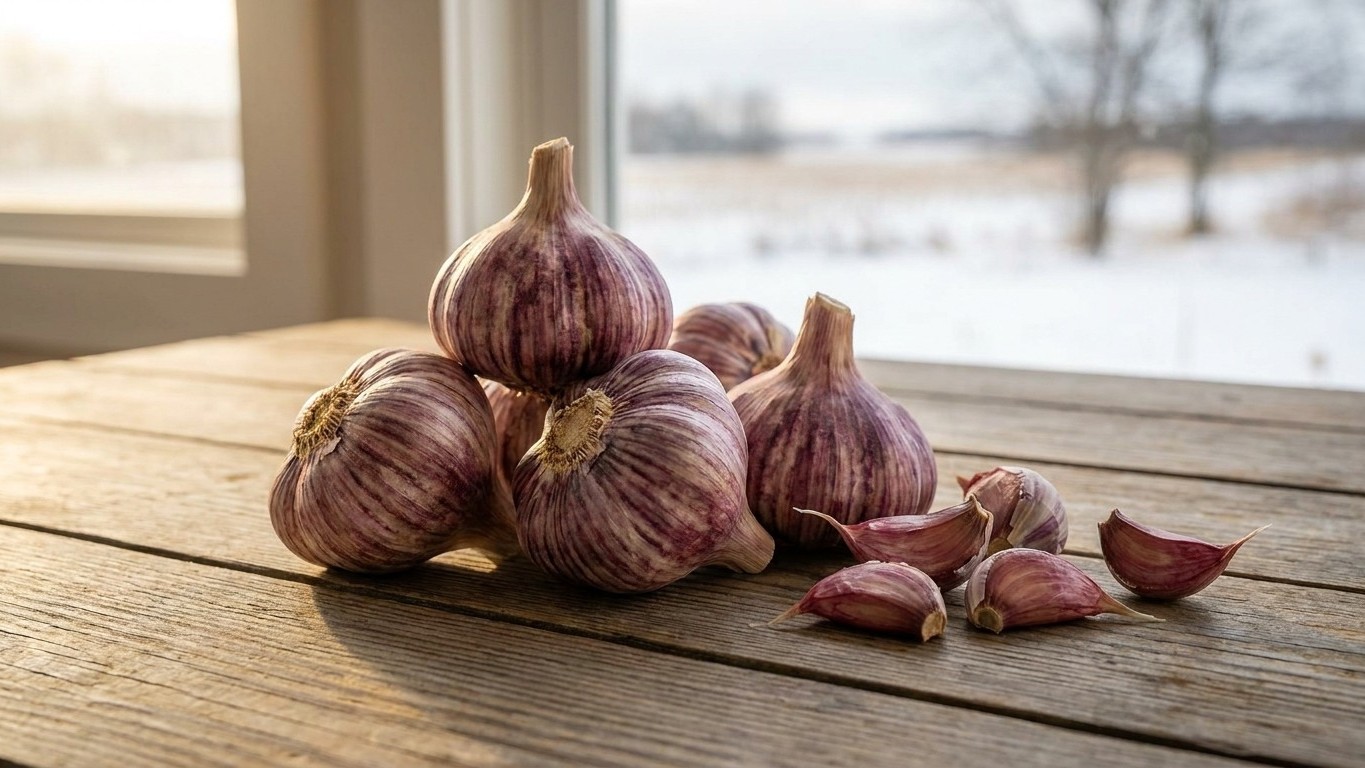

Krandasger Red garlic is a hardneck, Purple Stripe type with red-streaked wrappers, prized for a flavor described in its catalogue listing as “smooth and well balanced, offering rich garlic character without excessive heat.” It needs a real winter to divide into a full head of cloves, and in the coldest parts of the country that happens without any help. Elsewhere, the grower has to step in.
What Music actually is

Start with the family tree. Krandasger Red belongs to the Purple Stripe group, one of the hardneck branches of garlic, distinct from the softneck Artichoke and Silverskin types that fill most supermarket net bags. Hardneck garlic sends up a rigid central stalk, called a scape, and wraps its cloves around that stalk in a single ring, usually four to twelve cloves per head. That single ring is also why hardneck cloves are so easy to peel: fewer wrappers, cleaner separation.
On flavor, the catalogue calls it “smooth and well balanced, offering rich garlic character without excessive heat,” putting it closer to an everyday cooking garlic than to the sharper Rocambole types some cooks chase for raw use. No published disease or pest resistance is claimed for this variety.
Storage is the one place where Krandasger Red asks for attention. Hardneck garlic in general keeps shorter than softneck, and this variety sits at the shorter end of that range: three to four months at room temperature. A cook who braids softneck garlic and expects the same shelf life from Krandasger Red will be disappointed by midwinter. This is the head to cook through first, not the one to tuck away for spring.
Will it get the cold it needs where you are
A garlic clove planted in fall needs a sustained stretch of real winter cold to trigger the signal that splits one clove into a multi-clove bulb. Skip that cold, or shortchange it, and the plant grows leaves all season but never divides underground. What you lift in summer is a single round, onion-like bulb instead of a head of cloves, edible, but not the crop you planted for.
Hardneck types as a group, and Purple Stripe varieties like Krandasger Red specifically, are the most cold-dependent garlics grown in home gardens. That makes them a natural fit for regions with a “real” winter: the Northeast, the Upper Midwest, the Rocky Mountain states, and the colder interior valleys of the Pacific Northwest. There, a normal winter does the work on its own, and by the following July the grower is lifting full, well-divided heads without intervention.
Where it gets marginal
The picture is less certain through the Mid-Atlantic, the Ohio Valley, and the milder parts of the Mountain West, where winters are cold but inconsistent year to year. Some seasons deliver enough sustained chill; others don’t, especially after a run of warm winters or in a sheltered microclimate. In these zones, Krandasger Red can still work, but the outcome is less predictable. Treat the crop as promising rather than guaranteed, and watch how the bulbs actually divide at harvest before deciding whether to replant it.
Where it falls short
Along the Gulf Coast, in peninsular Florida, across southern Texas, and through low-elevation Southern California, winters generally don’t deliver the sustained cold hardneck garlic depends on. This is not a case of “try it and see”, it’s a mismatch between what the plant needs and what the climate offers, and no amount of good soil or watering substitutes for missing cold.
Two real options exist. The first is to refrigerate the seed cloves before planting, typically for several weeks in a crisper drawer, mimicking the chilling period the ground would otherwise provide. The second, often more reliable, is to grow a softneck or Artichoke-type garlic instead, since those types evolved with a lower cold requirement and are standard in warm-winter garlic regions like California’s Central Valley. Neither option is a downgrade so much as a matter of matching plant to place.
When to put the cloves in
Garlic is fall-planted and summer-harvested almost everywhere it’s grown, and the planting window is set by the first fall frost date rather than a fixed calendar date. Frost dates shift by weeks depending on where a garden sits, so a planting calendar built around one region will be wrong for another.
The underlying rule is the same everywhere: cloves need roughly four to six weeks to grow roots before the ground freezes solid, but shouldn’t have time to push much top growth before winter shuts things down. Root development anchors the plant for spring; too much leaf growth before winter just gives frost something to damage.
Cold, mild and warm regions
In cold-winter regions, plant in the weeks right around first fall frost. In milder regions, where frost comes later and soil stays workable longer, planting can happen later without losing the root-development window. In warm-winter regions where frost is rare, growers often plant on a set date in late fall instead of chasing a frost that may not arrive on schedule.
Regional sources genuinely disagree on the exact number of weeks before frost. A gardener’s best move is to treat the first fall frost date for their own area as the anchor point, then plant early enough in that four-to-six-week window to let roots establish before deep cold sets in.
Hardneck or softneck: what this one asks of you
Krandasger Red is a hardneck garlic, and that habit shapes almost every practical decision around growing it. A hardneck plant sends up a stiff central scape in early summer, and that scape has to be cut off while still curled, both to redirect the plant’s energy into the bulb and to harvest a good cooking green in its own right.
In exchange, hardneck types like this one give fewer, larger cloves arranged in a single easy-to-peel ring, generally four to twelve per head. What they don’t give is long storage life: three to four months at room temperature, compared with the six-to-ten-month shelf life softneck garlic offers, and hardneck’s stiff, woody stalk doesn’t bend for braiding.
Hardneck varieties like Krandasger Red are bred for, and perform best in, regions with genuinely cold winters, the same regions where the plant’s cold requirement is met without intervention. Softneck garlic is the traditional choice for mild-winter regions and for cooks who want a braid-and-store crop that lasts most of the year. Choosing Krandasger Red is choosing the hardneck trade: better flavor complexity and easier peeling, shorter storage, and a scape to manage every early summer.
Growing and curing it without losing the crop
Plant cloves about 2 inches deep and 4 to 6 inches apart, in rows spaced roughly a foot apart, pointed end up. A mulch layer of straw or shredded leaves, laid down after planting, buffers the soil against the freeze-thaw cycling that can heave cloves out of the ground over a long winter.
Watering matters most in spring, when bulbs are sizing up underground. Cut off watering roughly two to three weeks before expected harvest; wet soil at lift time invites rot and stains the wrappers, hurting both storage life and appearance. Cut the scape as soon as it forms a loop, both to push more energy into the bulb and to use it in the kitchen.
Readiness to lift shows in the leaves: when the lower third to half have browned while upper leaves are still green, bulbs are generally at full size. Digging too early leaves cloves undersized; waiting too long risks wrappers splitting in the ground, shortening storage life immediately. Curing comes next and is where home-grown garlic often quietly fails: bulbs need two to four weeks in a warm, dry, shaded spot with good airflow before the wrappers are dry enough for the garlic to be trimmed, cleaned, and stored. Rushing the cure is the classic mistake that turns a good harvest, especially one with Krandasger Red’s already-short window, into a crop that molds or sprouts within weeks.
Common questions
Can Krandasger Red be grown in a raised bed?
Yes, as long as the depth allows for the 2-inch planting depth plus reasonable root run, and mulch is still applied against winter freeze-thaw cycling.
Does Krandasger Red need fertilizer during the growing season?
No specific fertilizer program is part of the published data for this variety. General practice for hardneck garlic is a nitrogen feeding in early spring, tapering off before pre-harvest dry-down.
Is Krandasger Red a good choice for a first-time garlic grower in a cold climate?
In a genuinely cold-winter region, yes. The cold requirement is met by the climate itself, and the single-ring clove structure is forgiving to peel and cook with.
What should be done with the cut scapes?
They’re edible and often prized, with a milder, greener garlic flavor than the cloves, and can be chopped and used in cooking rather than discarded.