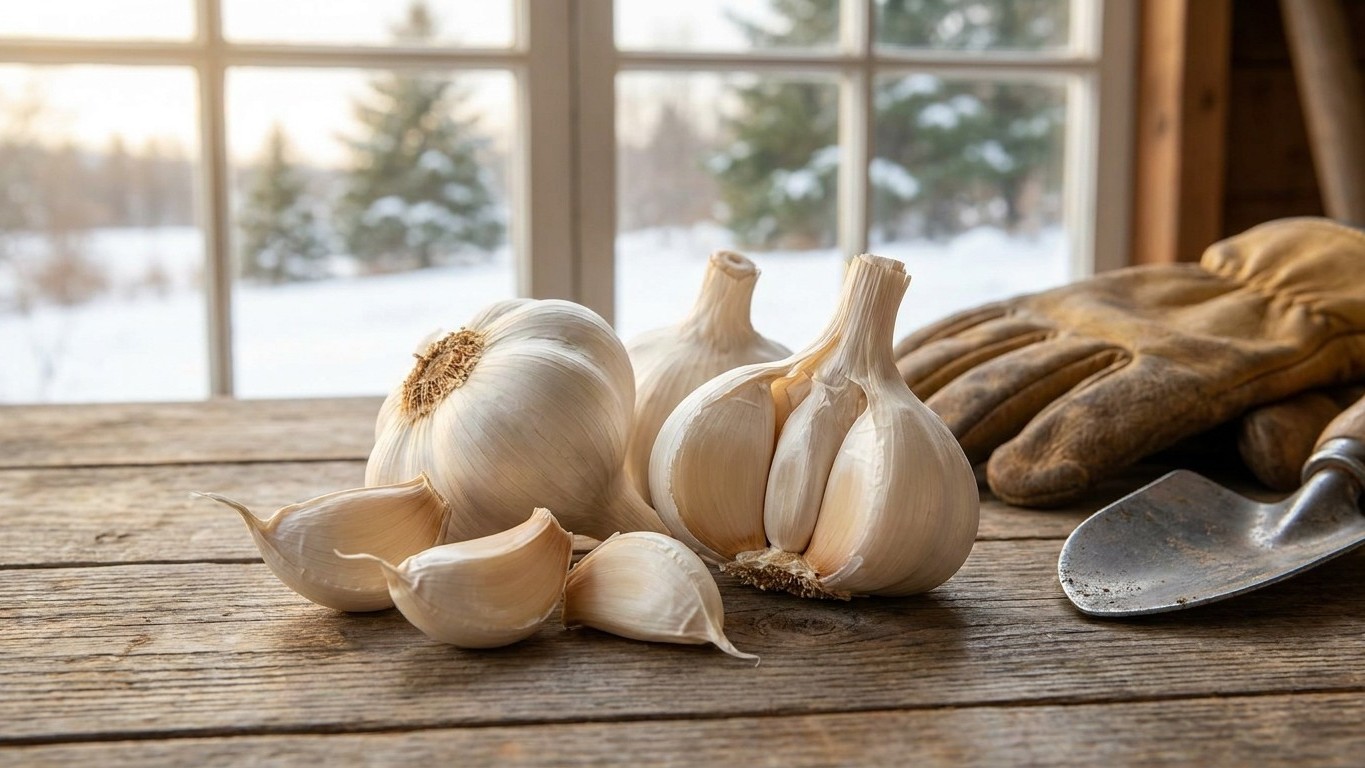

Mount Hood is a porcelain hardneck, and porcelains are built almost entirely around one requirement: a real winter. Plant the cloves in fall, anchored to your first frost date rather than a spot on the calendar, and give the ground enough sustained cold afterward to force each clove to split into a full head. Skip that cold, and you lift a single round bulb instead.
What Music actually is

Mount Hood belongs to the porcelain family: white-skinned, hardneck, with a small number of oversized cloves wrapped in smooth, papery layers instead of the tight cluster of a softneck. Catalog descriptions put the flavor as vibrant enough to carry a savory dish on its own, then note that roasting mellows it out considerably, a common trait among porcelains that turns raw sharpness into something closer to caramel.
In the kitchen, that translates to four to twelve cloves per head, each one large enough to peel in seconds rather than fight with a paring knife. That ease comes with a tradeoff worth planning around: Mount Hood keeps only three to four months at room temperature, noticeably shorter than the six-plus months a softneck can offer. Cooks who grow it are told, plainly, to eat this one first and save the longer-keeping varieties for late winter.
No pest or disease resistance is published for this variety. That absence is itself useful information, not an oversight to work around: gardeners shouldn’t assume Mount Hood carries any built-in defense against white rot, rust, or bulb mites just because other porcelains sometimes do. Plan crop rotation and site selection the same way you would for any garlic without a documented resistance profile.
Will it get the cold it needs where you are
Garlic doesn’t just tolerate winter, it uses it. After planting, the clove needs a stretch of sustained cold to trigger the hormonal shift that splits it into multiple cloves by summer. Skip that chilling period and the plant grows normally above ground but never divides below it, leaving the grower with a single undifferentiated bulb that looks more like a shallot than a head of garlic. This is the step most generic planting guides skate past, and it’s the one that actually determines whether Mount Hood is a smart pick for your yard.
Where the cold comes easily
Across the northern tier of the country, the Upper Midwest, New England, and the higher elevations of the Rocky Mountain states, winters deliver weeks of sustained near-freezing to well-below-freezing ground temperatures without any help from the gardener. Porcelains like Mount Hood are, if anything, at home in these conditions; the long, cold dormancy is exactly what the variety expects, and growers there rarely need to do anything beyond planting on schedule and mulching for insulation.
Where it gets marginal
Move into the mid-latitude belt, the Mid-Atlantic, the Ohio Valley, and parts of the Pacific Northwest west of the Cascades, and winter cold becomes less dependable from year to year. Some seasons bring enough of a hard, sustained chill; others stay too mild for too long. In these regions Mount Hood can still perform, but results vary more than in the true cold-winter zones, and a mild winter can mean a smaller, less divided harvest even when planting timing was correct.
Where it falls short
Across the Deep South, the Gulf Coast, peninsular Florida, and much of coastal Southern California, ground temperatures rarely stay cold long enough for a porcelain to split reliably on its own. That doesn’t mean Mount Hood is off the table there, but it does mean skipping the extra step is a real gamble. Two options actually work:
- Pre-chill the cloves. Store them in the refrigerator, separated but unpeeled, for several weeks before planting, mimicking the cold the ground won’t provide.
- Grow a type that asks for less. Softneck and artichoke varieties evolved with a lower chilling requirement and are the more forgiving choice for a warm-winter garden.
Refrigeration adds a step, not a barrier. Gardeners in warm climates who take it seriously can and do grow porcelains successfully; they just can’t skip the cold the plant is asking for and expect a full head at harvest.
When to put the cloves in
Garlic planted in fall spends winter building roots underground, then pushes leaves and eventually a scape the following spring and summer before it’s lifted. The timing that matters isn’t a date on a calendar, it’s the relationship between planting and your area’s first fall frost: cloves need enough time in the ground to root well before the soil freezes solid, but not so much time that they push a lot of leafy top growth that then gets damaged by winter cold.
That balance shifts by region, and sources genuinely disagree on the exact number of weeks, which is worth saying plainly rather than papering over with a false precision.
- Cold-winter regions (Upper Midwest, Northeast, mountain states): plant in the weeks surrounding the first fall frost, giving roots time to establish before a hard freeze locks up the ground.
- Mild-winter regions (Mid-Atlantic, Pacific Northwest, transitional zones): planting can run later into fall, since the ground stays workable and frost-free longer.
- Warm-winter regions (Deep South, Gulf Coast, coastal Southern California): late fall to early winter planting is common, timed after pre-chilling the cloves if that step is being used.
Whatever the exact week, the same failure shows up in every region when the timing is off in either direction: plant too early and vigorous top growth gets frost-damaged over winter; plant too late and roots never get established before the ground freezes, weakening the whole season’s growth.
Hardneck or softneck: what this one asks of you
Mount Hood is a hardneck, and that habit shapes almost everything about growing it. A rigid central stalk, the scape, rises from the plant in late spring and needs to be cut off before it fully curls, a step that redirects the plant’s energy back into the bulb instead of into that stalk. Skipping it doesn’t kill the crop, but it does shrink the heads.
In exchange for that extra step, hardnecks like Mount Hood give fewer, noticeably larger cloves, wrapped in skins that peel easily compared to the tight, papery layers of a softneck. The cost is storage life: hardnecks in general, and this variety specifically at three to four months, don’t last through winter the way softnecks can, which is why it’s the head to work through first rather than save for spring.
This tradeoff lines up with the cold discussion above almost exactly. Hardnecks evolved alongside long, cold winters and tend to perform best where that cold is reliable; softnecks, with their lower chilling requirement and longer shelf life, are the better match for milder climates. Choosing Mount Hood is, in effect, choosing to work with a real winter rather than around one.
Growing and curing it without losing the crop
Plant cloves root-down, about two to three inches deep, spaced four to six inches apart in rows a foot or so apart, in well-drained soil that won’t sit soggy over winter. A layer of mulch, straw or shredded leaves several inches thick, matters more here than with a spring-planted crop: it buffers the soil against the freeze-thaw cycles that can heave newly rooted cloves out of the ground before they’ve anchored.
Water regularly through spring as the plant bulks up, then stop watering roughly two to three weeks before the expected harvest. Bulbs finishing in wet soil are more prone to rot in storage, and a drier finish concentrates flavor. The signal that it’s time to lift is visual: the lower leaves turn brown and dry while the upper leaves are still green, usually several leaves’ worth of yellowing rather than the whole plant collapsing.
Curing is the step where a good crop most often gets ruined after the fact. Bulbs need two to three weeks in a shaded, dry spot with steady airflow, not direct sun, before the necks are trimmed and the skins are cleaned up for storage. Rushing this step, or curing in a humid or sun-baked spot, is the classic mistake that turns a full harvest into a pile of soft, moldy bulbs a few weeks into storage. Given Mount Hood’s already short three to four month shelf life, a bad cure eats into an already tight storage window fast.
Common questions
Can Mount Hood be grown without a cold winter?
It can, but the cloves need help splitting into a full head. Refrigerating the seed cloves for several weeks before planting substitutes for the sustained cold that a warm-winter garden won’t provide on its own.
Does Mount Hood have any disease resistance?
None is published for this variety. Growers should treat it like any garlic without a documented resistance profile, rotating beds and choosing well-drained sites to limit disease pressure generally.
Why does Mount Hood keep for such a short time?
It’s a trait of the porcelain type generally, and this variety in particular is described as keeping three to four months at room temperature, noticeably shorter than many softneck varieties. It’s meant to be used earlier in the storage season rather than saved for late winter.
Do the scapes need to be removed?
Yes. As a hardneck, Mount Hood sends up a rigid central scape in late spring that should be cut before it curls fully, redirecting the plant’s energy into bulb growth rather than into that stalk.