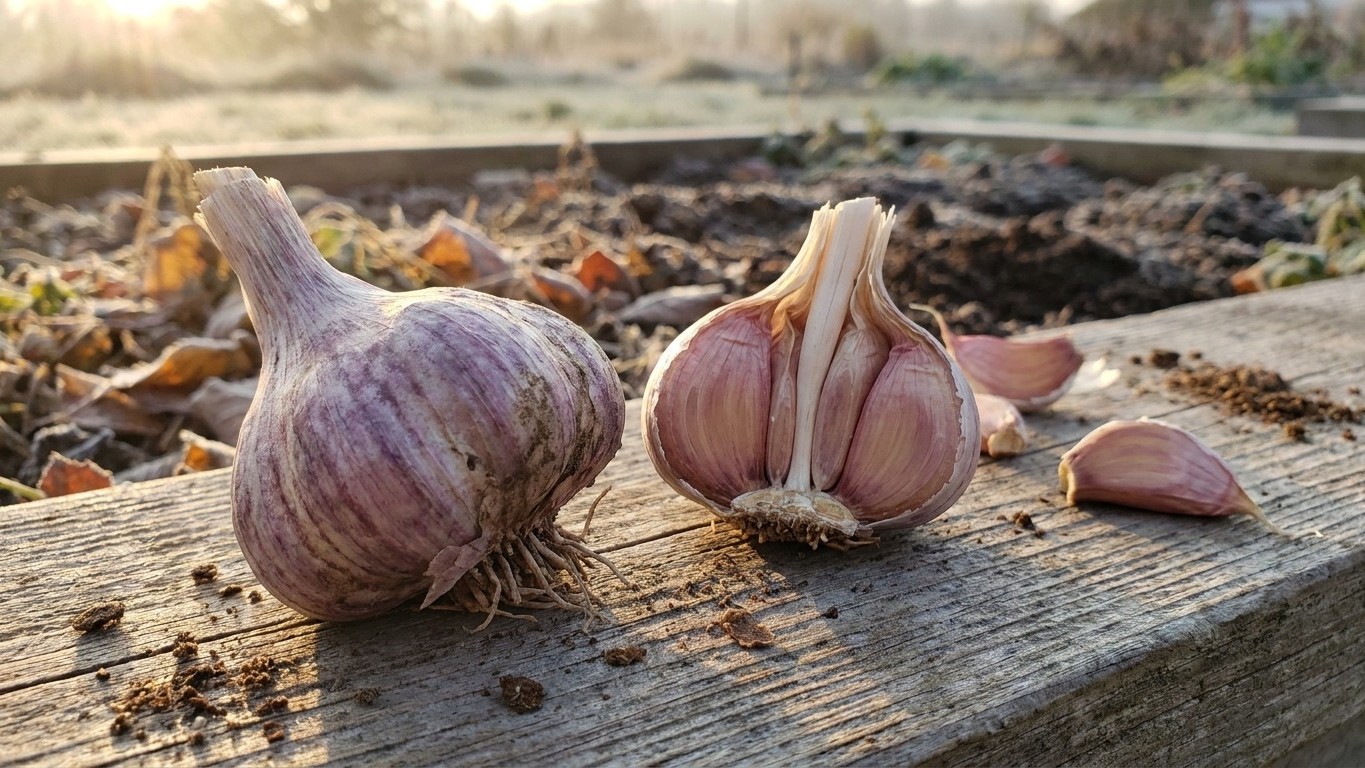

Norquay garlic is a purple-skinned porcelain hardneck that produces four to twelve big cloves per bulb, and it needs a real winter to pull that off. Plant it in fall, timed so the cloves root before the ground freezes solid but don’t push much leaf growth first. Skip the cold and the clove never divides, so you lift a single small round instead of a head of cloves. Where winters run mild, the answer is refrigeration or a different variety, not giving up on garlic altogether.
What Norquay actually is

Norquay belongs to the porcelain family, the hardneck group known for smooth, ivory-white wrappers over four to twelve fat cloves, purple in this case rather than the plain white some porcelains show. As a hardneck, it sends up a stiff central stalk called a scape each early summer, a trait that shapes how it’s grown and how long it lasts in storage.
Catalog descriptions of Norquay describe a strong, full garlic flavor with a spicy kick when eaten raw, mellowing with cooking the way most porcelain types do. Storage claims in that same catalog copy run in two directions worth noting side by side: the flavor description says it stores well into early spring, while the kitchen notes for this variety put practical room-temperature storage at three to four months, with a recommendation to eat it before the softnecks in a mixed harvest. Both claims come from the same seed source, and a home grower’s actual results will depend heavily on curing and storage conditions, not just the variety.
No disease or pest resistance is published for Norquay. That’s not a red flag by itself, since plenty of solid heirloom and modern garlic varieties carry no resistance codes at all. It just means a grower shouldn’t lean on Norquay’s name as protection against white rot, rust, or bulb mites; those are managed through site rotation and clean seed stock, not variety choice.
Will it get the cold it needs where you are
Hardneck garlic clove division depends on vernalization, the botanical term for a sustained stretch of cold that convinces the clove winter has happened. Skip that stretch and the plant skips straight to growing leaves off an undivided bulb. This is the single biggest reason a “garlic guide” written for the whole country falls apart the moment a reader in Phoenix or Charleston tries to follow it: the plant genuinely behaves differently depending on how cold the ground gets and for how long.
No weather-station figures are published specifically for Norquay’s chilling requirement, so the safest proxy is the USDA Plant Hardiness Zone Map, which tracks average winter minimum temperatures across the country. Porcelain hardnecks like Norquay are most at home in USDA zones 3 through 7, the belt that runs from the Dakotas and Minnesota through New England, the Appalachians, the Rocky Mountain high country, and the northern half of the Pacific Northwest. Winters there routinely sit at or below freezing for months, which is exactly the kind of cold porcelains evolved to expect.
Zone 8, covering much of the Southeast coastal plain, parts of Texas, and the lower elevations of the Pacific Northwest, is genuinely marginal territory for a porcelain hardneck. Some years bring enough chill; others don’t, and the result is inconsistent bulb size from one season to the next. Zone 9 and warmer, which includes peninsular Florida, the low desert of Arizona, and coastal Southern California, generally doesn’t deliver the sustained cold a porcelain hardneck wants at all.
Two options where winter falls short
A gardener in a marginal or warm zone isn’t out of luck, but the choices are real trade-offs rather than a workaround that erases the problem:
- Refrigerate the seed cloves before planting, storing them in a home refrigerator for a period ahead of putting them in the ground, to artificially supply the chill the winter won’t.
- Grow a type built for less cold instead, since softneck artichoke and silverskin varieties evolved in milder Mediterranean-type climates and divide reliably with far less winter chill than a porcelain needs.
Refrigeration isn’t a guarantee of porcelain-sized bulbs in a zone 9 garden, but it’s the honest first step rather than a reason to abandon the variety outright.
When to put the cloves in
Garlic goes into the ground in fall and comes out the following summer, and the timing hinges on the first fall frost rather than a fixed calendar date. The clove needs enough weeks of mild soil to grow roots before the ground locks up, but not so many weeks of warm air that it pushes tall green growth that then gets hammered by winter.
In cold-winter regions, where the ground can freeze hard by November, growers generally plant in the weeks bracketing the first fall frost, giving roots a head start while the soil is still workable. In milder regions where a hard freeze arrives later or barely at all, planting shifts later into the fall, sometimes into early winter, because there’s no rush to beat a freeze that isn’t imminent. Warm-winter regions push planting later still, since a clove planted too early there can sprout excessive top growth over a mild winter and struggle by spring.
| Region | Timing relative to first fall frost | What decides it |
|---|---|---|
| Cold-winter (northern tier, mountain West) | Around the first fall frost, a few weeks either side | Roots must establish before hard freeze locks the soil |
| Mild-winter (mid-Atlantic, Pacific Northwest lowlands) | Several weeks after first frost, into late fall | Soil stays workable longer, less urgency to beat a freeze |
| Warm-winter (Deep South, low desert) | Late fall into early winter | Avoid excess top growth during a mild, non-freezing winter |
Sources on exact planting windows genuinely disagree by region, and that disagreement is real rather than a gap in the research. A date that works in Vermont has no bearing on a garden in coastal Georgia, so the frost date, not a fixed month, is the reliable anchor.
Hardneck or softneck: what this one asks of you
Norquay is a hardneck, and that habit shapes almost everything about growing it. A stiff central scape rises in early summer and needs to be cut off before it fully curls, both to redirect the plant’s energy into the bulb and because that cut scape is edible on its own, good chopped into a stir-fry or blended into a pesto. Hardnecks trade quantity for size: four to twelve cloves per bulb, each one large and easy to peel, versus the dozen-plus small cloves packed tight in a softneck bulb.
The tradeoff shows up again in storage. Hardnecks like Norquay generally keep for a few months at room temperature, matching the three-to-four-month window noted for this variety specifically, while softnecks can often last six months or more, which is part of why softnecks dominate the braided garlic sold in grocery stores.
Climate decides which habit makes sense for a given garden. Hardnecks like Norquay are bred around long, cold winters and reward a grower in zones 3 through 7 with excellent flavor and easy peeling, at the cost of using the harvest up sooner. Softnecks handle mild winters better and store longer, which is why a gardener in a warm-winter zone often does better choosing a softneck over pushing a porcelain hardneck past its comfort zone.
Growing and curing it without losing the crop
Plant individual cloves about two inches deep, pointed end up, spaced four to six inches apart in rows roughly a foot to eighteen inches apart. A layer of mulch, straw or shredded leaves a few inches thick, matters more for an overwintered crop like garlic than for most vegetables, since it buffers the freeze-thaw cycles that can heave a clove partway out of the soil over winter and expose it to cold air directly.
Watering should taper off a couple of weeks before harvest; wet soil right up to lifting encourages the wrapper to stain and rot rather than cure cleanly. The classic signal that a bulb is ready is the foliage: when the lower leaves have browned and dried but roughly the top five or six leaves are still green, the bulb below has usually sized up without the wrapper starting to split.
Curing is where a lot of home-grown garlic quietly goes to waste. Pulled bulbs need to hang or lie in a single layer somewhere shaded, dry, and well ventilated, out of direct sun, for a couple of weeks before roots and tops get trimmed and the papery wrapper gets its final cleaning. Rush that step, or cure in a humid garage, and the bulb that looked perfect at harvest can rot from the inside within weeks of going into storage, long before that three-to-four-month clock even had a chance to run out.
Common questions
Can I grow Norquay garlic without any winter at all, like in a greenhouse?
Not really. The clove division that turns one clove into a full bulb depends on a sustained cold period, not just cool air for a few days. A heated greenhouse removes exactly the trigger the plant needs, so growing it entirely frost-free tends to produce small, undivided bulbs regardless of how well everything else is managed.
How is Norquay different from other purple-skinned garlic varieties?
The purple wrapper alone doesn’t tell you much, since purple stripe and rocambole types also show colored skins. What sets Norquay apart as a porcelain is its clove count (four to twelve large cloves rather than a dozen-plus small ones), its easy-peel character, and the specific flavor and storage notes published for this variety, none of which are published for it in terms of disease resistance.
Do I need to cut the scape, or can I let it grow?
Cutting it is the standard practice with hardnecks like Norquay. Left in place, the scape draws energy away from the bulb, and while some growers leave a few scapes on purpose to save seed stock, most home growers cut them for both a larger bulb and an edible scape harvest.
Why did my Norquay garlic come up as one round clove instead of a full bulb?
That’s the classic sign of insufficient chilling. It happens most often in warmer zones where winter doesn’t stay cold long enough, or when cloves are planted too late in fall and don’t get a full cold season before spring growth starts. Refrigerating seed cloves before planting, or switching to a lower-chill variety, addresses the same root cause.