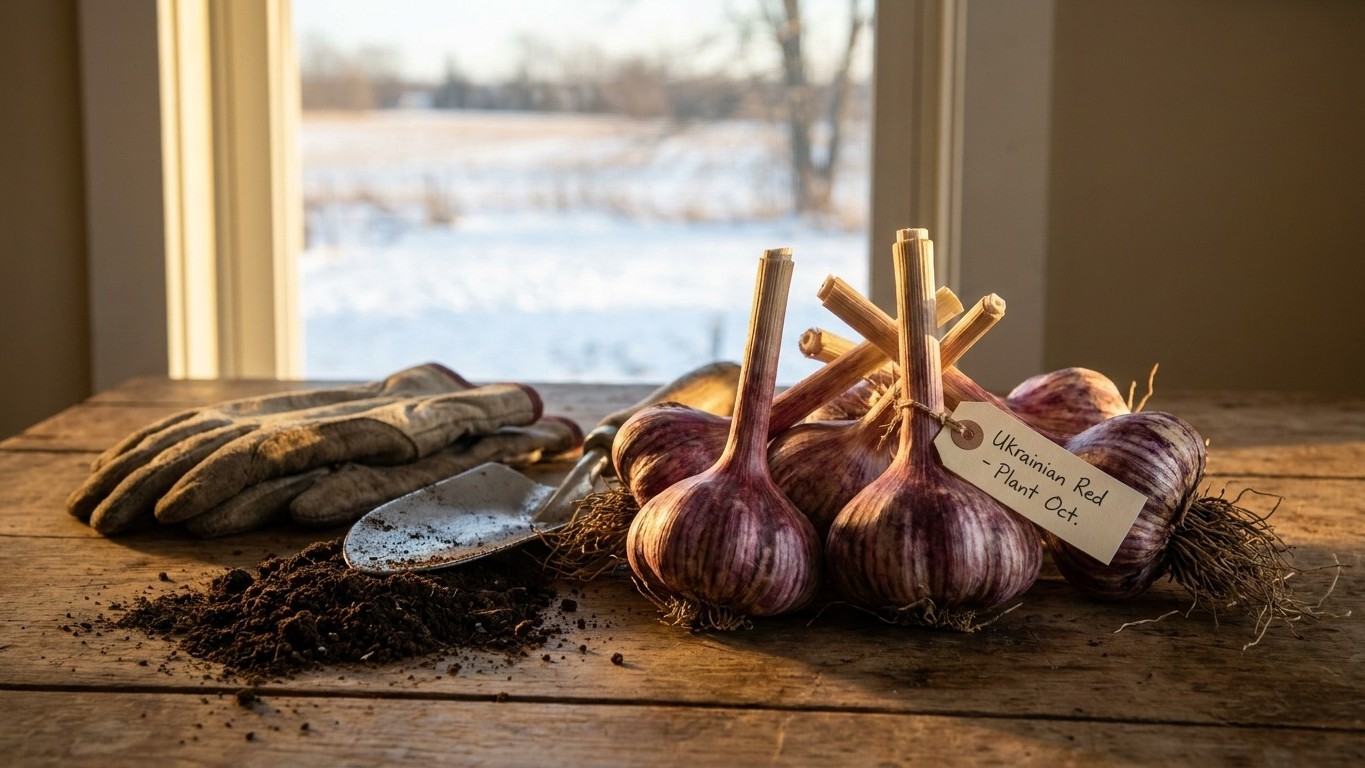

Ukrainian Red is a hardneck Rocambole garlic that needs a real cold winter to split into cloves. It grows best in regions with several weeks of hard freezing weather, poorly in the Deep South or coastal Southern California without help, and only fairly in places with short or spotty winters. Plant it in fall, after the first frost softens the ground but before a hard freeze locks it up.
What Music actually is

Start with the label, because it tells you what to expect on the plate and in the pantry. Ukrainian Red belongs to the Rocambole group, one of the hardneck families prized by cooks who care about flavor over shelf life. Hardneck garlics send up a rigid central stalk, called a scape, and carry their cloves in a single neat ring around it, usually between 4 and 12 to a head. That’s a smaller, looser cluster than a softneck grocery-store bulb, and each clove tends to be larger and easier to peel because the skins slip more readily.
On flavor, the seed catalog description calls it “as rich as its history.” That’s a marketing claim, not an independent lab result, but it lines up with what Rocambole types are generally known for: a sharper, more complex bite than the mild softnecks sold in supermarket mesh bags.
The tradeoff comes at the pantry counter. This variety keeps only 3 to 4 months at room temperature, which is short by garlic standards. No disease or pest resistance is published for it, so treat it as an unknown on that front. Cooks who grow it are advised to eat it first, before the longer-keeping softnecks in a mixed harvest. That detail should shape your kitchen planning, not just your garden bed.
Will it get the cold it needs where you are
Garlic doesn’t just tolerate winter. It requires it. A clove planted in fall needs a sustained stretch of cold to trigger the biological signal that tells it to divide into multiple cloves the following year. Skip that cold exposure, or cut it short, and the plant still grows, but comes up as a single rounded bulb instead of a head with individual cloves. That failure mode is the most common disappointment among first-time garlic growers, and it’s almost always a climate mismatch rather than a planting mistake.
Rocambole types like Ukrainian Red sit at the demanding end of the hardneck spectrum. They’re best suited to regions where winter means business: the Upper Midwest, the interior Northeast, the Mountain West, and the colder pockets of the Pacific Northwest away from the coast. There, the ground freezes hard and stays cold for an extended run, exactly the exposure a Rocambole clove needs. Growers in Minnesota, Vermont, or the high plains of Montana generally see full-size, well-divided heads without any extra intervention.
The picture is murkier in the middle of the country. Coastal Pacific Northwest gardens, much of the Mid-Atlantic, and the upper Southeast get real cold, but it can be shorter or less consistent than the Rocambole prefers. Growers there sometimes see smaller heads or more single-clove bulbs in a mild winter, worth treating as normal variability rather than outright failure.
Where winter is genuinely mild, the Gulf Coast, peninsular Florida, and coastal Southern California, a hardneck Rocambole is working against its own biology. A grower there has two honest options. The first is to refrigerate cloves before planting, giving them an artificial cold period to substitute for the winter the ground won’t provide. The second, more reliable option is to switch to a softneck or Artichoke-type variety, which needs far less chill and is the traditional choice for warm-winter garlic growing. No specific refrigeration duration is published for this variety, so treat it as an experiment for a small trial bed rather than a guaranteed fix.
When to put the cloves in
Garlic runs on a fall-to-summer calendar that confuses gardeners used to spring planting. Cloves go into the ground in autumn, sit through winter doing underground root work, then push leafy growth in spring and get lifted the following summer. Time that fall planting around the first frost rather than a fixed calendar date, since frost timing swings widely by region and year.
In cold regions, the aim is to get cloves rooted while the soil is still workable, but not so early that a warm spell pushes visible shoots above ground before winter locks things down. Gardeners with hard, early winters generally plant in the weeks bracketing that first frost. In milder regions, mid-to-late fall works, since the ground stays workable longer and there’s less risk of an early freeze catching unrooted cloves.
In warm-winter parts of the country, the window slides later still, since the goal is to avoid planting into soil that’s still summer-warm. Garlic-growing advice genuinely differs by source and region here, worth stating plainly rather than flattening into one national date. What every region shares is the underlying rule: roots need to establish before hard freeze, but the plant shouldn’t be putting up much leaf before winter sets in. Get that balance close, even if the exact week varies, and the clove is positioned to use the cold season the way a Rocambole needs to.
Hardneck or softneck: what this one asks of you
Ukrainian Red is a hardneck, and that classification carries real, hands-on consequences beyond flavor. Hardneck plants send up a stiff central scape in early summer, a curling flower stalk that needs to be cut off before it fully matures. Left alone, the scape draws energy away from bulb development, so cutting it is part of getting a full-size head at harvest. The scape itself is edible and often used in cooking, though that’s a kitchen bonus rather than a growing requirement.
Hardnecks trade quantity for quality in clove count: fewer cloves per head, generally 4 to 12 for this variety, but each larger and easier to peel than a softneck offers. The tradeoff shows up in the pantry, where hardnecks in general, and this Rocambole specifically at 3 to 4 months, don’t keep nearly as long as softnecks, which can hold for many months and are the type traditionally braided for storage.
That profile ties directly back to climate. Hardnecks are the traditional choice for long, cold winters, both because they need that cold to divide properly and because growers in those regions have bred and selected them for generations. Softnecks dominate in mild-winter regions for the opposite reason: less chill requirement, longer storage, and no scape to manage. Choosing Ukrainian Red means accepting the hardneck bargain, a shorter storage window and a scape to cut, in exchange for size, easy peeling, and flavor.
Growing and curing it without losing the crop
Plant cloves pointed end up, about 2 inches deep, spaced roughly 4 to 6 inches apart in rows a foot or so apart, giving each bulb room to bulk up without crowding. Mulch matters more here than with a spring-planted crop, because an overwintered clove sits through freeze-thaw cycles that can heave it toward the surface; a few inches of straw or shredded leaves insulate the soil and even out those swings.
Watering should taper off a few weeks ahead of lifting, since wet soil at that stage encourages rot rather than helping bulb size. The readiness signal to watch for is foliage: when the lower third to half of the leaves has yellowed and started to die back while upper leaves are still green, the bulbs are typically sized up and ready to come out. Pulling too early sacrifices size; waiting too long risks the wrapper splitting in the soil, shortening storage life further on a variety that’s already a short-term keeper.
Curing is where a lot of home-grown garlic quietly fails after a good season. Bulbs need to dry in a shaded, well-ventilated spot, not direct sun, for two to three weeks before trimming roots and tops, with the papery wrapper left intact until then. Skipping or rushing this step is the classic mistake that turns a strong harvest into a moldy disappointment in storage, and it matters even more for a short-keeper like Ukrainian Red.
Common questions
Can Ukrainian Red grow in a warm climate at all?
It can be attempted, but it’s working against its own biology as a demanding Rocambole. Refrigerating cloves before planting to mimic a cold period, or switching to a softneck variety bred for mild winters, are the two realistic paths rather than planting it untreated and hoping.
Why did my Ukrainian Red come up as one round bulb instead of separate cloves?
That’s the classic sign of insufficient cold exposure during the growing cycle. The clove grew but never received the sustained chill needed to trigger division into a multi-clove head.
Do I need to cut the scape, or can I leave it?
Cut it. As a hardneck, Ukrainian Red channels energy into that curling stalk if it’s left in place, at the expense of bulb size. Removing it directs that energy back into the developing head.
How soon should I plan to use my harvest?
Sooner than most garlic. At 3 to 4 months of room-temperature storage, this variety is meant to be eaten first, before longer-keeping softnecks from the same harvest.