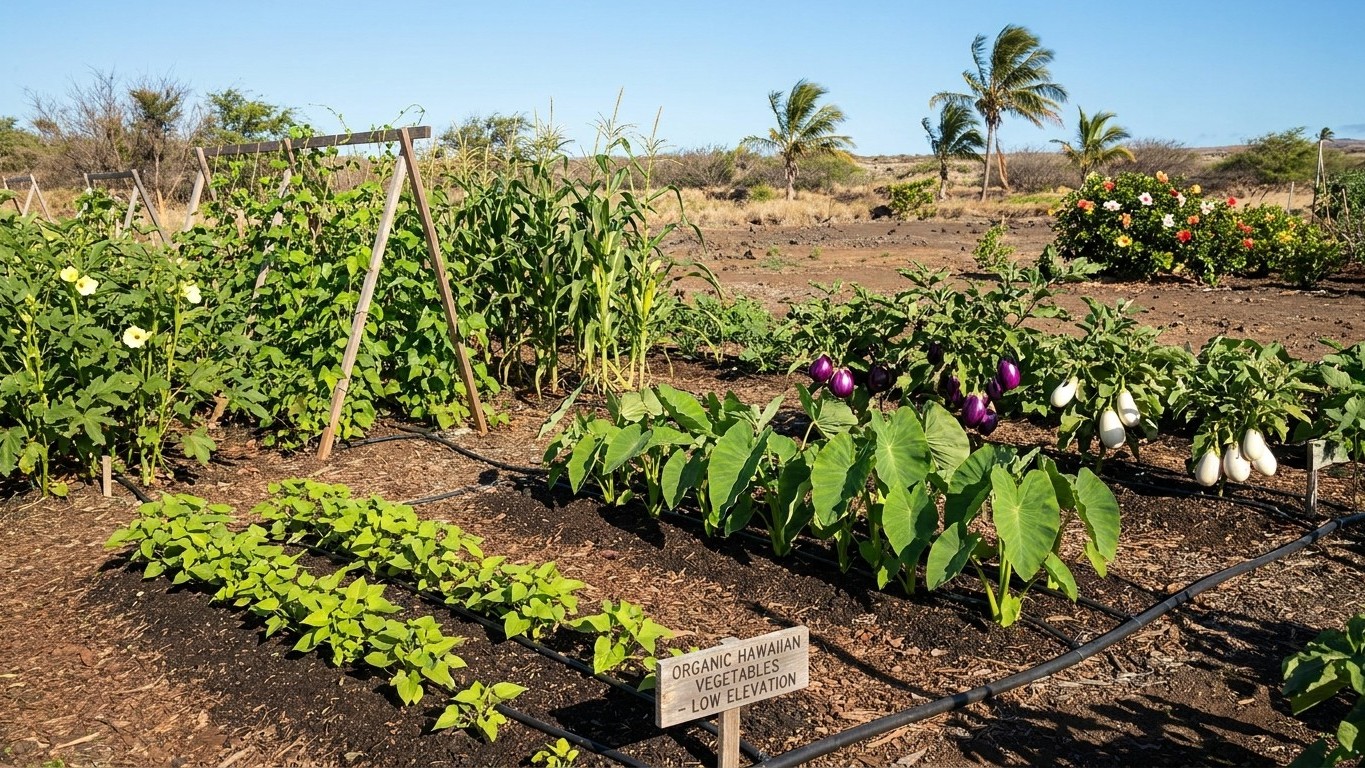

August in Hawaii isn’t about frost dates or a shrinking growing season, because neither exists here. It’s about heat, dry-season irrigation on leeward coasts, and hurricane-season wind. Sweet potato, taro, beans, corn, okra, eggplant, tropical greens and squash all go in now. The real planning question is elevation and exposure, not the calendar.
What goes in the ground in August

Lowland Hawaii has no frost season at all. NOAA’s 1991-2020 Climate Normals for the Honolulu station show zero days per year at or below 32°F, and every freeze percentile comes back “not computable” because a freeze essentially never happens where people garden. Frost shows up only on the summits of Mauna Kea, Mauna Loa and Haleakala, thousands of feet above any vegetable bed. That means a calendar built around a frost window, the kind mainland gardeners rely on, simply doesn’t apply. What decides planting here is rainfall, elevation and whether a garden sits on the windward or leeward side of an island.
August falls squarely in the dry season for leeward areas like Kona, West Maui and much of leeward Oahu. Soil there dries fast, so anything going in now needs either reliable irrigation or a spot with some afternoon shade. Windward gardens, facing the trade winds on the wet side of the islands, hold moisture longer and are more forgiving this month.
What thrives at low elevation now
Heat is not a problem in August, it’s the default. Sweet potato slips, taro huli, snap and lima beans, corn, okra, eggplant, peppers, cucumbers, summer squash and melons all go straight into warm ground. Sweet potato greens double as both a cover crop and a harvestable leaf vegetable, which makes them one of the most forgiving choices for a dry month. Banana keiki (the small offshoot plants) and papaya seedlings also transplant well now, provided they get consistent water while roots establish.
Elevation changes everything
The USDA Plant Hardiness Zone Map places Hawaii across a huge range, 9a to 13a, built entirely on average extreme minimum winter temperature. Coastal spots like Honolulu and Hilo sit at the warm end of that scale, while upcountry communities such as Kula on Maui or Volcano on the Big Island, sometimes only a 40-minute drive from a beach, sit far cooler within that same statewide range. At those higher elevations, August is actually a decent window for crops that sulk in lowland heat: lettuce, cabbage, broccoli and other brassicas can be started now for upcountry gardens, something that would scorch or bolt immediately at sea level.
What to start under cover
“Under cover” in Hawaii rarely means protecting seedlings from cold. It means shade cloth, a covered nursery bench or a screened structure that keeps heavy August downpours, slugs and fruit flies off tender starts. Because there’s no frost date to count backward from, the arithmetic gardeners elsewhere use doesn’t exist here in the same form. Instead, count backward from when a transplant will actually go into the ground, and from the wetter months that follow the dry season on leeward sides.
Slow growers benefit most from a head start indoors or under shade now. Tomatoes, peppers, eggplant and brassicas destined for upcountry beds do better started in trays or small pots where you control the water rather than direct-seeded into cracking, dry leeward soil. Give tomatoes and peppers roughly six to eight weeks under cover before they’re sturdy enough to transplant; brassicas for cooler upcountry gardens need a similar window so they’re not still fragile when they go out.
The two failure modes here look the same as anywhere else, just on a different clock. Start too early under cover and a hot nursery bench will push seedlings into leggy, rootbound stress long before there’s a bed ready for them. Start too late and a leeward garden’s dry stretch will have already hardened the soil, making it far harder for a young transplant to establish before you’re back to hauling water daily. A shaded nursery area with drip irrigation solves both problems at once: consistent moisture, filtered light, and a controlled pace that isn’t at the mercy of whichever way the trade winds are blowing that week.
What is ready to pick
August harvest in Hawaii runs on tree and vine cycles more than on a strict monthly clock, but a few things reliably wind down or peak now. Mango season is tailing off in most areas, so late-hanging fruit should come off as it colors up rather than waiting for a “perfect” moment; overripe mango drops fast and attracts fruit flies. Lychee is finishing its run in many locations, and breadfruit trees are often loaded, with fruit ready when it develops a slight give and the skin’s texture flattens between the segments.
Avocado varieties that fruit in summer are coming in, and banana and papaya, which don’t really have an off-season in Hawaii’s climate, keep producing steadily as long as the plants are watered. Sweet potato and taro planted earlier in the year may be reaching harvest size; check sweet potato by feeling around the base of the plant for swelling roots before pulling the whole hill.
Because nothing here is locked to a single freeze-driven harvest window, the more useful habit is checking stored crops rather than racing a calendar. Onions and any winter squash held from a previous harvest should get a hand check for soft spots, especially in humid weeks, since Hawaii’s moisture load speeds up rot far faster than it would in a dry mainland pantry.
The jobs that matter this month
August sits in the heart of the Pacific hurricane season, and that single fact should drive most of the month’s task list. Trees with heavy, top-loaded canopies (mango, avocado, breadfruit) benefit from thinning out dense growth now, reducing the “sail” that catches wind and reduces the chance of limb failure during a storm. Anything trellised, staked corn, tomato cages, bean poles, needs those stakes checked and reinforced before wind arrives, not after a plant is already leaning.
Mulch matters more in August than almost any other month, especially on leeward properties fighting the dry season. A thick layer, four inches or so of straw, wood chips or chopped green waste, cuts water loss dramatically and keeps root zones from baking. Pair that with a watering rhythm that favors deep, infrequent soaking over quick daily sprinkles; shallow watering trains roots to stay near the surface, which is exactly the wrong setup heading into wind season.
Succession sowing keeps beans, corn and greens coming instead of hitting one big harvest and then a gap. Pest scouting deserves a weekly pass, too: fruit flies target ripening mango, papaya and other soft fruit hard in warm weather, and catching an infestation early (removing fallen fruit promptly) does more good than any spray applied after populations build. Clearing drainage channels and checking that garden beds won’t pool water is worth doing before, not during, the first heavy tropical downpour.
What not to do in August
The most common misstep is treating warm air as permission to plant anything anywhere. Cool-season crops like lettuce, peas and most brassicas will bolt or simply refuse to head up in lowland August heat, no matter how good the soil looks. Save those for upcountry elevations or wait for cooler months at sea level; planting them now at the coast wastes seed and a bed slot that a heat-loving crop would have used well.
Skipping irrigation because it rained once this week is another trap, particularly on leeward properties where a single shower doesn’t come close to matching the moisture lost to August heat and wind. Check soil moisture with a finger, not a memory of last Tuesday’s weather.
Heavy nitrogen feeding right before storm season is also a mistake gardeners repeat every year. Nitrogen pushes soft, fast, leafy growth that snaps easily in wind and is more attractive to pests. If a plant needs feeding now, lean toward a balanced or lower-nitrogen option and hold off on a big nitrogen push until after the windiest stretch passes. Finally, don’t assume a plant thriving at a neighbor’s coastal lot will do the same three miles up the mountain, or the reverse; Hawaii’s microclimates shift fast with elevation, and copying a planting choice across that line is a reliable way to lose a season’s work.
Checking this against your own county
Everything above is a statewide starting point, and Hawaii’s islands are anything but uniform. Elevation, windward versus leeward exposure, and even which side of a single ridge a property sits on can shift these windows by weeks. A garden in Hilo and one in Kailua-Kona, both technically on the Big Island, run on almost opposite rainfall patterns. Before locking in a planting plan, check with the University of Hawaii’s CTAHR Extension Service, which tailors guidance to island and elevation rather than to the state as a whole.
Common questions
Does Hawaii ever get frost where people garden?
No. NOAA’s climate data for lowland Hawaii shows zero freeze days per year; frost only occurs on the high summits of Mauna Kea, Mauna Loa and Haleakala, far above any residential garden.
Can I plant tomatoes in August in Hawaii?
At low elevation, tomatoes often struggle with heat and disease pressure in August; they do better started under shade now for transplant into an upcountry garden, or held for a cooler stretch at sea level.
Why does my leeward garden need more water in August than my friend’s windward garden?
Leeward sides of the islands sit in the dry season this time of year, while windward sides facing the trade winds hold moisture more consistently, so identical crops need very different watering schedules depending on exposure.
What’s the single most important August task for a Hawaii garden?
Preparing for wind. August falls within hurricane season, so pruning heavy canopies, reinforcing stakes and trellises, and clearing drainage pays off far more reliably than any single planting decision.