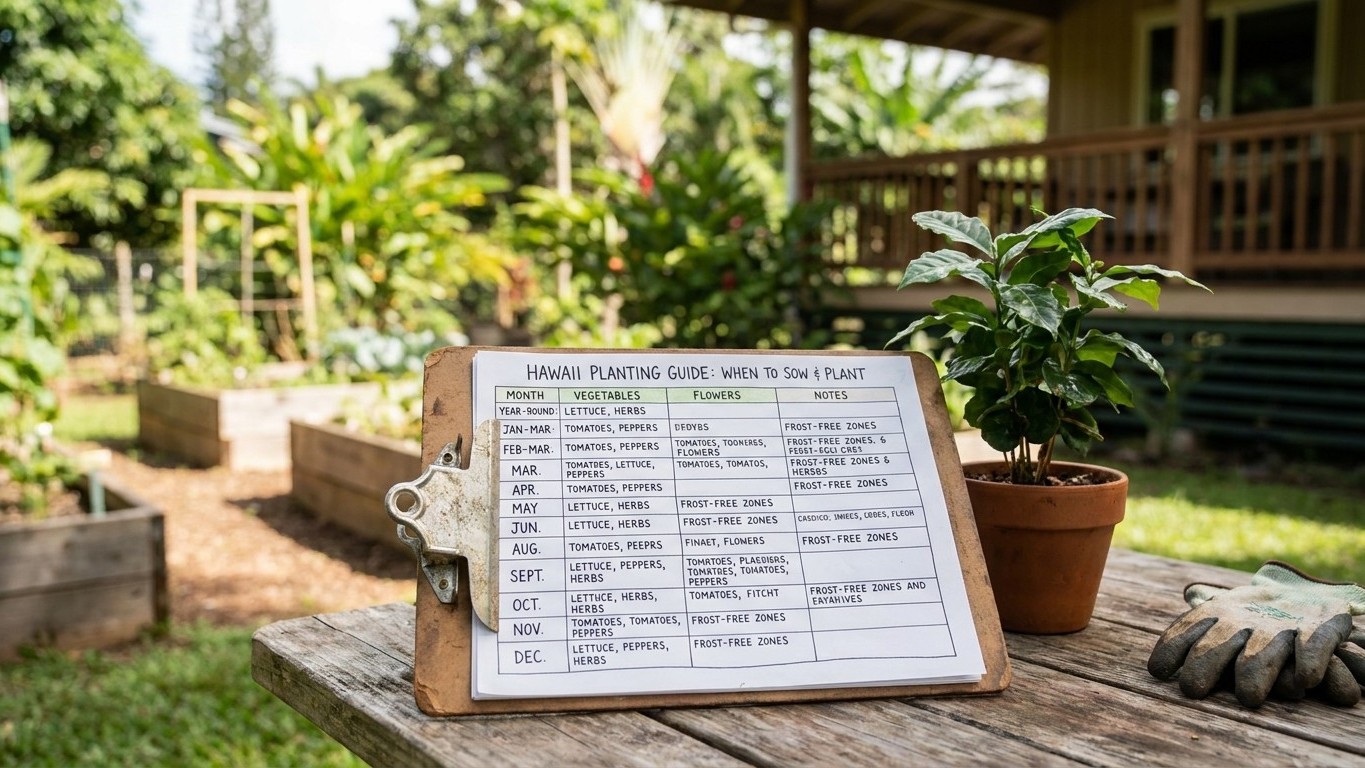

Your yard here never sees frost, not once, not even in January — so there’s no last-frost date to circle and no first-frost date to plant around. That single fact changes everything about how you time a garden in Hawaii. The one thing to do before you sow anything: skip the frost math entirely and instead figure out your elevation and rainfall pattern, because that’s what actually decides when tomatoes, lettuce, or beans go in the ground.
The frost window in Hawaii

In most of the continental United States, the planting calendar is built around two dates: the last freeze in spring and the first freeze in fall. Hawaii breaks that model completely. NOAA’s NCEI normals for Honolulu show no measurable freeze at any point in the year, and that holds true for essentially every inhabited part of the state. Frost exists in Hawaii, but only above roughly 11,000 feet, on the summits of Mauna Kea, Mauna Loa, and occasionally Haleakala. No garden, farm, or nursery operates at that elevation.
What that means in practice is a growing season that never closes. There is no six-month window bracketed by frost dates. A tomato bed in a Honolulu backyard can be replanted the same week it’s cleared, in What to Plant in Hawaii in February, in What to Plant in Hawaii in May, in What to Plant in Hawaii in July, in What to Plant in Hawaii in August, in What to Plant in Hawaii in September, in What to Plant in Hawaii in October, or in What to Plant in Hawaii in December, without worrying about a cold snap ending the crop. That’s a genuine advantage over most of the country, but it removes the single organizing signal that a mainland planting calendar depends on.
What actually governs timing here
Since frost is off the table, three things do the work instead: elevation, rainfall, and wind exposure. Honolulu sits near sea level and stays warm and fairly dry for long stretches. Upcountry areas on Maui and the Big Island, several thousand feet higher, run noticeably cooler year-round simply because of altitude, not because a cold front moved through. Windward coasts (the sides facing the prevailing trade winds, generally the north and east shores) catch far more rain than leeward coasts a few miles away. The NOAA figures above are specific to the Honolulu station, and a garden in Hilo, Kona, or upcountry Kula will run on a different temperature and rainfall pattern even though none of them see frost either.
Cool-season crops
Peas, spinach, lettuce, brassicas like broccoli and cabbage, and root crops such as carrots and beets are usually called “cool-season” because they tolerate a light frost that would kill a tomato. That tolerance is irrelevant in Hawaii, since there’s no frost to tolerate. What still matters is that these crops bolt, or go to seed early, in sustained heat, and that heat is exactly what lowland Hawaii has most of the year.
The practical fix is the one lever Hawaii gardeners have in place of a frost date, and checking a resource like What to Plant in Hawaii in November can help time cool-season crops around the hottest months rather than around frost, and checking a resource like What to Plant in Hawaii in January can help you time cool-season crops before the heat sets in, and it’s worth checking a month-by-month resource like What to Plant in Hawaii in March to see how elevation and rainfall shift the cool-season window: choosing crops by elevation and season rather than by cold tolerance. For a month-by-month breakdown of what to sow right now, see What to Plant in Hawaii in June: elevation. Lettuce and spinach that struggle through a hot spell in a Honolulu-area garden often do fine a few thousand feet up, where daytime temperatures stay lower. If you’re gardening at low elevation, the better approach is to aim these crops at whatever stretch of the year is comparatively cooler and less humid where you live, rather than trying to match a mainland “early spring” planting window that doesn’t apply here. Root crops in particular benefit from soil that isn’t waterlogged, so a spell with less rain also tends to suit carrots and beets better than the wettest weeks of the year.
Succession planting instead of a single window
Because nothing forces these crops out of the ground on a fixed date, many Hawaii gardeners treat lettuce and spinach as a rolling crop: sow a short row every few weeks, harvest continuously, and stop only when a hot, humid stretch makes the plants bolt or rot. That’s a different rhythm from mainland gardening, where cool-season crops get one spring run and one fall run bracketed by frost. Here, the limiting factor is watching your own plants for early bolting or fungal spotting on the leaves, not counting days from a date on a chart.
Warm-season crops

Tomatoes, peppers, squash, beans, and corn are the crops that a frost date usually protects on the mainland: you wait until the danger of a killing frost has passed before setting them out. In Hawaii that risk simply doesn’t exist, so the deciding factor becomes soil temperature and disease pressure instead. Warm-season crops germinate and root poorly in cold, wet soil, and humid, high-rainfall stretches raise the odds of fungal and bacterial disease on tomatoes and peppers regardless of how warm the air is.
Choosing a variety by days to maturity
Days-to-maturity figures on a seed packet are counted from transplant, and they’re the same wherever you garden, since they describe the plant’s genetics rather than local climate. In a place with no frost cutoff, the days-to-maturity number matters less for dodging a killing freeze and more for planning succession plantings and limiting the number of weeks a plant is exposed to disease-favoring humidity. A short-season tomato like Sakura (55 days from transplant) or Edox (also 55 days) gets picked and cleared out faster than a long-season paste tomato, which shortens the window fungal disease has to build up on the foliage.
For gardeners weighing a few named options against each other, the catalogue figures below are a starting point, and actual harvest timing will run a week or two either way depending on heat, rainfall, and how the plants are watered:
| Variety | Days to maturity | Growth habit | Notable disease resistance |
|---|---|---|---|
| Sakura | 55 | Indeterminate | Nematodes (intermediate), Tomato Mosaic Virus, Fusarium Wilt races 1, 2 |
| Valentine | 55 | Indeterminate | Early Blight (intermediate) |
| Sun Gold | 57 | Indeterminate | Tobacco Mosaic Virus, Fusarium Wilt race 1 |
| Juliet | 60 | Indeterminate | Late Blight, Early Blight (both intermediate) |
| Amalfi | 68 | Determinate | Nematodes, Late Blight, Early Blight (all intermediate) |
| Cherokee Purple | 72 | Indeterminate | None listed |
| Big Beef Plus | 72 | Indeterminate | Nematodes (intermediate), Gray Leaf Spot, Tomato Mosaic Virus |
| San Marzano II | 78 | Indeterminate | None listed |
| Celebrity Plus | 78 | Determinate | Nematodes (intermediate), Gray Leaf Spot, Tomato Mosaic Virus |
In humid, high-rainfall gardens, the resistance ratings matter more than they would in a dry climate. Nematodes build up faster in warm, moist soil, and fungal issues like early blight and gray leaf spot spread quickly wherever leaves stay wet for long stretches, which is common on windward-facing plots. A variety carrying intermediate or high resistance to those specific problems, such as Celebrity Plus or Big Beef Plus, gives you more room for error than one with no resistance listed, like Cherokee Purple or San Marzano II, both of which still produce well but need closer watching for leaf disease.
The fall planting window
On the mainland, the fall planting window is set by counting backward from the first fall frost: days to maturity, plus a buffer for slowing growth as daylight shortens. That calculation doesn’t work in Hawaii, because there is no first fall frost. NOAA’s normals for Honolulu show the same zero-freeze result in every season, so a fall planting date driven by an approaching freeze simply isn’t a real constraint here.
What replaces it is the shift toward cooler, and often wetter, weather later in the year. Growth slows somewhat as day length shortens even without a temperature drop, so a warm-season crop planted late still needs its full days-to-maturity count, plus some cushion, to reach harvest. A gardener planning a fall round of a longer-season tomato like Tiren or Granadero (both 75 days from transplant) should count that period out fully and add a margin, the same logic a mainland gardener uses, just without a hard frost deadline forcing the calculation.
One thing worth being honest about: on the mainland, a handful of crops, kale, brussels sprouts, and carrots among them, are famous for tasting sweeter after a light frost converts stored starches to sugars. That effect depends on the plant actually experiencing near-freezing temperatures. Since no frost reaches garden-level ground anywhere in Hawaii, that flavor change doesn’t happen here, however long you leave the crop in the ground. If a Hawaii gardening guide promises frost-sweetened kale, that claim doesn’t hold up locally.
Reading a planting calendar properly
A state-wide planting calendar, including this one, describes averages measured at one weather station, in this case Honolulu. It is a starting point, not an instruction sheet for every yard in the state. The same caution applies everywhere, just for different reasons: a Manitoba gardener working from a Manitoba planting calendar has to account for a short, frost-bound season that varies by weeks between the south of the province and the north, while an Idaho gardener checking an Idaho planting calendar has to factor in how much elevation shifts the frost date across the state’s mountains and valleys. Hawaii’s version of that variation isn’t frost timing, since there isn’t any, but it’s just as real: elevation, windward versus leeward exposure, and local rainfall swing growing conditions by just as much from one valley to the next.
What to watch in your own garden
Instead of a date, track conditions directly:
- Soil temperature at a few inches down, especially before setting out warm-season transplants
- How much rain your specific site gets compared to a forecast for the nearest town, since windward and leeward differences can be dramatic over a short distance
- Whether leaves stay wet late into the morning, a sign of fungal disease risk that matters more than any date
- How your plants behaved the last time you grew them at that spot, which is a better predictor than a generic chart
Local help
For county-level guidance, soil testing, and pest identification specific to your island, contact the state extension service, run through the University of Hawaii’s College of Tropical Agriculture and Human Resources. Extension staff can speak to conditions in your specific district in a way a state-wide page never can, since they work with growers on your island directly. For more on gardening across the islands, our Hawaii guides cover topics beyond timing, including soil amendments and crop choices suited to volcanic soil.
Common questions
Does Hawaii ever get frost at all?
Only at very high elevation, on the summits of Mauna Kea, Mauna Loa, and occasionally Haleakala, well above 11,000 feet. NOAA’s climate normals for the Honolulu station show zero freeze days across three decades of records, and that holds for essentially every garden, farm, and orchard in the state.
Can I really plant tomatoes any month of the year in Hawaii?
In terms of frost risk, yes, since there’s no frost to avoid. In practice, heavy rain, high humidity, and disease pressure make some stretches of the year much harder on tomatoes than others, so timing still matters, just for reasons other than cold.
Why do garden books talk about frost dates if Hawaii doesn’t have any?
Most national gardening references are written for the mainland, where frost is the default limiting factor. A calendar built that way simply doesn’t transfer to Hawaii, which is why local timing has to be based on elevation, rainfall, and disease pressure instead.
Will my vegetables taste different without a frost to sweeten them?
Some crops, particularly kale and carrots, are known for tasting sweeter after a light frost converts starches to sugar. Since no frost reaches garden-level ground in Hawaii, that specific flavor change won’t happen, regardless of how long the crop stays in the ground.
Is the growing season the same on every island?
No. The NOAA figures cited here are measured at the Honolulu station, and rainfall, elevation, and windward or leeward exposure vary sharply across Oahu, Maui, Kauai, and the Big Island. A garden a few miles away on the same island can run noticeably wetter or cooler than the reference station.
Related guides
- Idaho Planting Calendar: When to Sow and Plant, Frost Dates Included