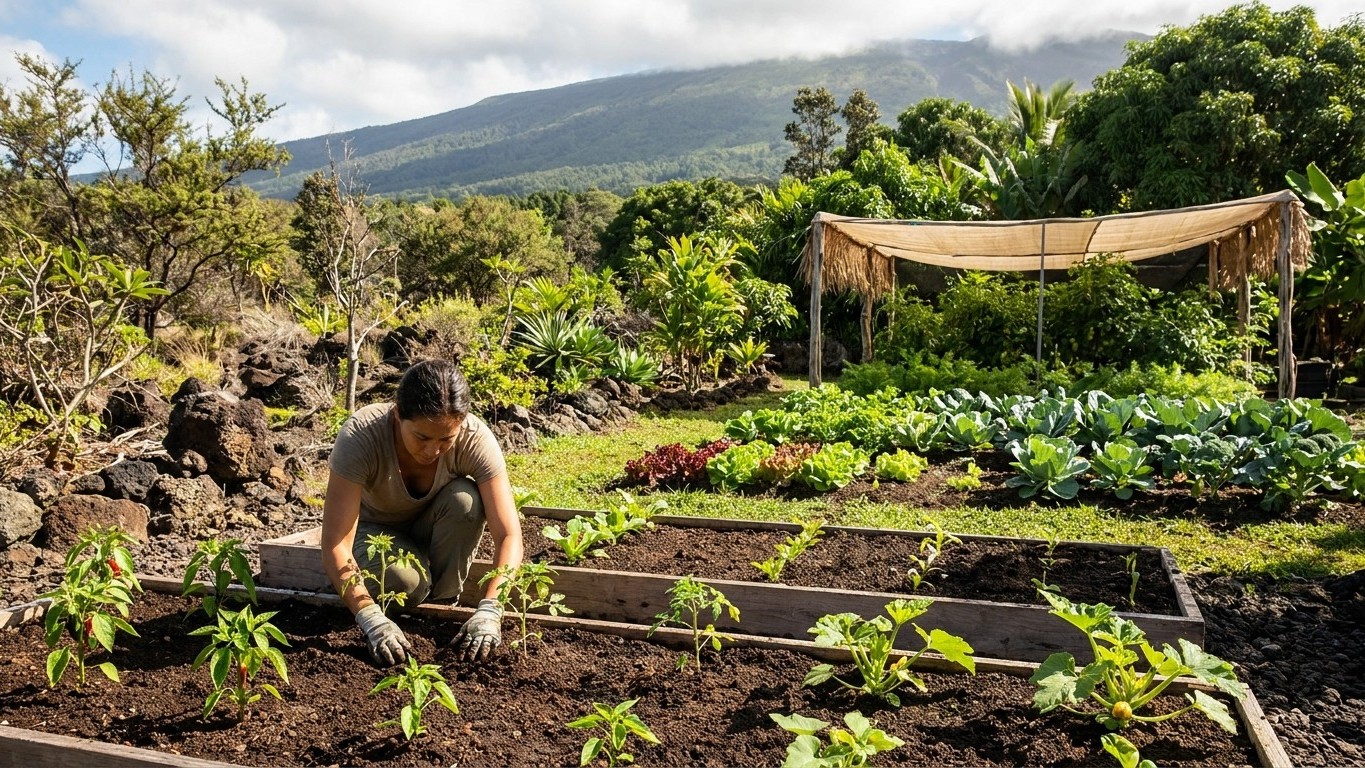

January in Hawaii isn’t a waiting month. There’s no frost line to clear, so the real question is elevation and rainfall exposure: warm-season vegetables go into the ground on the leeward lowlands, cool-season crops go in at elevation, and root crops and leafy greens work almost anywhere with decent drainage.
What goes in the ground in January

Mainland planting calendars run on frost dates. Hawaii’s don’t, because there aren’t any where people garden. NOAA’s 30-year climate data for Honolulu shows a flat zero: no days at or below 32°F, no computable frost percentile at all. The freeze line exists only on the summits of Mauna Kea, Mauna Loa and Haleakala, thousands of feet above any backyard. That single fact rewrites the whole planting calendar for the state.
What decides a January planting isn’t temperature, it’s where you stand. Elevation and windward-versus-leeward exposure do the work that frost dates do everywhere else. Below roughly 1,500 feet on the drier leeward sides (think the Kona coast, Kihei, or the lee side of Oahu), January days stay warm and the soil never chills enough to stall a warm-season crop. Tomatoes, peppers, beans, squash, corn and sweet potato can all go into the ground now.
Move upslope, into districts like Kula on Maui or Waimea on Hawaii Island, and January nights drop enough to favor the crops that sulk in true tropical heat. Lettuce, cabbage, broccoli, carrots, beets and peas all do better in that cooler air, and this is a solid month to get them started.
January also sits inside Hawaii’s wet season, which runs roughly November through March and hits windward coasts hardest. That means the limiting factor on the wet side isn’t cold, it’s drainage. Raised beds or berms matter more than any planting date. Taro, which actually wants wet feet, is a natural fit for this stretch on windward ground; most other vegetables need you to get water moving off the bed, not just onto it.
What to start under cover
Without a frost date to count backward from, the arithmetic changes. What you’re protecting against under cover in January isn’t cold, it’s the deluge and wind that come with the wet season, plus the stretch of weeks it takes seedlings to size up before the rains taper toward spring. Starting warm-season transplants indoors or under a simple cover now means they’re ready to go into the ground with several weeks of drier weather ahead of them rather than getting hammered as seedlings by a heavy squall.
The two failure modes are the same shape as anywhere else, just triggered by different weather. Start too early under cover and you get leggy, rootbound seedlings sitting in cell trays because a run of storms delays transplanting. Start too late and warm-season crops miss the calmer window before the dry season’s heat and wind stress arrives, particularly on leeward slopes where things heat up fast once the rains ease.
Cool-season crops bound for elevation gardens benefit from a short head start under cover too, mostly as insurance against slugs and heavy rain battering tiny seedlings rather than any concern about chill. A cold frame or even a plastic tunnel over a bed does less to warm soil here than it does on the mainland; its real job in Hawaii is keeping torrential rain off young plants and cutting wind damage until stems toughen up.
Seed started under cover this month should be sized to transplant within four to six weeks, which lines up well with the gradual tapering of the wet season on most islands. Track your own rainfall rather than a generic date, since windward and leeward timing can differ by weeks even on the same island.
What is ready to pick
January harvests are wide open compared to a mainland winter, precisely because nothing has been killed back by frost. Overwintered brassicas planted in fall (cabbage, broccoli, kale) are sizing up at elevation and can be picked as heads and leaves firm up. Leafy greens at lower elevation keep producing on a rolling cut-and-come-again basis all month.
Tree and vine crops planted well before winter keep bearing on their own schedule rather than a calendar month: papaya fruits continuously once established, bananas ripen in cycles tied to when the bunch flowered rather than the season, and some citrus and avocado varieties hit peak ripeness in the cooler months, though exact timing depends heavily on the specific variety and microclimate.
Root crops are worth checking now too. Sweet potato and taro planted earlier in the season are often ready to lift, and the wet-season soil moisture actually makes digging easier than in the dry months. If you’re storing squash, onions or potatoes from an earlier harvest, Hawaii’s humidity makes rot check a bigger priority than it is in drier climates: go through storage now and pull anything soft, sprouting or smelling off before it spreads to the rest of the batch.
The jobs that matter this month
Because Hawaii skips the deep dormancy that shapes a mainland winter, January reads as a working month, not a resting one. The plants keep growing; the jobs that keep them healthy don’t pause either.
Soil, drainage and pests
Wet-season rain leaches nutrients out of tropical soils fast, so this is a good month to test and amend rather than wait. Working compost or amendments into beds now gives it time to settle before the next planting push. Drainage work, whether that’s a raised bed, a berm, or just clearing a channel so water doesn’t pool around root crowns, pays off directly in disease pressure avoided later. Pest scouting matters more here than in a frosty climate, because nothing dies back over winter to reset populations. Aphids, mites and slugs that would be knocked out by a hard freeze elsewhere simply keep cycling in Hawaii, so a January walk-through checking undersides of leaves catches problems while they’re still small.
Tools, orders and structure
At the higher elevations where a few deciduous fruit trees (apple and peach types grown in places like Kula) get enough of a chill to slow down, January is the window for dormant-season pruning before new growth pushes. Ordering seed now, before popular varieties sell out, still applies in Hawaii exactly as it does anywhere else. Cleaning and sharpening tools, repairing bed edges and fencing battered by wet-season storms, and turning compost that’s had a chance to heat up all belong on the January list. None of it is filler; skipping it just shows up as a rougher season later.
What not to do in January
The most common mistake is importing a mainland mental model wholesale. Gardeners who move to Hawaii or garden from a mainland habit sometimes hold off on tomatoes or beans waiting for a “last frost” that will never come in lowland Hawaii, and lose weeks of good growing time waiting on a date that doesn’t apply.
The opposite mistake shows up on the wet side: planting straight into saturated ground during a heavy rain stretch without addressing drainage first. Roots sit in standing water, and what looks like a slow-growing plant is often a plant slowly rotting from the crown down. Raised beds or simple mounding solve this before it starts; digging up a waterlogged bed after the fact rarely saves the crop.
Fungal disease is the other January trap. Combine natural wet-season humidity with a gardener still watering on a dry-season schedule, and you get exactly the damp, still conditions that powdery mildew and blight favor. Cut back supplemental watering during heavy rain weeks and let the sky do the work; save irrigation for the drier stretches.
Skipping pest scouting because “it’s winter” is a habit worth breaking here specifically, since there’s no cold spell to do that job for you. A five-minute check of new growth once a week catches an aphid colony while it’s still small enough to squash by hand.
Checking this against your own county
A state-wide January is a starting point, not an instruction. Hawaii’s own hardiness range, 9a through 13a on the USDA Plant Hardiness Zone Map, spans everything from cool upland districts to hot coastal lowlands within the same state, sometimes within the same island. Elevation, windward rainfall and leeward dryness move real planting windows by weeks, not days, so what’s right for a Kona lowland garden may be wrong for a Kula hillside a few miles away.
For a planting calendar built around your specific island and elevation, the University of Hawaii’s CTAHR Cooperative Extension Service is the direct source, with local offices and agents who can speak to conditions on your particular slope.
Common questions
Does Hawaii ever get frost in January?
Not where people garden. NOAA’s 30-year climate data for Honolulu shows zero days at or below 32°F, and no computable frost date at all. Frost only occurs on the high summits of Mauna Kea, Mauna Loa and Haleakala, far above any backyard or farm.
Why does elevation matter more than season in Hawaii?
Because there’s no frost line pushing crops in and out of season, elevation becomes the main lever on temperature. Lowland districts stay warm enough for tropical and warm-season crops year-round, while higher districts run consistently cooler, favoring cool-season vegetables regardless of the calendar month.
Is January a good time to plant tomatoes in Hawaii?
On leeward lowland ground, yes, since there’s no cold snap coming to damage them. On the wet windward side, make sure drainage is sorted first, since standing water in a rainy January does more damage to tomatoes than any temperature swing.
What’s the single biggest planting mistake tied to Hawaii’s climate?
Treating the state as one climate. A planting choice that works on a dry Kona lowland can fail on a wet windward slope a short drive away, which is why checking local extension guidance for your specific island and elevation matters more here than in most states.