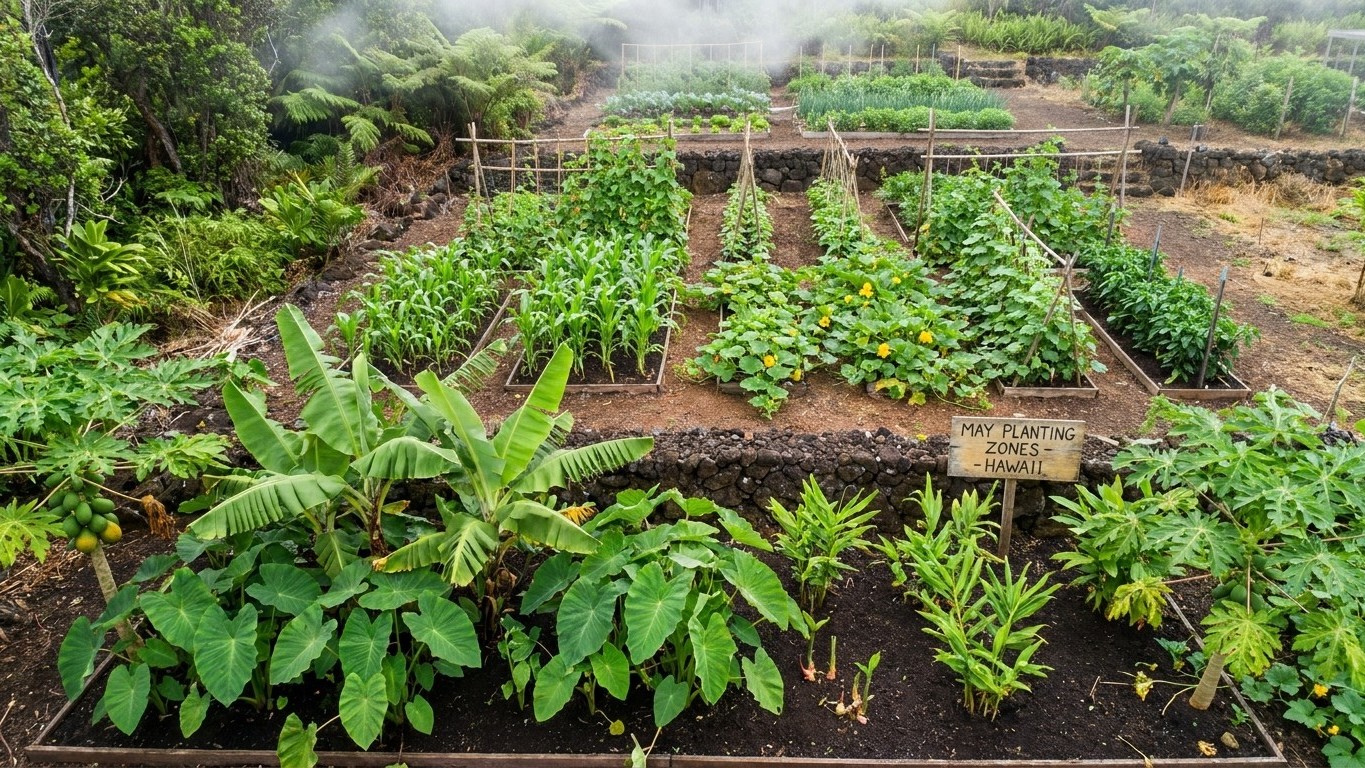

May sits at the hinge between Hawaii’s wetter months and its drier half, and that shift, not any frost date, is what decides the planting list. There’s no frost anywhere gardeners actually work the soil, so the calendar runs on elevation, rainfall and which side of the island you’re on. Warm-season staples like corn, beans, squash and sweet potato go in almost everywhere; cooler crops need altitude to succeed.
What goes in the ground in May

Hawaii has no freeze season where people garden. NOAA’s 1991-2020 climate data for the state marks every freeze threshold as not computable, with zero days per year at or below 32°F recorded at the reference station. Frost exists only on the summits of Mauna Kea, Mauna Loa and Haleakala, thousands of feet above any vegetable bed. That single fact rewrites the whole planting logic: instead of counting weeks to a last-frost date, gardeners here work off elevation, rainfall pattern and whether their yard faces windward (wetter) or leeward (drier).
Near sea level, in the hot, humid band up to roughly 500 feet, May favors taro, banana, papaya, ginger and turmeric, along with heat-tolerant greens like sweet potato tops and Chinese cabbage varieties bred for the tropics. From about 500 to 2,000 feet, the classic warm-season garden takes over: corn, bush and pole beans, cucumber, summer squash, melons, okra, eggplant and pepper transplants all settle in well now, and sweet potato slips root fast in the warming soil.
Above roughly 2,000 to 3,000 feet, on the cooler mauka slopes of the Big Island, Maui and parts of Kauai and Oahu, the math changes again. These upland gardens hold enough of a temperature drop that lettuce, cabbage, broccoli and peas can still be planted with a real shot at heading up before heat stress sets in, something that would fail outright at sea level in May.
The gamble crops are the cool-season ones planted too low. Lettuce, spinach and peas set out in a hot, humid lowland yard in May tend to bolt, rot at the crown or simply stall. Save those for upland beds or wait for the cooler months down at sea level. Everything else on the warm-season list above is a safe, straightforward call this month.
What to start under cover
“Under cover” in a Hawaii garden rarely means protecting seedlings from cold. It means shaded nursery flats, a lath house, or containers pulled back from driving rain and wind, since May can still bring heavy windward showers even as the leeward side dries out. Tomatoes, peppers, eggplant and brassicas destined for upland beds all do better started this way, in partial shade, before they ever meet open ground.
Because there’s no frost window to count backward from, the arithmetic runs off the crop’s maturity time and the season it’s heading into instead. A gardener planning lettuce or broccoli for an upland bed should count back from the point where daytime highs typically climb enough to stunt those crops, roughly the number of weeks the variety needs to reach harvest, and start seed that far ahead under shade cover. Miss that window and the transplants hit peak heat before they’re grown, bolting or refusing to head at all.
The two failure modes here mirror any garden. Start warm-season seedlings, tomatoes and peppers especially, too early in small trays, and roots go bound and leggy before there’s a bed ready for them, setting the whole crop back once it finally goes in. Start the upland cool-season crops too late, and they run out of cool weather before they mature, arriving at harvest size right as the mauka slopes warm into their own dry-season stretch. Papaya seed, started in bags now, has enough runway to size up before it needs a permanent spot.
What is ready to pick
Corn and beans planted as the dry season opened are usually filling out by May, and sweet potato vines set out several months earlier are ready to check by lifting a test hill at the row’s end rather than guessing from the foliage on top. Taro planted many months prior, whether in a wet patch or a dryland bed, is often within range of harvest; growers judge readiness by the size and firmness of the corm at the base, not by a fixed date.
Tree fruit carries a lot of the month. Mango season is getting underway in many locations, lychee is filling out on trees that set fruit earlier, and avocado timing varies widely by variety and elevation, so the safest check is a hand test, gentle give at the stem end, rather than the calendar. Banana, which fruits year-round on a healthy mat, keeps producing regardless of season, and a full bunch showing yellow at the tip end is worth cutting before birds or rats get to it.
Leafy greens from an upland bed, along with anything grown under shade cloth at lower elevation, are worth picking young and often in May, since heat pushes lettuce and Asian greens toward bolting fast once they size up. For stored crops, sweet potato and onion sets from earlier harvests should get a quick check for soft spots or sprouting, since Hawaii’s humidity shortens storage life compared to drier climates.
The jobs that matter this month
Mulch is the single biggest lever in a May garden. As most locations ease into the drier half of the year, a thick layer around corn, beans and squash holds soil moisture that would otherwise evaporate fast in the strengthening sun, and it keeps weed pressure down while everything is growing quickly. Skipping it now means more watering and more weeding for the rest of the season.
Irrigation lines are worth checking before the rains taper further, especially on leeward slopes where May can turn dry fast. A drip line with a clogged emitter is easy to miss in a wet month and painful to discover in a dry one. Vining crops, tomatoes, pole beans, cucumbers and squash, put on fast growth this month, so staking and trellising now prevents the tangled, disease-prone mess that comes from letting them sprawl on wet ground.
Pest scouting matters more in May than most months, since warmth accelerates insect life cycles. Fruit flies, one of Hawaii’s most damaging agricultural pests, are active on ripening mango, papaya and other tree fruit, and early bagging or trapping now limits losses later. Aphids build quickly on new bean and pepper growth in warm, humid weeks. Anyone moving plant material between islands should check the state’s inter-island quarantine rules before doing so, since pests like coffee berry borer and other regulated organisms spread that way.
Heavy feeders like corn and taro benefit from a fertilizer application as they hit their main growth push, timed to when the plant is actively building leaf and stalk rather than after it’s already set fruit or corms.
What not to do in May
The most common mistake is treating “Hawaii” as one climate. A crop that thrives in a Hilo backyard can fail outright in a Kona one a few miles away, because rainfall and elevation, not latitude, run the show. Planting cool-season greens at sea level because the guide said “May is planting season” without checking elevation is the single most avoidable failure here.
Overwatering out of habit is another. Gardeners used to the wetter months sometimes keep watering on the same schedule as rains taper off in May, waterlogging roots in soil that no longer needs it, or conversely assuming the rains will keep coming on the leeward side and letting seedlings dry out. Check the soil, not the calendar or the memory of last month’s rain.
Heavy nitrogen applications aimed at fruiting crops, tomatoes, peppers, squash, once they’ve already set fruit tend to push leafy growth at the expense of the harvest, a classic case of feeding at the wrong point in the plant’s cycle rather than feeding too much overall.
Finally, moving cuttings, soil or plant material between islands without checking quarantine rules risks spreading pests the state is actively trying to contain. It’s a mistake with consequences well beyond one garden.
Checking this against your own county
A state-wide May guide is a starting point, not an instruction sheet. Hawaii spans USDA Plant Hardiness Zones 9a through 13a, a range built on one measure, average annual extreme minimum temperature, and it says nothing about the rainfall and elevation differences that actually govern planting here. A yard at 3,000 feet on the windward side of one island can run weeks behind a leeward yard at sea level on the same island. For local specifics, the University of Hawaii’s CTAHR extension service is the reliable source.
Common questions
Does Hawaii ever get frost in the garden?
No. NOAA’s climate data shows zero recorded freeze days at or below 32°F in the state’s lowland record, with every freeze percentile marked not computable. Frost is confined to the summits of Mauna Kea, Mauna Loa and Haleakala, far above any planted ground.
Why does elevation matter more than the calendar month in Hawaii?
Because temperature drops with elevation even though there’s no seasonal cold, a bed at 2,000 to 3,000 feet stays cool enough for lettuce, cabbage and broccoli to succeed in May, while the same crops fail fast in the heat and humidity at sea level.
What’s the difference between windward and leeward planting in May?
Windward sides, facing the prevailing trade winds, hold onto rain longer into the drier season, while leeward sides dry out faster. That changes irrigation needs and mulching urgency even for gardeners on the same island growing the same crop.
Can I plant tropical fruit trees in May?
Yes. Banana, papaya and many tree fruits establish well now, since there’s no frost risk at any point in their growth and the warming, transitioning weather gives young trees time to root in before the driest stretch of the year sets in.