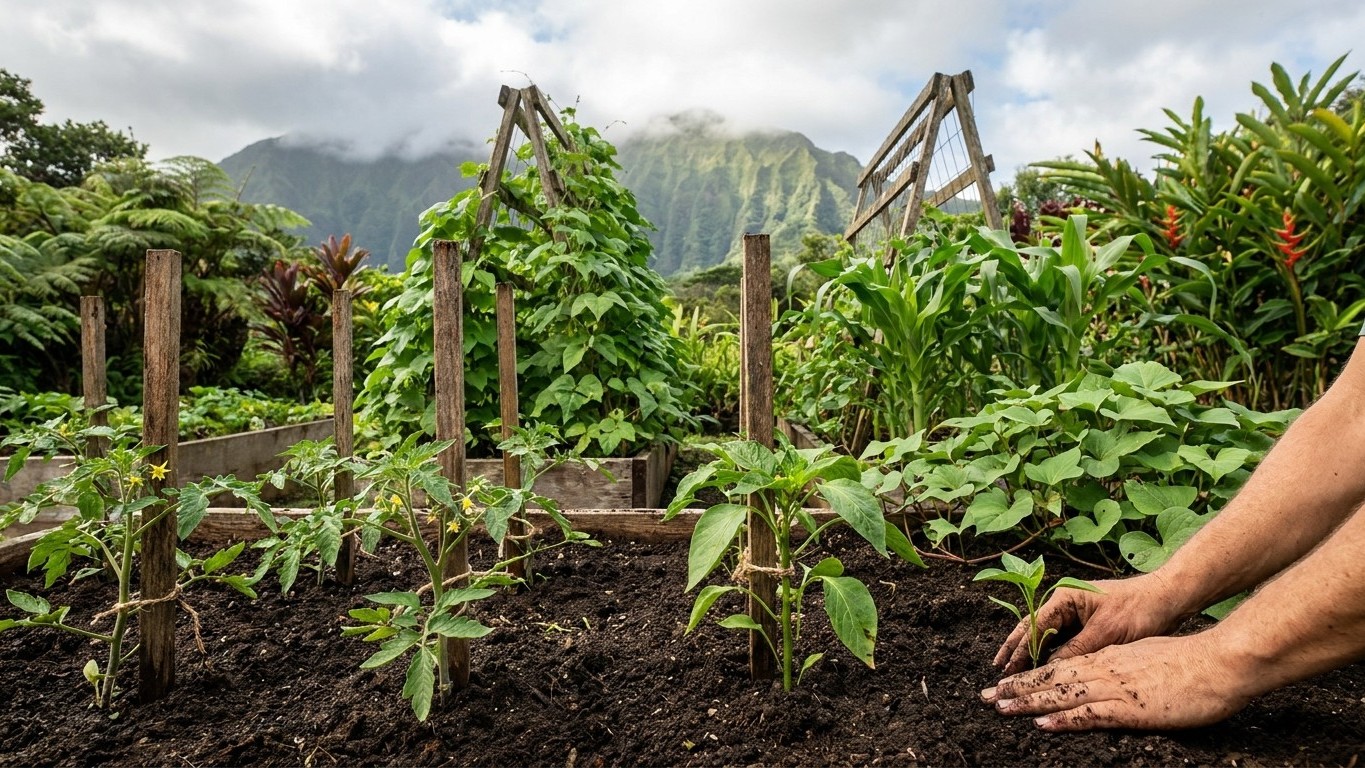

April sits at the hinge between Hawaii’s wet season and its drier months, which makes it one of the most productive planting windows of the year across the lowlands. Corn, beans, tomatoes, peppers, sweet potato slips and taro huli all go into the ground now, though what thrives depends far more on elevation and rainfall exposure than on any date on a calendar.
What goes in the ground in April

Hawaii does not run on a frost calendar. NOAA’s 1991-2020 Climate Normals for the islands show zero days per year at or below 32°F in inhabited areas, and every freeze percentile at that station comes back not-computable. Frost exists only on the summits of Mauna Kea, Mauna Loa and Haleakala, thousands of feet above where anyone gardens. So the question that decides an April planting list is not “has the last frost passed” but “how much rain is falling here, and how high up am I.”
On windward lowland sites (Hilo, Hana, the Kona side flipped around to face trade winds directly), April rain is still generous enough to direct-sow corn, pole and bush beans, cucumber, summer squash and edible-pod peas without daily irrigation. Tomato and pepper transplants that were started under cover in February go into these beds now, staked early since both crops sprawl fast in warm, wet soil. Sweet potato slips and taro huli root reliably in April’s warmth, and banana keiki planted this month have a full dry season ahead to establish before the next heavy rains.
Leeward and drier sites (much of Kona, the Waianae side of Oahu, lower Maui) need the same crop list but with irrigation built in from day one, because April’s rainfall there can be a fraction of the windward total. Upland zones above roughly 2,000 feet, places like Kula on Maui or Waimea on Hawaii Island, run cooler and support crops that would bolt or rot in the lowland heat: lettuce, brassicas, strawberries and temperate herbs all do better in April at elevation than at sea level.
The USDA Plant Hardiness Zone Map puts the islands anywhere from zone 9a to zone 13a, a spread wider than almost any other state. Honolulu sits toward the warm end of that range; a garden at 3,000 feet on the Big Island can sit two or three zones cooler. Treat the state-wide zone as a starting point, not a planting instruction for your particular hillside.
What to start under cover
Because there is no frost date to count backward from, seed-starting timing in Hawaii runs off two other clocks: how long a crop needs before it can handle full sun and heat, and how many weeks of dry weather remain before the next wet-season surge. Peppers and eggplant, both slow starters, want six to eight weeks under cover before they go out, so seed started now sets up transplants for early summer beds. Tomatoes need less lead time, closer to four to six weeks, which makes April sowing a good match for a June transplant.
Upland gardeners have a second reason to start under cover: cool-season crops like lettuce, cabbage and broccoli germinate better in a shaded seed tray than in open ground that swings from cool nights to hot midday sun. Starting these indoors or under light shade cloth for two to three weeks, then hardening them off, avoids the leggy, weak stems that come from direct-sowing brassicas into inconsistent upland temperatures.
The two failure modes are the same ones gardeners hit everywhere, just triggered by different signals. Start too early, before there is a bed ready to receive the transplant, and pepper or eggplant seedlings sit in small cells until they’re rootbound and stalled. Start too late, missing the window before the next rain surge saturates the ground, and warm-season transplants go into soggy soil that invites root rot before the roots ever spread. Watching the rainfall pattern for your specific coast matters more here than watching a wall calendar.
What is ready to pick
April harvests reflect what went in during the previous few months. Citrus trees planted in fall are dropping ripe fruit now in most lowland gardens, and avocado varieties with an early fruiting habit are starting to size up, though full ripeness for most trees is still weeks away. Lettuce and greens sown in February or March are at peak cutting size, and green onions planted earlier in the season are ready to pull.
Corn started in the depths of the dry season is tasseling or filling ears by April on many leeward sites, tested the standard way: pull back the husk on a sample ear and press a kernel, it should burst with milky liquid rather than run clear or feel hard. Herbs, especially basil and mint in beds that got consistent water, are producing enough for regular kitchen use.
Stored crops deserve a walk-through too. Sweet potatoes and taro corms held from earlier harvests should be checked for soft spots or a sour smell, both signs of rot spreading from one tuber to its neighbors in storage. Onions and any winter squash held over should get the same inspection, since one turning bulb in a bin can take down several others within a couple of weeks if it’s not pulled out.
The jobs that matter this month
April’s biggest payoff job is soil preparation timed to the tail of the wet season. Working compost and amendments into beds now, while the ground is still moist enough to turn easily but before the heaviest rains compact it, sets up drainage and fertility for the warm-season crops going in behind it. Skip this window and gardeners end up amending dry, crusted leeward soil by hand later, or fighting waterlogged windward clay that won’t absorb anything.
Mulching comes right behind soil prep. As rainfall tapers through the month on most of the islands, a two to three inch layer of mulch around new transplants holds the moisture that’s already there instead of letting April’s sun bake it out of exposed soil. This matters most on leeward sites, where the difference between a mulched and unmulched bed can be watering every other day versus watering daily.
Staking needs to happen before tomatoes, beans and cucumbers sprawl, not after. A cage or trellis set at planting time costs five minutes; the same job done three weeks later means untangling vines that have already rooted where they touched the ground. Succession sowing corn and beans every two to three weeks through April keeps a harvest coming rather than one glut followed by a gap.
Pest scouting picks up urgency as temperatures climb. Fruit flies target ripening mango, papaya and citrus, and aphids build fast on new pepper and bean growth in the humidity that follows April rain. Fruit trees heading into their flowering window also need attention: this is the moment to check that irrigation and mulch are in place before bloom, not after fruit set has already been decided by how much stress the tree carried through flowering.
What not to do in April
The most common mistake is treating “warm and sunny today” as a green light for planting, without checking whether the soil underneath has actually caught up. A leeward bed that looks dry on the surface can still be cool and compacted a few inches down after a stretch of overcast mornings, and warm-season transplants set into that cooler root zone stall rather than take off. Dig down before planting, don’t just check the air.
Overwatering by habit is the second trap, especially for gardeners who spent the wetter months on autopilot. As April’s rainfall eases on most islands, beds that got no supplemental water in January can suddenly need irrigation two or three times a week, and skipping that adjustment leaves transplants stressed right when they’re trying to establish roots.
Nitrogen timing trips up fruit tree growers specifically. Heavy nitrogen feeding right as citrus, mango or avocado trees are setting flower buds pushes leafy growth at the expense of bloom, and can delay or reduce fruit set for the whole season. A lighter, balanced feeding before flowering, saving heavier nitrogen for after fruit has set, protects the harvest instead of the foliage.
Windward gardeners also underestimate fungal pressure. Beds that get daily rain plus warm April temperatures are exactly the conditions blight and powdery mildew need, and crowding tomatoes or squash too close together in that environment guarantees disease pressure that wouldn’t show up on a drier leeward site with the same spacing.
Checking this against your own county
A statewide planting list is a starting point, not a set of instructions for one specific yard. Hawaii’s five counties span sea-level windward rainforest, dry leeward lava fields and upland zones cool enough to grow strawberries year-round, and a crop that thrives at 100 feet in Hilo can struggle at 3,000 feet in Kula the same week. Elevation, rainfall exposure and whether a site faces the trade winds directly or sits in their shadow move planting windows by weeks, sometimes months, within the same island.
The University of Hawaii’s College of Tropical Agriculture and Human Resources runs the state’s Cooperative Extension Service, with county-level offices that track local rainfall patterns, pest pressure and variety trials specific to each island. Their office directory is available at ctahr.hawaii.edu/site/extension.aspx, and it’s worth checking against the general guidance above before committing a season’s worth of seed to any single planting date.
Common questions
Does Hawaii ever get frost where people garden?
No. NOAA’s climate data for the islands shows zero days per year at or below 32°F in inhabited areas; the only frost on the islands occurs on the high summits of Mauna Kea, Mauna Loa and Haleakala, far above any garden.
Why does the same crop get planted at different times on different islands?
Rainfall exposure and elevation matter more than the calendar. A windward lowland site gets enough natural rain to direct-sow warm-season crops that a dry leeward site of the same elevation would need daily irrigation to support.
Can upland gardeners grow crops that don’t work in lowland Hawaii?
Yes. Areas above roughly 2,000 feet run cool enough for lettuce, brassicas and strawberries to perform well through months when lowland heat would push those same crops to bolt or fail.
What is the single biggest factor in choosing a planting date in Hawaii?
Rainfall pattern for the specific site, checked against elevation and windward or leeward exposure. There is no frost date to plan around, so local rain and heat take that role entirely.