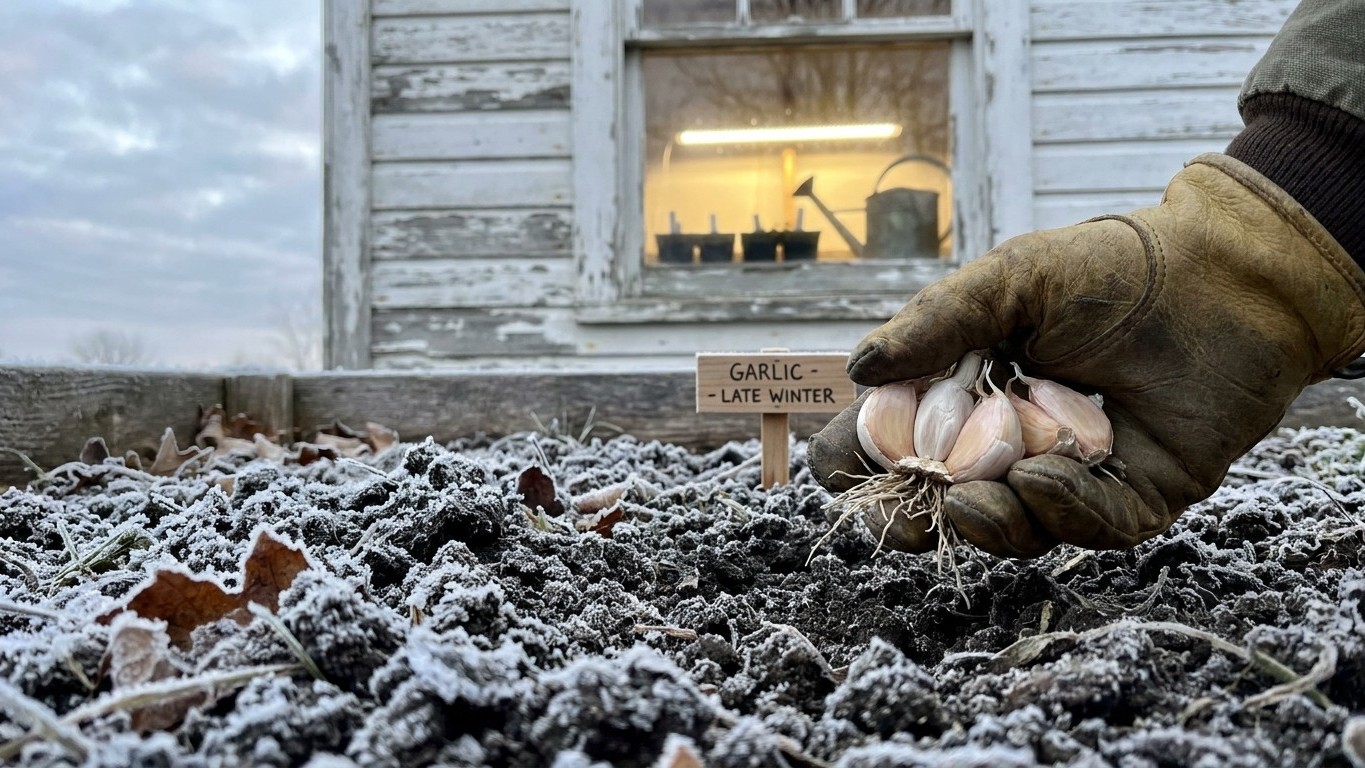

February gives Iowa gardeners almost nothing to plant outdoors. The state spans USDA Hardiness Zones 4b to 6a, and most counties carry frozen or saturated soil straight through to the frost window that starts April 12. What actually happens this month is bare-root garlic where a bed is still workable, forced rhubarb and chicory indoors, and the first seed trays for onions and peppers going under lights. The real February work is indoor prep, not soil work.
What goes in the ground in February

Soil temperature, not the date on the wall, decides what survives outdoors. Iowa’s last spring frost falls between April 12 and April 24, based on NOAA’s 1991-2020 climate normals for the 32°F freeze threshold. That’s the airport-station figure, and Iowa State Extension’s own county records, built from data running back to 1950, push spring frost about 4 days later across most of the state. So the honest window for most counties opens closer to mid or late April, not the optimistic end of that range.
Why the calendar doesn’t decide
February soil in Iowa sits frozen several inches down for weeks at a stretch, and even a stretch of 50°F days won’t thaw a bed fast enough to work it safely. Standing on frozen or half-thawed clay compacts it for the whole season. That’s the mechanism behind the blunt answer here: nothing goes into open ground this month for the vast majority of crops.
What can still go in
A few exceptions hold. If garlic or shallots didn’t get planted in fall and a bed happens to be workable during a thaw, pushing cloves in now is a gamble that sometimes pays off, though fall planting gives stronger bulbs. Cold frames and low tunnels covering hardy greens planted the previous fall, kale, spinach, mâche, can keep producing leaves on any day the cover traps enough heat. Bare-root fruit trees and cane fruit (raspberries, currants) wait for thawed, drainable soil, which usually isn’t February’s gift in Iowa, but ordering them now means they’re ready the moment ground opens. Indoors, forcing rhubarb crowns or chicory roots in a dark, cool space produces tender stalks and blanched chicons long before anything stirs outside.
What to start under cover
Seed starting this month runs on arithmetic, not instinct. Count backward from the last frost window (April 12 to April 24, with most counties running a bit later) and each crop has its own lead time before it’s ready to move outside.
Counting backward from frost
| Crop | Lead time before last frost | What that means for February |
|---|---|---|
| Onions & leeks (from seed) | 10 to 12 weeks | Sow now under lights; this is their prime start window |
| Peppers | 8 to 10 weeks | Sow early to mid-month for strong transplants by frost-out |
| Broccoli & cabbage | 6 to 8 weeks | Sow mid to late month for outdoor transplant timing |
| Tomatoes | 6 to 8 weeks | Hold until late February or slide into March |
The two ways to get it wrong
Start too early and tomatoes or peppers turn leggy and rootbound long before the ground is warm enough to take them, spending weeks fighting for light on a windowsill instead of growing steadily. Start too late, especially with onions and leeks, and the plants never bulk up enough before summer heat shuts down bulb formation. February’s job is threading that needle: onions and peppers now, tomatoes waiting their turn.
What is ready to pick
Outdoors, February in Iowa offers little to nothing. Snow cover and frozen ground shut down growth across the state, and that’s simply the season being what it is.
What still feeds a household comes from what was set up months earlier. Kale and leeks planted the previous fall and left under a thick mulch or snow cover often survive and can be harvested by pushing snow aside, since both crops sweeten after hard frost rather than turning bitter. Cold frames holding spinach or mâche can produce a light cutting on any day warm enough to lift the lid. Indoors, sprouts and microgreens on a windowsill or under a grow light take a week or less from seed to harvest, a fast, reliable source of fresh greens when nothing else is coming out of the garden.
Storage crops need a check now, not later. Squash, potatoes, and onions sitting in a root cellar or basement should get pulled out and inspected: soft spots on squash, green sprouting eyes or shriveling on potatoes, and any onion going soft at the neck all mean pull it now and use or compost it before it spreads rot to the rest of the bin.
The jobs that matter this month
Nothing about February in Iowa is a pause. It’s the month where the season’s structure gets decided, and skipping these jobs now costs real ground come spring.
Pruning and ordering
Dormant pruning on apple, pear, and cherry trees, plus raspberry and blackberry canes, is best done while the plants are fully dormant and the structure of the branches is visible without leaves in the way. Cuts made now heal cleanly before sap starts moving. At the same time, seed catalogs are moving fast: popular tomato and pepper varieties, and especially seed potatoes, sell out weeks before planting season actually starts. Ordering in February means having what’s wanted rather than settling for what’s left.
Soil, tools, and stored crops
Soil tests can go out to a lab even with the ground still cold, and results come back in time to plan amendments before the first spring planting. Compost piles built in fall benefit from a turn now to keep them breaking down instead of freezing solid. Tools, pruners especially, cut cleaner and cause less plant damage when sharpened and oiled before the season’s first use. And raised beds or fencing damaged by winter weight or frost heave are far easier to repair on a mild February day than in the middle of a busy spring planting week.
What not to do in February
The most common mistake is trusting the air instead of the soil. A run of 55°F days in February feels like spring, but soil several inches down is often still near freezing, and any warm-season transplant set out now dies at the first hard freeze that follows. Wait for the soil itself to warm, not the thermometer on the porch.
A second mistake follows the same pattern: pulling mulch or row cover off overwintered crops after a mild stretch, only to have a hard freeze return and hit exposed crowns that had been protected all winter. Keep protective covers on until the freeze risk has genuinely passed, not just until one warm week arrives.
Feeding nitrogen this early is the third trap. Dormant trees, shrubs, and any overwintered vegetables can’t use nitrogen yet, and an early application either washes away with snowmelt or, worse, pushes soft new growth right before a freeze damages it. Hold nitrogen until active growth actually resumes, and use February instead for phosphorus and potassium work based on that soil test, since those move more slowly through soil and benefit from an earlier start.
Checking this against your own county
A state-wide frost window is a starting point, not a fixed instruction. Iowa’s north and south run weeks apart, and local elevation and low-lying frost pockets shift the real date in either direction. The USDA hardiness range of 4b to 6a for the state reflects that same spread: a garden near the Minnesota border and one near the Missouri line are not on the same clock.
For a county-specific frost window and planting calendar, Iowa State University Extension (extension.iastate.edu) publishes local data that accounts for these differences far better than any statewide average can.
Common questions
Can I plant grass seed in Iowa in February?
No. Grass seed needs soil temperatures well above what February offers across the state, and seed sown onto frozen or snow-covered ground mostly washes away or rots before germinating.
Is it too early to start tomato seeds in February?
For most of the month, yes. Tomatoes need only 6 to 8 weeks before the last frost window (April 12 to April 24), so starting in early February usually means leggy, rootbound plants by the time it’s safe to set them outside. Late February works better for most counties.
Why is my overwintered kale still alive under the snow?
Snow acts as insulation, and kale actually converts starches to sugars after a hard frost, which is why it tastes sweeter and survives conditions that would kill a summer green outright.
Should I amend soil while it’s still frozen?
Send a sample to a soil lab now so results are ready in time to plan, but hold off on physically spreading or working amendments into frozen or waterlogged ground, since that compacts the soil structure rather than improving it.