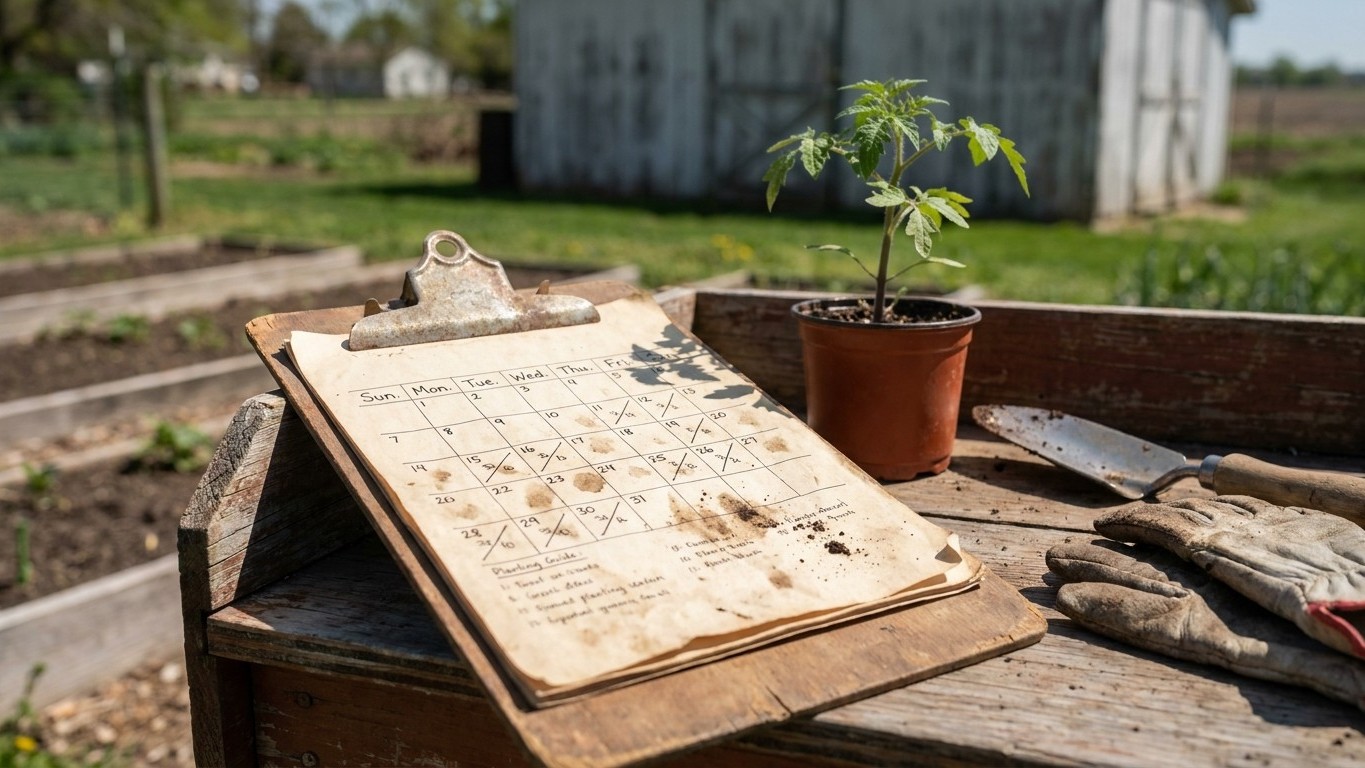

Iowa’s last spring frost at Des Moines usually falls between April 12 and April 24, but that date isn’t what tells you it’s safe to plant tomatoes — the soil temperature is. Even after the air stops freezing, cold ground will stall a transplant or rot a seed just as fast as a hard frost would. So before you sow anything warm-season, get a soil thermometer into the bed where you’re actually planting and read it, rather than counting days on a calendar.
The frost window in Iowa

At Des Moines, NOAA’s 1991-2020 Climate Normals put the last spring freeze at 32°F somewhere between April 12 and April 24, and the first fall freeze back at 32°F somewhere between October 14 and October 25. Both figures come from the 30 to 70 percent probability band, meaning a freeze on any single day inside that window is neither a rare fluke nor a near-certainty. Treat the early end of each range as the risk you take and the late end as the safer bet.
What the range means for the rest of the state
These numbers are measured at one weather station near Des Moines. Iowa State University Extension’s own county-by-county data, drawn from 1950-2021 records, runs about four days later in spring and ten days earlier in fall than that airport figure. A gardener in a colder county, or anywhere north of the metro, should plan on a shorter season than the Des Moines numbers alone would suggest, not a longer one. The airport dates are the optimistic end of the range for the state as a whole.
How long the season actually runs
Combine the two ranges and the frost-free season at Des Moines runs anywhere from about 173 days (a late spring frost on April 24 paired with an early fall frost on October 14) to about 196 days (an early spring frost on April 12 paired with a late fall frost on October 25). Most years land somewhere between those two extremes. That window is what every sowing and transplanting date in this calendar works backward or forward from.
Cool-season crops
Peas, spinach, lettuce, brassica transplants and most root crops tolerate a light frost and actually prefer to finish their early growth in cool soil, so none of them wait for the frost-free date the way tomatoes do. They go in relative to the last spring frost, not to a fixed date on the calendar.
Direct-sown crops
Peas and spinach are the two crops most gardeners get into the ground earliest, generally well ahead of the last spring frost, since both germinate in cold soil and shrug off a light freeze once they’re up. Lettuce and radishes follow a similar rule, going in as soon as the soil can be worked rather than waiting for a set date on a calendar. For a fuller month-by-month breakdown, including What to Plant in Iowa in December, including What to Plant in Iowa in January, including What to Plant in Iowa in September, including What to Plant in Iowa in October, including What to Plant in Iowa in May, including What to Plant in Iowa in March, and the rest of the season’s sowing schedule, including What to Plant in Iowa in June, including What to Plant in Iowa in August, including What to Plant in Iowa in April, including What to Plant in Iowa in November, including What to Plant in Iowa in July, see What to Plant in Iowa in February. Carrots and beets are a little more particular about soil temperature for even germination, so most gardeners hold them until the week or two right around the last frost date rather than pushing them as early as peas.
Transplanted brassicas
Broccoli, cabbage and other brassica transplants go out a bit later than direct-sown peas, generally a couple of weeks before the last frost, because a transplant already has some size on it and a hard freeze can still damage exposed leaves even on a frost-tolerant crop. Hardening off matters more here than with direct-seeded crops, since a plant raised indoors under stable light and temperature needs several days outside in a sheltered spot before it can handle the swings of an early Iowa spring.
- Peas and spinach: direct-sow ahead of the last spring frost, as soon as soil can be worked
- Lettuce and radishes: direct-sow alongside peas and spinach, succession-sow every couple of weeks
- Carrots and beets: direct-sow around the last frost date once soil has warmed slightly
- Broccoli and cabbage: set out hardened-off transplants a couple of weeks before the last frost
Warm-season crops

Tomatoes, peppers, squash, beans and corn all die at 32°F, so the last spring frost date is the outer limit for setting them out, not the target. What actually decides the safe date is soil temperature, since warm-season seeds and transplant roots stall out or rot in cold soil even when the air is technically frost-free.
Soil temperature versus the calendar date
A tomato transplant set into soil that is still in the 40s will simply sit there, and bean or corn seed sown into cold, wet soil is more likely to rot than germinate. That is why nearly every tomato variety in the table below is rated to go out late April to early May at Des Moines, a window that opens after the earliest possible last frost date and gives the soil another week or two to come up to temperature before a transplant goes in the ground. Gardeners just across the border work from a similar soil-temperature rule, though its frost dates run differently, and the Kansas planting calendar is worth checking separately if you garden near that state line.
Starting seeds indoors
Because the outdoor transplant window is late April to early May, count back five to seven weeks, the typical time a tomato seedling needs to reach transplant size, to find the indoor sowing window, which lands in mid to late March. Peppers generally need a week or two longer under lights than tomatoes to reach the same size, so their seed-starting date should sit slightly ahead of the tomato date rather than alongside it.
| Variety | Type | Days to Maturity (from transplant) | Set Out Window | First Ripe | Margin Before Fall Frost |
|---|---|---|---|---|---|
| Sakura | Indeterminate | 55 | Late April to early May | Early July | 104 days |
| Edox | Indeterminate | 55 | Late April to early May | Early July | 104 days |
| Valentine | Indeterminate | 55 | Late April to early May | Early July | 104 days |
| Glacier | Determinate | 55 | Late April to early May | Early July | 104 days |
| Sun Gold | Indeterminate | 57 | Late April to early May | Early July | 102 days |
| Supersweet 100 | Indeterminate | 60 | Late April to early May | Early July | 99 days |
| Juliet | Indeterminate | 60 | Late April to early May | Early July | 99 days |
| Amalfi | Determinate | 68 | Late April to early May | Mid July | 91 days |
| Cherokee Purple | Indeterminate | 72 | Late April to early May | Mid July | 87 days |
| Big Beef Plus | Indeterminate | 72 | Late April to early May | Mid July | 87 days |
| Tiren | Indeterminate | 75 | Late April to early May | Late July | 84 days |
| Granadero | Indeterminate | 75 | Late April to early May | Late July | 84 days |
| San Marzano II | Indeterminate | 78 | Late April to early May | Late July | 81 days |
| Celebrity Plus | Determinate | 78 | Late April to early May | Late July | 81 days |
Several of these carry named disease resistance worth choosing for if a garden has a history of trouble. Big Beef Plus and Celebrity Plus both carry high resistance to Tomato Mosaic Virus, and Sakura, Edox and Glacier all carry high resistance to the same virus plus Fusarium Wilt races 1 and 2, while Cherokee Purple and San Marzano II carry no listed resistance and depend entirely on cultural practice for disease control. The days-to-maturity figures above are counted from transplant, not from seed, and catalog numbers can shift by a week or two depending on how warm and sunny the actual season turns out to be.
The fall planting window
Fall crops work backward from the first fall frost instead of forward from the last spring one. At Des Moines, NOAA’s 1991-2020 normals put that first 32°F freeze at October 14 to October 25, so the question for any fall crop is whether it can finish, or at least reach an edible stage, before that window opens.
Counting back from first frost
Take the days-to-maturity figure printed on the seed packet and add margin, since growth slows as daylight shortens through September even when temperatures stay mild. A crop that needs 30 days on the packet in the middle of summer often needs closer to 40 to 45 days by early September. Counting back from the earliest end of the frost range, October 14, gives the safer sowing date, since a plant that is a week behind schedule going into a colder-than-average October still has a chance to finish.
Crops that improve after a light frost
A handful of crops taste better after the first light frost touches them, because cold triggers the plant to convert stored starch into sugar. Kale, spinach, carrots and Brussels sprouts are the most commonly grown examples, and gardeners in Iowa can leave all four in the ground through the first frost or two rather than rushing to harvest ahead of it.
- Kale: leaves sweeten and hold quality for weeks after a light frost
- Spinach: cold exposure improves flavor without damaging the leaf
- Carrots: roots convert starch to sugar measurably after a frost
- Brussels sprouts: sprouts firm up and sweeten after one or two frosts
Reading a planting calendar properly
A state-wide planting calendar, this one included, is only a starting point built from data measured at one weather station. Iowa’s terrain, water bodies and even its cities shift the real date around that regional figure by more than a week in either direction.
Local variables that shift the date
Elevation and low-lying ground matter more than most gardeners expect. Cold air is heavier than warm air and drains downhill overnight, so a garden at the bottom of a slope or in a river valley can see a frost on a night when a garden a quarter mile away, but slightly higher, stays clear. Large bodies of water do the opposite, holding heat into the evening and delaying the first frost nearby, which is one reason the Mississippi and Missouri river corridors often run a few days behind inland spots elsewhere in the state. Urban heat from pavement and buildings pushes the frost date later still, so a downtown garden bed can safely go in before a rural bed a short drive away.
A late cold snap can undo all of this in a single night, arriving well after the statistical last frost date and killing transplants that were following the calendar correctly. The only real defense is watching the ten-day forecast in the two weeks after your planned transplant date and keeping row cover or an old sheet on hand. A grower used to reading the Quebec planting calendar, where the frost-free season is far shorter and more compressed, will recognize the same principle at a smaller scale: the map gives a starting figure, and the garden itself gives the final answer.
Local help
Iowa State University Extension is the best source for county-level frost dates and soil testing, since its recommendations are built on decades of local weather station data rather than the single Des Moines figure used throughout this page. Reach the Iowa State University Extension service directly to find your county office, request a soil test, and get a frost date specific to your part of the state. For other tasks and troubleshooting around the state, the Iowa guides hub collects planting, pest and soil advice by topic.
Common questions
What happens if I plant tomatoes before the last frost date passes?
A frost at 32°F kills tomato, pepper and squash foliage outright, and a hard freeze kills the whole plant. If a late cold snap catches transplants already in the ground, cover them overnight with row cover, a bucket or an old sheet reaching all the way to the soil, and pull the cover the next morning once temperatures rise.
Is the des moines frost date the same for the whole state?
No. Iowa State University Extension’s county data runs about four days later in spring and ten days earlier in fall than the Des Moines airport figures used on this page, and northern and higher-elevation counties should expect a shorter season than the Des Moines numbers suggest.
Can I trust the first-ripe dates listed for tomato varieties?
Treat them as an estimate built from the catalog’s days-to-maturity figure and the local set-out window, not a guarantee. A cool, cloudy stretch after transplanting can push the first ripe fruit back by a week or two compared to the number on the packet.
Do I need to cover plants if there’s a frost warning after I already planted?
Yes, for anything warm-season. Peas, spinach, lettuce and brassicas need no protection from an ordinary light frost, but tomatoes, peppers, squash, beans and corn should all be covered or, if potted, brought inside for the night.
How do I find my exact county’s frost date instead of the Des Moines one?
Contact your local Iowa State University Extension office through the main extension site, since county offices hold the 1950-2021 local data referenced throughout this page rather than the single-station NOAA figures used here as a statewide baseline.
Related guides
- Minnesota Planting Calendar: When to Sow and Plant, Frost Dates Included
- Wisconsin Planting Calendar: When to Sow and Plant, Frost Dates Included
- Kansas Planting Calendar: When to Sow and Plant, Frost Dates Included