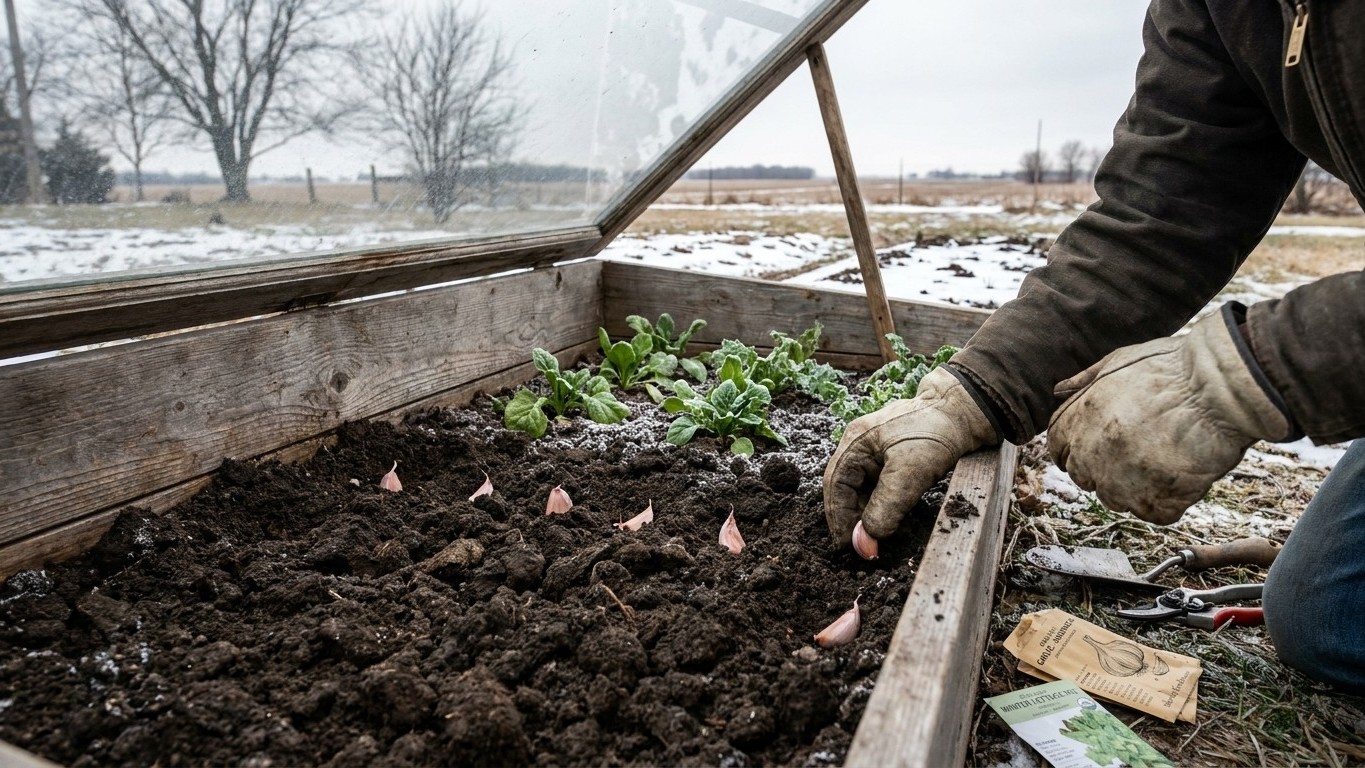

February in Kansas sits well before the state’s last spring frost window of April 4 to April 18, so open-ground planting is mostly off the table. Garlic and shallots can still go in where the soil is workable, cold frames stretch the season for hardy greens, and the real work this month happens indoors: starting seedlings under lights, ordering seed, and getting dormant pruning done before buds break.
What goes in the ground in February

Soil temperature, not the calendar, decides what survives outdoors. Across most of Kansas, February ground is still frozen solid or hovering just above freezing, and with the last spring frost falling between April 4 and April 18 depending on where you are, the state is still five to ten weeks out from that threshold. That is the honest starting point: for the great majority of vegetables, nothing goes into open ground this month.
There are exceptions, and they matter. Garlic and shallot cloves can still be tucked into the soil on any day it is workable, meaning not frozen, not waterlogged, and not covered in snow. These crops root slowly through cold soil and push up green shoots once temperatures climb, so a late-winter planting window still gets them established before summer bulking. If the ground is frozen solid through most of February in your area, this becomes a job for the first thaw rather than a fixed date.
Cold frames and low tunnels change the equation entirely. Inside one of these structures, soil temperature runs several degrees warmer than the open garden, and that gap is often the difference between dead seedlings and a functioning mini-harvest. Spinach, mache, and hardy lettuce varieties can be direct-sown under cover this month in much of the state, particularly in southern counties where the zone runs closer to 7a. Further north and at higher ground, where conditions sit closer to zone 5b, treat cold-frame sowing as an experiment rather than a guarantee.
Bare-root fruit trees, roses, and cane fruits (raspberries, blackberries) can go into prepared holes if the ground is not frozen and drains well. Dormant plantings like these do not need warm soil to establish roots, only workable soil. Indoors, this is also the window for forcing rhubarb crowns or chicory roots in a dark, cool space, giving you a harvest of tender stalks or blanched chicons weeks before anything comes out of the garden.
What to start under cover
Seed-starting math runs backward from the last frost window, not forward from a fixed date. With frost clearing between April 4 and April 18 across the reference station, count back from whichever end of that range fits your county.
Onions and leeks started from seed need roughly 10 to 12 weeks indoors before transplanting, which puts the sowing date somewhere in mid-to-late January through early February for most of the state. Peppers run 8 to 10 weeks, landing squarely in the February window. Tomatoes need only 6 to 8 weeks, so an early-February start risks leggy, rootbound plants sitting on a windowsill for too long before the soil warms enough to move them outside. Broccoli and cabbage, at 6 to 8 weeks, fall into the same mid-to-late February slot as tomatoes for most counties.
The two ways this goes wrong are mirror images of each other. Start too early and you end up with stretched, pale stems and roots circling the bottom of a cell tray, weeks before the ground is anywhere near ready. Start too late and the plant never reaches transplant size before the frost-free window opens, costing you real weeks of the growing season. A grow light and a way to track your own county’s frost data, rather than a generic date pulled from a seed packet, is the difference between the two outcomes.
What is ready to pick
Outdoors, February offers little in most of Kansas, and it is worth saying that plainly rather than padding the answer. But “little” is not “nothing.”
Kale and leeks that overwintered in the garden, particularly under a layer of snow acting as natural insulation, often survive and can be harvested as soon as the ground around them thaws enough to dig. Snow cover buffers roots and crowns from the harshest air temperatures, so a kale plant that looks collapsed after a hard freeze can bounce back within days of a thaw.
Cold frames carry more weight this month. Spinach, mache, and hardy lettuce sown in the fall or in a protected frame can still be cut a few leaves at a time, and this cut-and-come-again approach keeps the plant producing rather than harvesting it out in one pass.
Indoors, sprouts and microgreens fill the gap on a much faster clock, ready in as little as a week from seed on a countertop. Stored crops need attention too: check squash for soft spots near the stem end, potatoes for green skin or sprouting eyes, and onions for softness at the neck. Pull anything showing early rot before it spreads to the rest of the bin, and use those first rather than letting them sit.
The jobs that matter this month
Dormant pruning is the single biggest task on the calendar right now. Apple and pear trees, along with grapevines and cane fruits like raspberries and blackberries, should be pruned while they are still fully dormant and before buds swell. Cutting now, rather than after growth starts, reduces stress on the plant and makes it far easier to see the branch structure without leaves in the way.
Seed ordering has a real deadline too, even though it feels less urgent than pruning. Popular varieties, especially heirloom tomatoes and specialty peppers, sell out from seed companies well before spring, and waiting until March often means settling for whatever is left rather than what you actually planned to grow.
Soil, planning, and equipment
This is also the window to test soil, since results take time to come back and amendments like lime or sulfur need weeks to change pH before spring planting. The Kansas State University Research and Extension office runs soil testing services county by county, and a sample sent now gives you results in time to act before the ground warms. Turning compost piles, even in cold weather, keeps decomposition moving and gives you finished compost sooner rather than later.
Tool maintenance rounds out the list: sharpening pruners and hoes, oiling wooden handles, and repairing raised beds or fencing while the garden is empty and easy to work around. None of this is filler. A dull pruner tears bark instead of cutting clean, and a fence repaired now saves a scramble later when seedlings are already in the ground and rabbits are hungry.
What not to do in February
A run of 60-degree days in late February convinces a lot of gardeners that spring has arrived. It has not. Air temperature swings fast; soil temperature moves slowly, and planting warm-season crops like tomatoes or peppers outdoors because the afternoon felt warm is one of the most common mistakes made in this window. Soil several inches down is often still near freezing even when the air feels mild, and cold soil rots seeds before they germinate.
The same mild-spell trap catches gardeners who pull back mulch or row cover too early. A warm stretch in February is frequently followed by another hard freeze, since the state’s true frost-free window does not open until April 4 at the earliest. Removing protection now, then getting caught by a return to freezing temperatures, can undo weeks of insulation that were protecting roots and crowns.
Nitrogen fertilizer applied to dormant perennials, fruit trees, or lawns at this point pushes soft new growth that a late freeze will kill outright. Wait until you see real green-up before feeding; a dormant plant does not need nitrogen it cannot yet use.
Working garden soil while it is still wet or half-frozen compacts it, squeezing out the air pockets roots need later. If a shovel comes up muddy and sticks together in a clump rather than crumbling, the bed is not ready to be turned yet, no matter how tempting it feels to get a head start.
Checking this against your own county
A state-wide frost window is a starting point, not an instruction. Kansas spans a wide range of hardiness zones, from 5b to 7a on the USDA Plant Hardiness Zone Map, and the difference between the high plains of the west and the lower elevations of the east can shift a last-frost date by weeks in either direction. Elevation, local wind patterns, and how close you are to a river valley all move the numbers further still.
The Kansas State University Research and Extension service, at ksre.k-state.edu, publishes county-specific guidance and a state planting calendar that accounts for these local differences far better than any single statewide date can.
Common questions
Can I plant grass seed in Kansas in February?
No. Cool-season grass seed needs soil temperatures the state typically does not reach until several weeks after the last frost window closes in April. Seeding this month risks the seed sitting dormant or washing away before it can germinate.
When should I start tomato seeds indoors in Kansas?
Counting back 6 to 8 weeks from the last frost window of April 4 to April 18 puts most tomato starts in mid-to-late February, depending on your county’s typical frost date.
Is it too early to prune fruit trees in February in Kansas?
No, this is close to the ideal window. Apple, pear, and cane fruits should be pruned while fully dormant and before buds swell, which for most of the state means late winter through this month.
What vegetables can survive frost in a Kansas garden?
Overwintered kale and leeks, along with cold-frame spinach, mache, and hardy lettuce varieties, can tolerate freezing temperatures and snow cover far better than warm-season crops, and often resume growth as soon as the ground thaws.