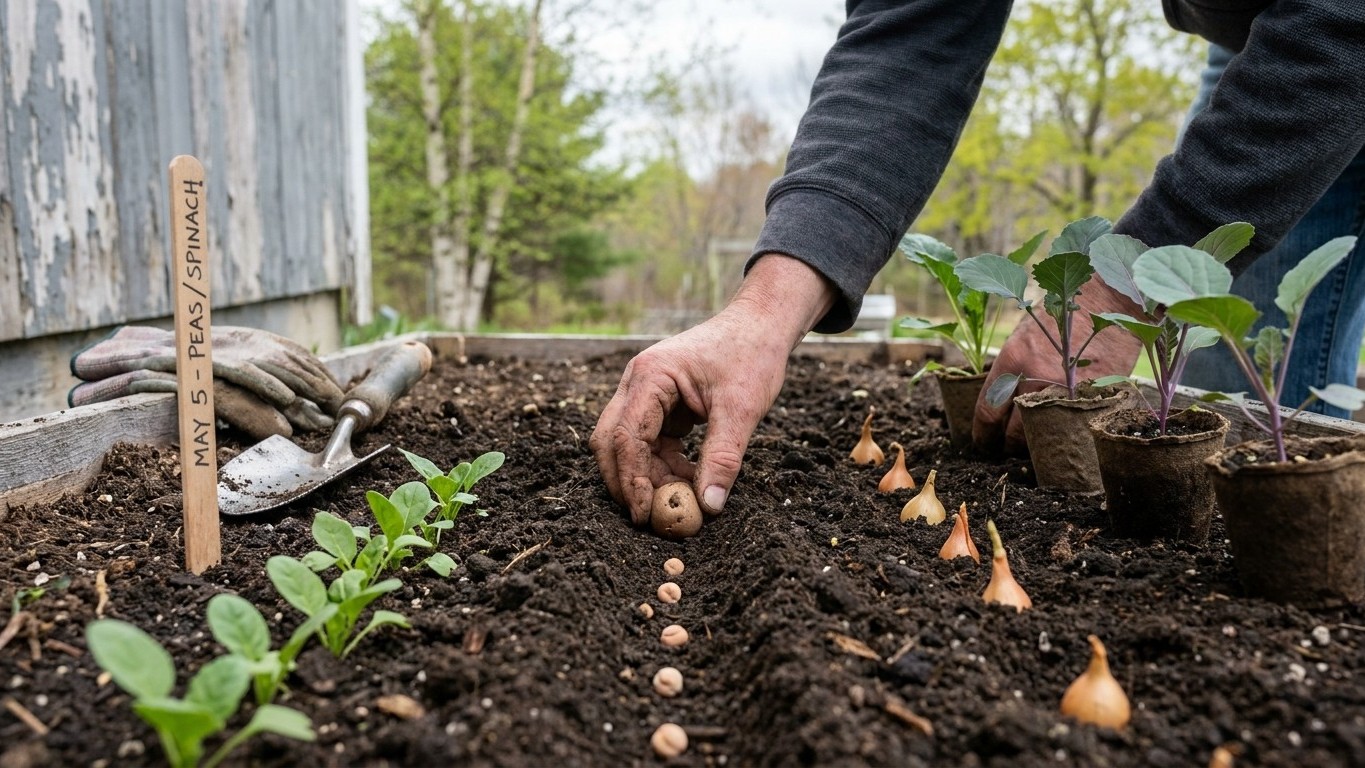

May is the month Maine gardeners actually get to use the soil, but the safe planting list changes by the week and by the county. Coastal areas near Portland can direct-sow peas, greens, and root vegetables early in the month and move to tender transplants once the frost window closes. Inland and northern growers should treat the whole month as transition, holding warm-season crops back and leaning on cold-hardy varieties instead.
What goes in the ground in May

The calendar says May, but the soil and the sky decide what actually survives. In Portland, NOAA’s 1991-2020 climate normals put the last spring freeze somewhere between April 22 and May 1, which means the first third of May is still inside or just past that risk window depending on where a garden sits relative to the coast. That single fact reshuffles everything on the planting list.
Hardy crops don’t care much about that lingering frost risk. Peas go in as soon as the soil can be worked, even if a light frost is still possible, because they germinate in cold ground and shrug off a cool night. Spinach, lettuce, and other leafy greens handle the same conditions, and so do onion sets, seed potatoes, carrots, beets, and radishes sown direct. Brassica transplants, cabbage, broccoli, kale, started indoors earlier, can go out hardened off, since a few degrees below freezing won’t finish them off the way it would a tomato seedling.
Alliums are worth calling out specifically. Garlic planted the previous fall is already up and growing by May, and shallot sets or onion sets go in early in the month without much drama.
Warm-season crops are the gamble. Tomatoes, peppers, squash, beans, cucumbers, and corn need both warm soil and a guarantee that the frost window has closed, and that guarantee looks different in Bar Harbor than it does forty miles inland or in the northern part of the state, where the USDA Plant Hardiness Zone Map places conditions closer to zone 3b, a much colder profile than the coastal zones near 6a. Pushing those crops into the ground in early May, or even mid-May inland, risks a setback that costs more time than waiting would have. The safer move is treating late May as the earliest realistic date for tender transplants along the coast, and pushing that further into the first weeks of June anywhere colder.
What to start under cover
Seed starting in May is really about arithmetic worked backward from that same frost window. Tomatoes and peppers typically need six to eight weeks indoors before they’re ready for the garden, which means anyone aiming to set them out once the coastal frost risk clears would have needed to start seed back in mid-March. If that didn’t happen, the practical fix is buying started transplants from a local greenhouse rather than trying to compress the timeline, or choosing a fast-maturing variety that can still catch up.
Cucumbers, squash, and melons run on a shorter clock, usually three to four weeks from seed to transplant size, so early May is still a reasonable window to start them indoors or under a cold frame for a late-May or early-June move outside. Fast brassicas and lettuce can be started in succession right through the month for planting out a few weeks later, which keeps a steady supply coming rather than one big harvest all at once.
The two ways this goes wrong both show up in May. Starting too early leaves seedlings rootbound and leggy on a windowsill, stretching for light and struggling once transplanted, since nothing about indoor conditions matches the garden. Starting too late means the plant never reaches a productive size before the shortening days of fall cut the season off, which matters more in a state where the first fall frost arrives as early as October 9 in parts of the Portland reporting area. Counting backward from both frost dates, spring and fall, rather than from a fixed date on the wall, is the only way to get the timing right in a climate this variable.
What is ready to pick
May is a lean month in the Maine garden, and it’s honest to say so before listing what actually feeds a household. Fresh outdoor harvests are limited mostly to asparagus, which starts pushing spears once soil temperatures climb, and rhubarb, which is often ready to cut by mid-month. Overwintered kale, collards, and leeks that made it through the cold months under mulch or row cover are usually still edible and often sweeter after exposure to cold.
Cold frames and low tunnels started in late winter or early spring are the other reliable source, producing lettuce, spinach, and other quick greens weeks ahead of what the open garden can offer. Indoors, sprouts and microgreens fill the gap for households that want fresh greens on a shorter cycle than anything grown outside can deliver in May.
Stored crops need checking this month more than any other, since they’re at the end of their storage life. Potatoes held in a root cellar should be checked for sprouting and soft spots, winter squash for any give in the skin or a musty smell that signals rot starting from the inside, and stored onions for softening necks. Anything showing early signs should get used first rather than left to spread problems to the rest of the batch.
The jobs that matter this month
Soil preparation is the job that sets up everything else, and May is the window for it before planting crowds the schedule. Working compost or aged manure into beds, testing pH, and breaking up compacted soil all pay off directly in how well May’s plantings establish. Skipping this step doesn’t show up immediately, but it shows up by midsummer in stunted growth that’s hard to fix later.
Hardening off and staking
Any transplant started indoors needs a hardening-off period, gradually increasing outdoor exposure over a week to ten days before it goes into the ground permanently. Skipping this step is one of the most common ways a healthy seedling dies within days of transplanting, scorched by direct sun and wind it was never exposed to indoors. Staking and support structures for peas, and eventually for tomatoes and vining crops, are far easier to install now than after the plant has sprawled and tangled, so setting them at planting time saves a frustrating rescue job in July.
Mulching, watering, and pest scouting
Mulch applied once soil has warmed holds moisture and suppresses the first flush of weeds, both of which matter more in May than later, since young roots are shallow and can’t compete for water. Watering rhythm matters too: deep, less frequent watering builds stronger root systems than a light daily sprinkle. Pest scouting should start now rather than after damage appears, since flea beetles on brassicas and slugs on tender greens are both easier to manage early, before populations build. Succession sowing of quick crops like lettuce and radishes every couple of weeks keeps harvests coming rather than arriving all at once.
What not to do in May
The classic mistake is reading a warm afternoon as a signal that it’s safe to plant tomatoes or peppers, when what actually matters is soil temperature and the frost window, not how the air feels. Warm-season transplants set into cold soil often just sit there, stalled, and are more vulnerable to disease than if they’d waited another week or two for the ground to catch up. Waiting for a stretch of warm nights, not just warm days, is the more reliable signal.
Uncovering row covers or cold frames too early after a mild stretch is another common misstep. A few warm days in early May don’t rule out a return to frost, especially given how wide the freeze window runs across the state, and plants that were protected suddenly exposed can lose weeks of progress in a single cold night.
Nitrogen timing trips people up too. Heavy nitrogen feeding early in the season pushes leafy growth at the expense of root and flower development, which matters especially for anything that will need to fruit later, like tomatoes or squash. A better approach is a balanced feed at planting, saving heavier nitrogen applications for leafy greens and brassicas specifically, and holding off on fruiting crops until they’re established and flowering.
Checking this against your own county
A state-wide planting month is a starting point, not an instruction. Maine’s elevation changes, its proximity to the coast, and the difference between the southern counties and the northern reaches of the state can shift these windows by weeks in either direction. A garden in Aroostook County is working with a very different frost calendar than one near Portland, even though both are technically in the same state.
The most reliable next step is checking that timing against local data rather than a general guide. The University of Maine Cooperative Extension publishes county-specific planting guidance that accounts for these local differences directly.
Common questions
Is it safe to plant tomatoes outdoors in Maine in May?
Along the coast near Portland, late May is generally past the last frost window of April 22 to May 1, but inland and northern areas run later, so waiting until early June is the safer call outside the mildest coastal spots.
What vegetables can be direct-sown earliest in May?
Peas, spinach, lettuce, carrots, beets, and radishes tolerate cold soil and light frost, making them the safest direct-sown crops at the start of the month.
Why does Maine have such a wide hardiness zone range?
The USDA Plant Hardiness Zone Map places the state between 3b and 6a because it measures average annual extreme minimum temperature, and that figure varies sharply between the coast and the interior or northern regions.
What should be done with stored crops still in the cellar in May?
Potatoes, squash, and onions held over winter should be checked for sprouting, soft spots, or a musty smell, and anything showing early decline should be used first before it spreads to the rest of the stored batch.