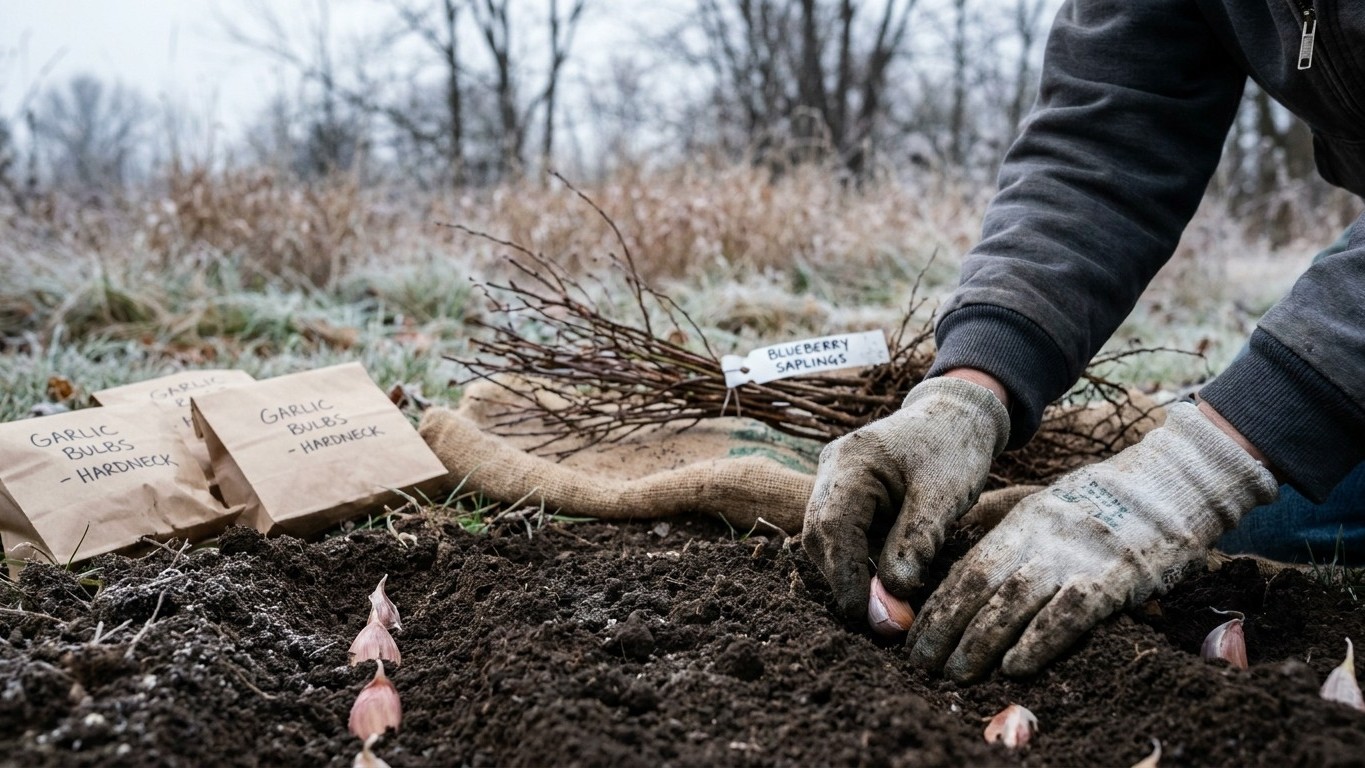

By November, the growing season in Michigan is essentially closed for anything tender. The fall frost has already swept through the state, so the honest answer is that the open garden is done for direct-sowed vegetables. What’s left is garlic, dormant plantings, cold-frame greens, and a long list of dormant-season jobs that decide how well next spring starts.
What goes in the ground in November

The frost window is what actually decides this month, not the calendar page. MSU Extension puts the first fall frost between October 6 and October 21 for zone 6a, and colder zones in the northern Lower Peninsula and the Upper Peninsula see it earlier. That means by the time November opens, every part of Michigan has already had at least one hard frost. Tomatoes, peppers, beans, squash, anything tender is finished. There’s no gamble to weigh here because the decision has already been made by the weather.
What still goes into open soil is narrow but real. Garlic and shallots are the main event: pushed into the ground while the soil is still workable, before it locks up hard, they’ll sit dormant through winter and push up in spring ahead of almost everything else in the bed. Spring-flowering bulbs (tulips, daffodils, crocus) belong in the ground now too, planted deep enough to sit below the frost line.
Bare-root and dormant plantings of fruit trees, brambles, and shrubs can still go in as long as the ground hasn’t frozen solid, though nurseries in Michigan sell most of this stock earlier in fall, so availability narrows fast. Cold frames and low tunnels are where the action is if you want anything green: spinach, mâche, and claytonia sown under cover in early fall are usually still cropping through a cold frame’s protection well into this month.
Indoors, this is the month to force chicory roots for winter salad (Belgian endive doesn’t happen outdoors) and to bring in rhubarb crowns for forcing in a dark, cool spot. Neither needs open ground, and both give you something to harvest while the beds outside sit bare.
What to start under cover
Counting backward from spring planting dates, November sits too far out for most seed-starting math to matter yet. Onions and leeks, the earliest indoor starts of the year, are typically begun 10 to 12 weeks before the last spring frost, which lands around April 30 in the Detroit area and early to mid May across most of the Lower Peninsula. Worked backward, that puts onion-starting in mid-to-late winter, not now. Starting them this early would leave you with rootbound, leggy transplants long before the ground is ready to take them.
What does make sense under cover this month is smaller-scale and faster-turning: microgreens and sprouts on a windowsill or under a grow light, which go from seed to harvest in one to three weeks and don’t care what the calendar says outside. A steady succession of these keeps something fresh coming out of the kitchen counter through the darkest stretch of the year.
Forcing bulbs for indoor bloom is the other project that belongs here. Paperwhites can be potted and forced with no chilling at all, usually flowering in three to five weeks. Amaryllis follows a similar timeline. Hardy bulbs meant to bloom indoors in deep winter (hyacinths, tulips forced in pots) need a cold period first, typically 12 to 16 weeks in a dark, cold space before they’re brought into warmth and light, so potting them up now is close to the last reasonable window if you want blooms before the season turns.
The failure mode to watch for isn’t starting too early this month; it’s starting too late. Miss the window on chilled bulbs and they simply won’t be ready when you want color indoors.
What is ready to pick
Outdoors, harvest is mostly finished. What’s left standing is the cold-hardy stuff that was planted specifically to outlast frost: kale, collards, and Brussels sprouts often get sweeter after a freeze, since the cold converts starches to sugars. Leeks left in the ground can be dug as needed, sometimes right through a light snow cover, as long as the ground hasn’t frozen too hard to work a fork into it.
A cold frame or low tunnel sown in early fall with spinach or mâche should still be giving small, steady pickings. It won’t be a big harvest, but it’s fresh greens in a month when almost nothing else is.
Indoors, microgreens and sprouts are the most reliable food coming out of the house this month, ready in as little as a week from a windowsill tray.
The other job here is inspection, not harvest. Stored squash, potatoes, and onions from earlier in the season need a walkthrough: squash with soft spots or a sour smell should be used immediately, not left to spread rot to the rest of the batch. Potatoes that have gone green or started sprouting should be pulled out and used or discarded. Onions that feel soft at the neck are on their way out and won’t hold much longer. Catching these early saves the rest of the stash.
The jobs that matter this month
This is a working month even though almost nothing is being planted or picked, and skipping these tasks costs real ground come spring.
In the garden
Clean up plant debris from finished beds, especially anything that hosted disease or pests over the summer; leaving it in place over winter just gives problems a place to overwinter too. Once the ground has started to freeze, a layer of mulch over perennial beds and around the base of young trees helps stabilize soil temperature and protects roots, but timing matters here (more on that below). Tender bulbs that can’t survive a Michigan winter in the ground, like dahlias and gladiolus, need to be dug up, dried, and stored before a hard freeze hits them.
Drain and disconnect garden hoses and irrigation lines before a deep freeze cracks the fittings. Wrap the trunks of young fruit trees to protect against rabbits and rodents that gnaw bark over winter when other food is scarce.
In the shed and on paper
Clean and sharpen tools before they sit unused for months; a little oil on metal parts now prevents rust that shows up as a surprise in spring. Test soil pH and nutrient levels while beds are empty, since amendments like lime take months to fully adjust soil chemistry and working them in now gives them a head start. Turn the compost pile one more time before cold slows the whole process down.
Order seed catalogs and place early orders for the coming season. Popular varieties, especially heirloom and disease-resistant types, sell out well before spring. Sketch out next year’s crop rotation while the current season’s layout is still fresh in memory; waiting until spring means trying to remember what grew where.
What not to do in November
The biggest mistake this month is misreading a stretch of mild weather as a green light. A few warm days don’t undo the frost that’s already come through, and any tender plant put in the ground now, or left uncovered after being protected, is gambling against odds that are already settled for the season.
Mulching too early is a quieter version of the same mistake. Piling mulch on beds before the ground has actually begun to freeze traps warmth near the soil surface, which can encourage rodents to nest there and, in some cases, delay the dormancy that perennials need. Wait until after a real freeze sets in, not just a cold snap.
Feeding nitrogen at this point works against the plant, not for it. Nitrogen pushes new, soft growth, and any new growth this late won’t have time to harden off before real cold arrives, leaving it vulnerable to dieback. If woody plants need feeding at all this time of year, it should be a balanced or low-nitrogen formula, not a growth booster.
Leaving tender bulbs like dahlias and gladiolus in the ground past a hard freeze is a common regret. Once the foliage blackens from cold, the clock is running; dig them within a reasonable window or lose the bulbs to rot. And leaving hoses, rain barrels, or irrigation lines full of water once temperatures drop below freezing invites cracked fittings and burst lines that show up as a bigger repair bill in spring.
Checking this against your own county
A statewide picture of November is a starting point, not a fixed instruction. Michigan spans USDA Hardiness Zones 4a through 6b, and that range alone tells you the Upper Peninsula and the northern Lower Peninsula are working with a very different frost and freeze timeline than the southeast corner near Detroit. Elevation and the moderating effect of the Great Lakes shift local conditions further still, sometimes by several weeks in either direction from a statewide average.
For dates and guidance tuned to a specific county, MSU Extension’s outreach programs are the reliable next stop, along with the university’s own Michigan Garden Calendar.
Common questions
Can I still plant garlic in Michigan in November?
Yes, as long as the soil is still workable and hasn’t frozen solid. Garlic planted in fall needs a cold period to develop properly, and it will sit dormant through winter before growing in spring.
Is it too late to plant grass seed or start a lawn this month?
By November, soil temperatures across Michigan are too cold for grass seed to germinate reliably. That work belongs in early fall, well ahead of the first frost window.
Should I cover my cold frame every night now?
Cold frames need venting on milder days to prevent overheating and fungal issues, even in late fall. Cover fully only when a hard freeze is expected, and check moisture levels regularly since covered soil dries out more slowly than open beds.
What’s the single most useful job to do this month if I only have a weekend?
Digging and storing tender bulbs, then mulching perennial beds once the ground has actually begun to freeze, protects the most value for the least effort. Both tasks prevent losses that are expensive or impossible to fix once winter fully sets in.
Gardeners who plant by the Moon can check the November 2026 moon planting calendar, a tradition rather than a proven method.
Related guides
Elsewhere? See what to plant in November in every state and province.