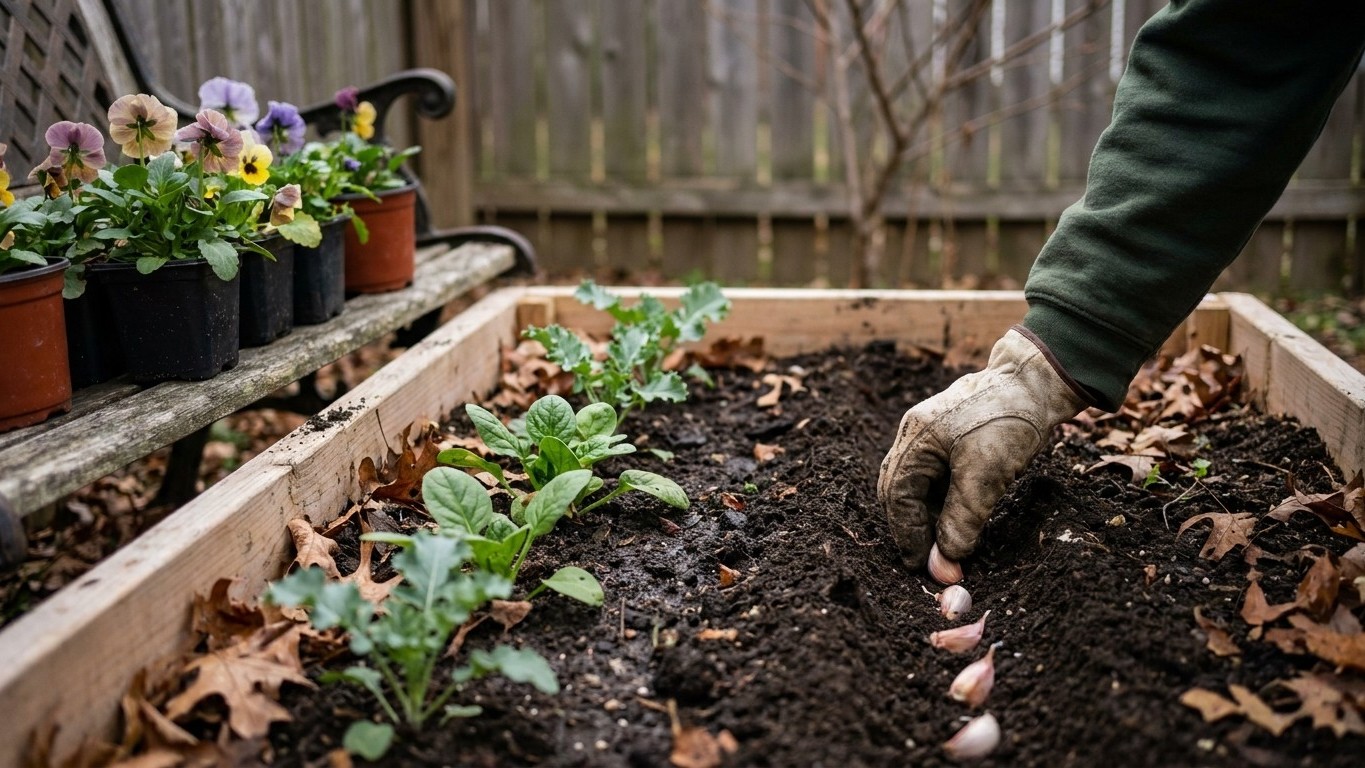

Garlic and shallots go in the ground this month, spring bulbs follow right behind them, and that is close to the whole list. New Brunswick’s average first fall frost lands on October 2 (Moncton climate normals), which means most of the month sits on the cold side of that line. The safe work now is planting what overwinters, protecting what is still producing, and closing the garden down properly rather than starting anything new and tender.
What goes in the ground in October

The calendar says October, but the soil does not read a calendar. What decides whether a seed or a clove survives is soil temperature and how close the ground is to freezing solid, and in New Brunswick that clock is already running by the time this month opens. The October 2 average first frost from the Moncton station is a midpoint, not a guarantee. Half the years on record, frost arrives later than that date, sometimes well into the month. But it works both ways: half the years it comes on time or earlier. Treat the date as a warning line you are already standing near, not a safe deadline still ahead of you.
Garlic and shallots are the exception that makes this month worth gardening in at all. Both go into prepared beds in fall specifically because they need weeks of cold soil before they sprout roots, and a Canadian hardiness zone of 5a (for the reference city used in these figures) supports both crops reliably when they are mulched. Spring-flowering bulbs (tulips, daffodils, crocus) follow the same logic: plant them while the ground is still workable, and they use the cooling soil to root before winter locks everything down.
Quick, cold-hardy greens (spinach, arugula, mesclun mixes) can still go in during the first week or so of the month if the ground has not yet frozen, but only under row cover or in a cold frame, and only as a bet that this particular year runs later than average. Anything tender is already off the table.
| Crop or plant | October status |
|---|---|
| Garlic and shallots | Plant now, mulch heavily |
| Spring bulbs (tulips, daffodils) | Plant while soil is workable |
| Quick greens under cover | Possible only in early October, no guarantee |
| Beans, squash, tomatoes, other tender crops | Do not plant; already past the frost line most years |
What to start under cover
There is not much arithmetic left to do this month, and that is the honest answer. Counting backward from an average first frost of October 2, anything meant to be transplanted outdoors after starting indoors needed to be sown weeks earlier, in September at the latest. By the time October opens, that math has already run out.
What still makes sense indoors is work that never crosses the frost line at all. Sowing microgreens on a windowsill takes seven to fourteen days regardless of what the weather is doing outside, and a fresh tray every week or two keeps the kitchen supplied through the darkest stretch of fall. Forcing bulbs (paperwhites, amaryllis) for indoor bloom is the other real option this month: pot them now in a cool, dark spot, and they need roughly the same lead time whether the garden outside is frozen or not.
The two failure modes worth naming still apply, even on this reduced list. Starting greens or transplants too early under cover in a heated house produces the same leggy, rootbound seedlings gardeners fight every spring, since the light indoors rarely matches the growth rate of the roots. Starting too late is less about missing a planting window now and more about missing the harvest window before the days get too short and too dark for anything to grow much at all, even under grow lights. Microgreens sidestep both problems, which is why they carry this section.
What is ready to pick
Main-season crops come off the garden in earnest this month, and timing the harvest to just ahead of hard frost matters more than any single date on a chart. Potatoes, winter squash, carrots, beets, cabbage, and Brussels sprouts should all be out of the ground or off the plant before a hard freeze settles in, though carrots and Brussels sprouts actually sweeten with a light touch of frost and can be left a little longer on purpose.
Kale and leeks are the two crops worth leaving in place through the season’s early cold snaps. Both improve in flavor once frost has hit them, converting starches to sugars, and leeks in particular can often stay in the ground under mulch well past this point.
Apples and late-season tree fruit are also coming ripe in New Brunswick orchards and home gardens this month, and the usual test still applies: fruit that separates from the branch with a gentle twist and upward lift is ready, fruit that resists is not.
Once storage crops (squash, potatoes, onions) are in, check them every couple of weeks rather than assuming they will hold. A soft spot, a sweet smell, or a shriveling neck on an onion means that item gets used first, before it takes down the ones stored next to it.
The jobs that matter this month
This is the month where the season’s work either gets finished properly or gets left half-done under snow, and there is no shortage of tasks that carry real deadlines rather than serving as filler.
Closing down the beds
Cutting back spent perennials, clearing diseased plant material rather than composting it, and laying a heavy mulch over the garlic and shallot beds all belong here. Mulch does double duty: it insulates the soil against the freeze-thaw cycles that heave young roots out of the ground, and it suppresses the first flush of spring weeds before they even start.
Planning ahead while the details are fresh
Testing soil now, while beds are still accessible and before the ground locks up, gives amendments time to work into the soil over winter instead of sitting on frozen dirt come spring. This is also the window to order seed for next season before the most popular varieties sell out, since seed companies routinely run through their best-selling stock well before spring planting begins. Sketching next year’s crop rotation while this year’s layout is still visible in the garden beats trying to remember it from memory in April.
Equipment and structures
Draining and storing hoses before a hard freeze cracks them, cleaning and sharpening tools before they sit unused all winter, and repairing fencing or raised bed frames while the ground is still soft enough to work are all cheaper and easier now than they will be once everything is frozen solid.
What not to do in October
The classic mistake this month is trusting a warm afternoon over the calendar’s warning. A mild stretch in early October can feel like an invitation to tuck in one more round of tender crops, but soil temperature lags well behind air temperature, and a single overnight dip below freezing erases weeks of that gamble in one night. If the crop is tender, the safe move is to skip planting it, not to bet on the weather holding.
Tender bulbs (dahlias, gladiolus) left in the ground past the first hard frost are the other recurring error. Once frost blackens the foliage, those bulbs need to come up, dry out of direct sun for a few days, and go into storage; leaving them in the ground on the assumption that “it’s just one frost” usually means losing them to rot once the ground freezes solid around them.
Feeding nitrogen at this point in the season is a mistake that shows up weeks later. Nitrogen pushes soft new growth exactly when the plant should be hardening off for winter, and that tender growth is the first thing frost kills. If a plant needs feeding at all this late, a low-nitrogen or no-nitrogen amendment does less harm.
Uncovering row covers or cold frames on a mild day and forgetting to close them back up before the temperature drops overnight undoes the entire point of having them. Check the forecast before opening anything up, not just before closing it.
Checking this against your own county
A single province-wide date is a starting point, not an instruction for a specific backyard. Elevation, distance from the Bay of Fundy, and the general difference between New Brunswick’s milder south and its colder interior and north can shift a frost window by weeks in either direction from the Moncton-based figures used here. A garden near the coast may see frost arrive noticeably later than one further inland at higher elevation, even within the same province.
For a planting calendar built around a specific county or district, the federal Agriculture and Agri-Food Canada site is the place to start checking local conditions.
Common questions
Is it too late to plant garlic in October in New Brunswick?
No. Garlic is one of the few crops timed specifically for fall planting, and going in during October, ahead of the ground freezing solid, gives the cloves the weeks of cold soil they need to root before winter.
Can I still start vegetables from seed indoors this month?
Not for anything meant to transplant into the garden this season. The realistic window for that closed weeks earlier. Microgreens and forced bulbs are the two indoor options that still make sense in October.
What happens if frost comes earlier than the average date?
The October 2 figure is a midpoint from the Moncton station, so frost arriving earlier is well within normal variation. Any tender crops still in the ground should be harvested or covered as soon as a frost warning appears, rather than waiting to see if the average date holds.
Should I mulch garlic right after planting or wait?
Mulch right after planting, once the cloves are in and watered. The mulch layer protects against the freeze-thaw cycles that can heave newly planted cloves partway out of the soil before they have rooted properly.
Gardeners who plant by the Moon can check the October 2026 moon planting calendar, a tradition rather than a proven method.
Related guides
Elsewhere? See what to plant in October in every state and province.