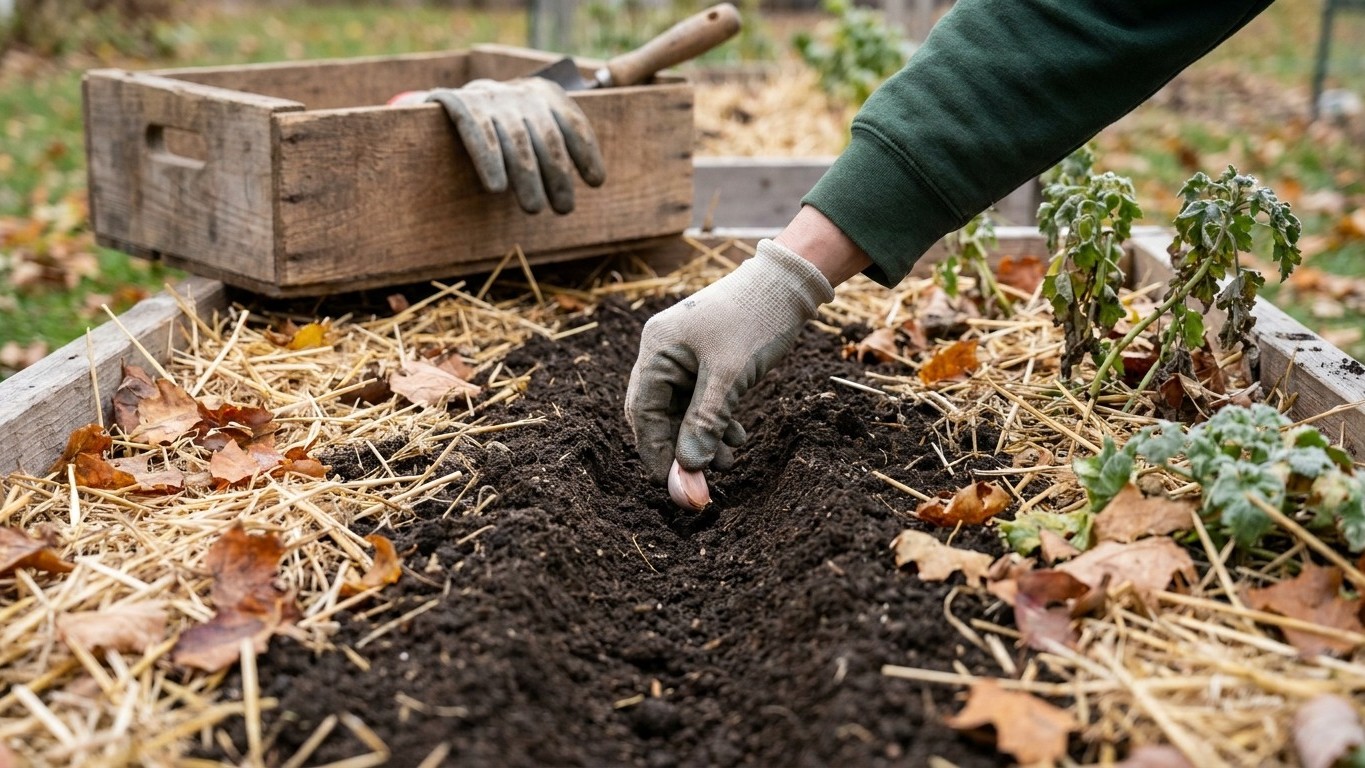

Garlic and shallots go into New Mexico soil in November wherever the ground still works, cold frames carry hardy greens through the cold, and bare-root fruit trees and canes go in dormant. Everything else outdoors is finished for the season across most of the state, because the first fall freeze has typically already passed by early November.
What goes in the ground in November

The number that matters this month isn’t the calendar, it’s the freeze window. At the Albuquerque-area reference station, the first fall frost lands somewhere between October 29 and November 9, based on NOAA’s 1991-2020 climate normals. By the time November opens, a large share of the state has already crossed that line. That single fact reshapes the whole planting list: this is not a month for direct-sowing anything tender, and it’s barely a month for direct-sowing anything at all in the colder counties.
What still goes in is narrow but real. Garlic and shallots are the anchor crop for the month almost everywhere the soil hasn’t frozen solid, planted as individual cloves or bulbs 2 inches deep, pointed end up, then mulched heavily before hard cold sets in. In the lower elevations of the south, around the Mesilla Valley and the Rio Grande corridor, soil often stays workable well into the month, giving gardeners a longer runway than the mountain valleys of the north ever get.
Cold frames and low tunnels extend the list a little further. Spinach, mache, and hardy mustard greens can still be tucked under cover where a frame traps enough daytime heat to keep the soil above freezing. Bare-root and dormant plantings, fruit trees, roses, grapes, and cane berries, also belong on this month’s list: they go in while the plant is fully dormant and the ground hasn’t locked up, and they root in quietly over winter without needing a growing season at all.
Indoors, this is also the month to force rhubarb crowns or chicory roots in a dark, cool space for an off-season harvest of tender stalks or blanched shoots. It’s a small trick, but it’s one of the few ways to pull fresh growth out of a garden that has otherwise gone still. New Mexico’s USDA hardiness range runs from 4b up in the northern mountains to 9a in the low desert basins, and that spread is exactly why a gardener in Taos and a gardener near Las Cruces are working with two different Novembers under the same state name.
What to start under cover
Working backward from the spring frost window, March 31 to April 12 at the reference station, is the only reliable way to time indoor starts, because counting forward from November tells you nothing about when the garden reopens. For crops that need 8 to 10 weeks of indoor growth before they can go outside near that window, late November through December becomes the natural sowing point, not this month. That means November itself is mostly a holding pattern for transplants, with one exception worth using.
Onions grown from seed rather than sets need a long head start, often 10 to 12 weeks under lights before they’re ready to harden off, which puts a November sowing squarely in range for gardeners aiming at an early spring transplant date. Sowing too early is the first failure mode: start onions in November and let them sit under mediocre light for four months, and they turn leggy, rootbound, and stressed long before the soil outside is ready for them. The second failure mode is the mirror image, waiting until February to start slow crops and running out of runway before the last frost clears.
Outside of onions, November under cover is better spent on fast, low-commitment crops: microgreens and sprouts that go from seed to harvest in one to three weeks regardless of what the weather is doing outside, and herbs like parsley or chives kept going on a windowsill. These don’t need the frost-window math at all, since they never leave the kitchen.
What is ready to pick
Outdoors, the honest answer for most of New Mexico is very little once the first freeze has passed, and in the higher elevations it may be nothing at all. But the garden isn’t empty everywhere. Kale, collards, and leeks that were planted earlier in the fall often keep producing under a layer of row cover or snow, since both crops tolerate hard freezes and actually sweeten with cold exposure. A leek is ready to pull once the shaft has thickened to finger width or better; kale leaves stay pickable as long as they haven’t gone slimy or translucent at the edges.
Cold frames do real work here too. Spinach and mache planted under cover earlier in the fall can be harvested leaf by leaf right through the month, as long as the frame is vented on sunny days to keep the plants from cooking.
Indoors, sprouts and microgreens fill the gap for households wanting something fresh weekly, no soil, no frost risk, just a jar or a tray on the counter.
The other harvest this month happens in the pantry, not the garden: checking stored winter squash, potatoes, and onions for the early signs of rot. A soft spot on a squash, a sprouting potato, or an onion that’s gone papery and soft at the neck means pulling it now before it spreads to the rest of the bin.
The jobs that matter this month
Dormant pruning is the biggest task on the list, and November is the right window for it because the wood is fully asleep and cuts made now heal without pushing tender new growth into the cold. Apple, pear, and stone fruit trees, along with cane berries, benefit from shaping and thinning while the branch structure is easy to see without leaves in the way.
Seed ordering belongs on this month’s calendar too, not out of habit but because the best-performing regional varieties, especially chile and short-season tomato types bred for New Mexico’s swing between hot days and cold nights, sell out early once catalogs go live. Ordering now beats settling for whatever’s left in late winter.
Soil work pays off quietly but adds up. Testing pH and amending with compost or lime now gives amendments the whole winter to integrate before spring planting, instead of trying to correct soil chemistry in the two weeks before a spring sowing date. Turning the compost pile keeps decomposition going even as temperatures drop, and it’s an easy job to let slide once the weather turns unpleasant.
Tool cleaning and sharpening, bed repair, and fence checks round out the list. A raised bed frame that’s rotting at the corner or a fence panel a deer has been testing all summer is far easier to fix in an empty garden than in the middle of spring planting chaos. And one more pass through the root cellar or pantry, checking stored crops for the rot that started in the harvest section above, keeps a small problem from becoming a wasted winter’s worth of squash.
What not to do in November
The classic mistake this month is trusting a warm afternoon over the calendar and the freeze data. A run of mild, sunny days in early November can feel like an invitation to tuck in a few more tender transplants, but soil temperature lags air temperature by days, and a single overnight dip below freezing, well within the normal range for this point in the season, undoes the gamble instantly. If it’s past the first-frost window for the reference station, treat any warm stretch as borrowed time, not a season extension.
Uncovering cold frames or removing mulch too early after a mild spell is the second common error. Gardeners see a few 60-degree days and pull back the covers to let plants “breathe,” only to have a hard freeze roll back through and kill growth that had already hardened off nicely under protection. Leave winter coverings in place until the pattern is genuinely settled, not just after one comfortable weekend.
Feeding nitrogen at this point is also a mistake, particularly around garlic beds or any perennial going dormant. Nitrogen pushes soft, leafy growth right when the plant needs to be shutting down and hardening its tissue for cold, and that new growth is exactly what frost damages first. Hold off on nitrogen-heavy feeding until active spring growth resumes, and use mulch, not fertilizer, as this month’s protective move.
Checking this against your own county
Everything above is built on data from one reference weather station, and New Mexico’s terrain makes that a starting point, not a rulebook. A hardiness range of 4b to 9a across the state means a garden in the northern mountains near Taos can be locked in frozen ground while a garden in the low desert near Las Cruces is still workable weeks later. Elevation changes frost timing by a week or two in either direction, sometimes more, and a valley floor holds cold differently than an open bench above it.
Before acting on any date in this piece, check it against local records through the New Mexico State University Cooperative Extension Service, which tracks conditions at the county level rather than from a single airport station.
Common questions
Is it too late to plant garlic in November in New Mexico?
No, in most of the state November is still within the planting window, especially in the lower-elevation south where soil stays workable longer. In the higher, colder counties, plant as early in the month as possible and mulch heavily right after planting.
Can I still start vegetables from seed outdoors this month?
Generally no. With the first fall frost typically landing between October 29 and November 9 at the reference station, most of the state has already crossed that threshold by the time November begins, so direct-sown tender vegetables won’t survive.
What should I do if my garden still looks fine in mid-November?
Treat it as a mild stretch, not a season extension. Keep dormant plantings and mulch in place, and avoid adding new tender transplants, since a single freeze can undo weeks of apparent stability.
Does New Mexico’s hardiness zone range affect what I can plant this month?
Yes, significantly. A 4b zone in the northern mountains and a 9a zone in the low desert basin are two different climates operating under one state name, so a gardener should weight every date and recommendation here against local extension data rather than the state average.