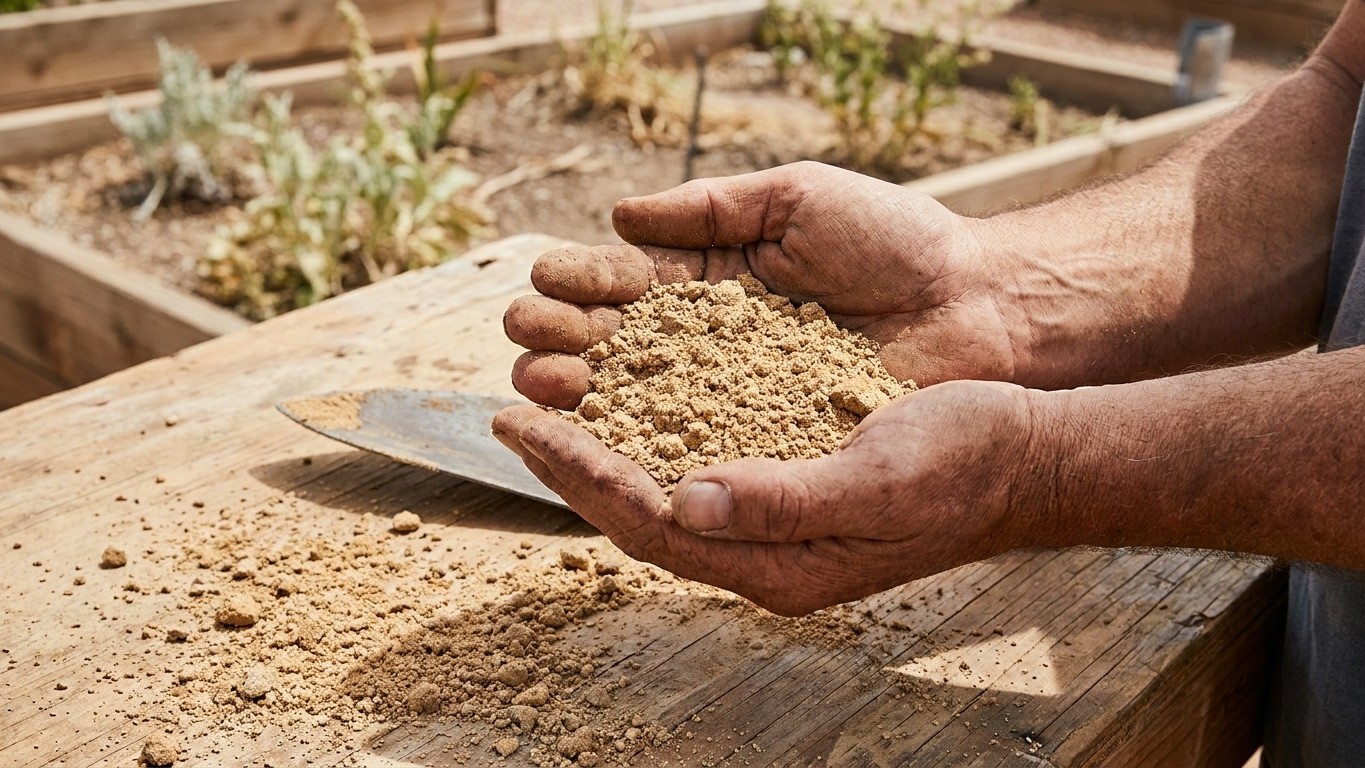

Most New Mexico gardens sit on sandy, alkaline ground that drains fast and holds almost no organic matter naturally, that combination shapes nearly every problem you’ll run into, from chlorotic leaves to water that vanishes before roots can use it. Here’s what the state’s representative soil actually looks like, and what to do about the one under your own feet.
What is under your garden

The USDA names the Penistaja series as representative of New Mexico. It’s an Aridisol, the soil order that forms under dry climates and tends to run alkaline and carry salts near the surface. That’s not a guess or a regional generalization, it’s how the USDA NRCS classifies dry-climate soils across the Southwest, and Penistaja fits the pattern closely.
The numbers on the surface horizon, drawn from 47 mapped components in the Soil Survey Geographic Database, are specific: a surface pH around 7.5, texture that’s 69 percent sand, 15 percent clay, and 16 percent silt, organic matter around 1.4 percent, and a drainage class of well drained. Put together, that describes a soil that’s gritty in your hand, sheds water quickly, runs alkaline, and has almost nothing in the way of stored fertility.
| Reading | Value |
|---|---|
| Surface pH | about 7.5 (alkaline) |
| Sand | 69 percent |
| Clay | 15 percent |
| Silt | 16 percent |
| Organic matter | about 1.4 percent |
| Drainage class | well drained |
None of that is your soil, necessarily. Penistaja is the series USDA lists as representative of the state as a whole, one series standing in for a state that spans desert flats, river bottoms, mountain foothills, and thousands of residential lots that a builder has scraped, graded, or filled with trucked-in dirt. The ground along the Rio Grande valley can be heavier and richer than this. A newly built subdivision might be sitting on subsoil with no topsoil left at all. Treat the Penistaja numbers as a starting expectation, not a verdict.
Two five-minute checks
You can get a rough read on your own dirt before any lab is involved. For the ribbon test, wet a small handful of soil until it’s moldable, then squeeze it out between thumb and forefinger to form a ribbon. Sandy soil like Penistaja won’t ribbon at all, it just falls apart, gritty and loose. Clay-heavy soil forms a long, smooth ribbon that holds together.
For the jar test, fill a clear jar about a third full of soil, top it off with water, shake it hard, and let it sit overnight undisturbed. Sand settles first and fastest, forming the bottom layer within minutes. Silt settles next, over a few hours. Clay stays suspended longest and forms the finest top layer, sometimes still cloudy after a full day. Whatever separates out in your jar is a truer answer than any state average.
Testing before you amend
Dumping lime or sulfur on a bed because you read that your state’s soil runs alkaline is how gardeners waste a season and sometimes waste money for years, over-correcting pH is slow to reverse, and guessing at nutrient levels means you might add phosphorus a bed already has plenty of while it starves for nitrogen. A soil test reads what your eyes can’t: exact pH, salt levels, phosphorus, potassium, and organic matter percentage in the bed you’re actually going to plant.
Given the Penistaja numbers, you can reasonably expect a New Mexico garden to test alkaline, somewhere in the neighborhood of that 7.5 mark, and low in organic matter. But expecting is not knowing. Fill, disturbed soil, heavy compost use, or proximity to a wash can all shift those numbers in either direction.
To take a sample that actually represents your growing area:
- Choose one bed or planting area at a time, don’t mix a vegetable bed with a flower border in the same sample.
- Dig 6 to 10 small cores from different spots in that area, going down to the depth roots actually occupy (about 6 inches for most vegetables and lawns).
- Remove any surface mulch, grass, or debris from each core before collecting the soil.
- Mix all the cores together in a clean bucket and break up clumps.
- Pull about a pint of the mixed soil for the lab sample and let it air-dry if it’s wet.
- Label the bag with the bed name and submit it along with the crop you plan to grow there.
Amending it
The Penistaja pH of about 7.5 sits above 7.3, and that number tells you exactly which direction to work. This is alkaline ground, and every amendment decision follows from that one fact plus the texture numbers: 69 percent sand and only 15 percent clay.
Never add lime
Lime raises pH. Soil that’s already at 7.5 needs the opposite treatment, and lime on ground like this pushes it further into the range where nutrients start locking up. This is worth stating plainly because lime is the reflexive fix a lot of gardeners reach for, and it’s simply wrong for this soil.
Elemental sulfur and organic matter
Elemental sulfur is the slow, honest route to lowering pH here, bacteria in the soil convert it to sulfuric acid over time, gradually nudging the number down. It’s not instant. Organic matter works alongside it, buffering pH swings and feeding the same microbial activity that makes sulfur effective. Compost, aged manure, and leaf mold all help, and at 1.4 percent organic matter, this soil has a lot of room to absorb them without saturating.
Watch for iron chlorosis
At high pH, iron becomes chemically locked out of a plant’s reach even when there’s plenty of it in the ground. Yellow leaves with green veins, especially on newer growth, are the classic sign. Chelated iron products can help in the short term, but the underlying fix is the same slow pH correction with sulfur and organic matter.
Working with the sand
With sand making up more than two-thirds of the texture, water and nutrients move through fast and don’t stick around. The fix is organic matter again, worked in to add water-holding capacity, plus watering on a shorter, more frequent schedule rather than deep soaks that just drain past the root zone. Never add sand to try to “fix” this soil further, and never add sand to clay soil elsewhere expecting it to lighten the texture. It’s the wrong direction.
Texture doesn’t change quickly. Adding organic matter to boost water retention and feed microbial life is a project measured in three seasons of steady compost additions, not three weeks. pH correction with sulfur runs on a similar timeline. If you’re expecting a one-bag fix before next month’s planting, this soil isn’t going to give you one.
Drainage and compaction
Penistaja is classified well drained, and with 69 percent sand in the mix, that tracks, water moves through this soil quickly rather than pooling. Standing water in a garden bed after rain, if you see it at all, usually points to compaction or fill dirt rather than the native texture itself.
You can check your own drainage with a simple percolation test: dig a hole about a foot deep and a foot wide, fill it with water, let it drain completely once, then fill it a second time and time how fast the water level drops. A drop of 1 to 3 inches per hour is typical and workable for most garden plants. Faster than that, and you’re dealing with genuinely fast-draining ground that will need more frequent watering. Slower than an inch an hour points to compaction or a clay layer, regardless of what the state series predicts.
Compacted soil from foot traffic, parked equipment, or construction grading behaves nothing like the native texture underneath it. Double digging used to be the standard fix, but it’s fallen out of favor because it disrupts soil structure and microbial layers that took years to establish, and the compaction often returns within a season anyway. On badly compacted ground, especially in a yard where builders graded and compacted the lot before landscaping, a raised bed is often the more honest answer than years of amendment. It sidesteps the problem instead of fighting it.
Practical takeaways for well-drained, sandy ground like this:
- Water more often but in smaller amounts, since moisture doesn’t linger.
- Mulch heavily to slow evaporation from the surface.
- Skip plants that need consistently moist soil, they’ll fight this texture the whole season.
- Build raised beds over compacted or graded areas rather than trying to loosen them by hand each year.
Local help
New Mexico State University’s Cooperative Extension Service runs soil testing through its county offices statewide. Submit a sample and the county agent will walk you through the results in person, translating pH and nutrient numbers into what to actually add to your specific bed rather than a state-wide average.
Common questions
Is all New Mexico soil sandy and alkaline?
The Penistaja series, which USDA lists as representative, is sandy and alkaline, but the state includes many other soil series. River valleys, mountain areas, and disturbed urban lots can differ substantially. A soil test is the only way to know your own ground.
Can I lower my soil’s pH quickly?
Not safely. Elemental sulfur lowers pH gradually as soil bacteria convert it, typically over a season or more. Faster chemical treatments risk overshooting and damaging root systems.
Why are my plant leaves yellow with green veins?
That pattern usually points to iron chlorosis, common in alkaline soil where iron becomes chemically unavailable to roots even when present in the ground. It’s a pH problem more than a fertility problem.
Should I add sand to break up compacted soil?
No. Adding sand to clay or compacted ground doesn’t lighten the texture the way people expect, and it can make drainage worse. Organic matter and, in badly compacted spots, a raised bed are more reliable fixes.