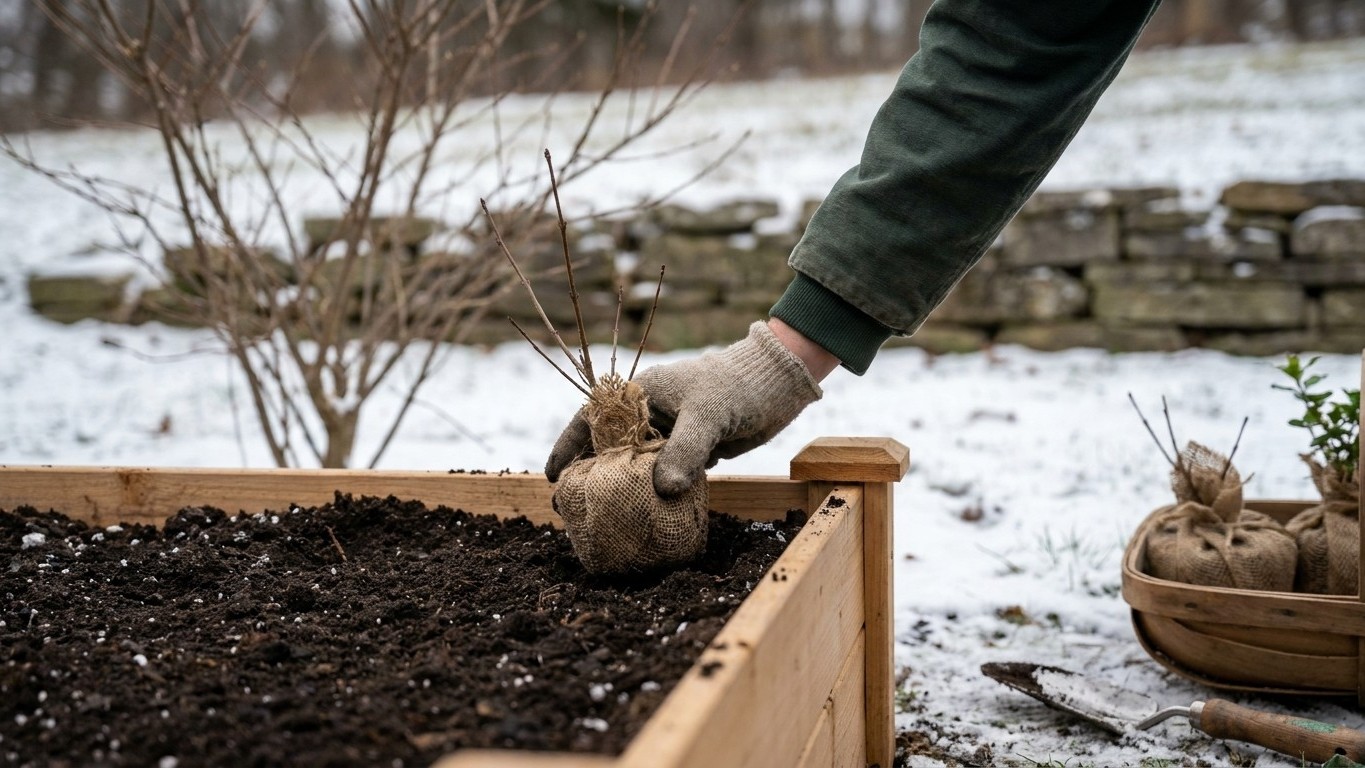

December is deep winter across New York, and for most of the state the ground has been frozen or freezing since mid-to-late November. There is no direct sowing outdoors this month in the vast majority of counties. What does move forward: garlic and shallots in the small window before the soil locks up, cold frames and low tunnels protecting crops already in place, and dormant pruning and planning work that sets up spring.
What goes in the ground in December

The decision this month is not about the calendar, it is about whether the soil can still be worked with a spade. New York City’s Central Park station, used here because it is the state’s best-documented climate record, shows a first fall freeze between November 14 and November 27, based on NOAA NCEI’s 1991-2020 climate normals. That is a 32°F freeze window for a dense urban site. Upstate counties, the Adirondacks, and the Tug Hill snowbelt freeze noticeably earlier in fall, sometimes weeks ahead of that city figure. By the time December opens, that freeze has already happened almost everywhere in the state.
For the large majority of New York, the honest answer is that nothing goes into open, unprotected ground in December. Soil that has frozen solid cannot be dug, and any seed or transplant set into it will not establish before real cold arrives.
What still works
A few things remain possible, and they matter more than a blank list would suggest:
- Garlic and shallots, but only in the narrow stretch of early December when the ground in a particular yard is still workable, typically in the milder Hudson Valley, Long Island, or lower-elevation western NY sites.
- Cold frames and low tunnels sheltering greens that were already established before the freeze, such as spinach, mache, and hardy lettuce.
- Bare-root and dormant plantings of fruit trees or canes, on the rare occasion soil is still soft enough to dig, mostly in the warmest downstate pockets.
- Forcing rhubarb or Belgian endive (chicory) indoors in a dark, cool space, using roots dug and stored before the ground froze.
New York’s USDA Plant Hardiness range, according to the USDA Plant Hardiness Zone Map (2023 edition, built on 1991-2020 normals), spans zone 3b to 7b. That gap between the coldest Adirondack valleys and the mildest parts of Long Island and New York City is the real reason a single December instruction cannot cover the whole state: what is merely cold in one county is already locked under frozen ground in another.
What to start under cover
The right way to plan indoor sowing is to count backward from the last spring frost window, not forward from today’s date. Using the Central Park normals of March 23 to April 3 as a reference point, most warm-season transplants (tomatoes, peppers, eggplant) are started roughly 6 to 8 weeks before that window, which lands in early-to-mid February for the city and later still upstate. Onions and leeks, which grow slowly from seed, are usually started 10 to 12 weeks ahead, putting their sowing date in January even at the mildest downstate sites, and later in colder zones.
Run that arithmetic and December comes up early for almost everything destined for the spring garden. Starting tomatoes or onions now, months ahead of that backward count, produces the first classic failure: seedlings that outgrow their pots, become rootbound, and stretch into weak, leggy stems long before it is safe to plant them outside. The second failure mode, starting too late, is not really a December risk, but it is worth naming because gardeners who skip December planning often catch themselves scrambling in February with too little time left.
What legitimately belongs under cover this month is different from garden transplants. Kitchen herbs (basil, chives, parsley) grown on a sunny windowsill for cooking, microgreens on a tray under a grow light, and citrus or houseplant cuttings taken indoors all make sense now, precisely because they are not tied to the outdoor frost calendar at all.
What is ready to pick
Outdoors, December offers little or nothing across most of New York. Any crop still standing in an open bed has usually been finished off by the freeze that arrived weeks earlier. That is the plain answer, and it is worth saying rather than dressing up.
What still feeds a household comes from three places. First, overwintered kale, leeks, and Brussels sprouts left in the ground and buried under mulch or snow cover, which sweeten after a hard freeze and can be dug or cut as needed, snow permitting. Second, cold-frame greens, spinach, mache, and hardy lettuce, tucked under glass or plastic and harvested a few leaves at a time on any day mild enough to lift the cover. Third, whatever is growing indoors: sprouts on a countertop, microgreens under lights, and forced rhubarb or chicory started from roots dug before the ground froze.
The other job this month is checking the pantry, not the garden. Winter squash, potatoes, and onions in storage need a walk-through every couple of weeks. A soft spot on a squash, a sprouting potato, or an onion gone soft at the neck are all signs to pull that item out and use it before it spreads rot to its neighbors. Storage crops fail from the inside out, and one overlooked squash in a bin can take down several others before the next check.
The jobs that matter this month
A garden with nothing in the open ground still has a full list of work, and December’s jobs are easy to underestimate precisely because none of them involve a seed going into soil.
Pruning, ordering, and planning
Dormant pruning of apple and pear trees, grapevines, and raspberry canes is best done while the plants are fully asleep and the structure is easy to see without leaves in the way. Skip pruning during a hard, brittle-cold stretch, since wood cut in extreme cold heals more slowly, but a typical dormant winter day works fine. Seed ordering belongs on this month’s list too: popular varieties, especially heirloom tomatoes and specialty onions, sell out from catalogs by late winter, and December orders beat the rush.
Soil, tools, and storage
This is also the season to test soil, a sample sent to a local Cornell Cooperative Extension office can flag pH or nutrient gaps well before spring planting decisions are due. Turning or insulating an active compost pile keeps it from stalling completely in the cold. Cleaning rust off tools and sharpening pruners and hoes now means no delay when the ground thaws. Fences and raised bed frames are easier to repair while nothing is growing and the ground, where still workable, allows a post to be reset. Mulching garlic beds, roses, and other perennials with straw is worth doing once the ground has genuinely frozen, which protects roots from the freeze-thaw heaving that damages them more than steady cold ever does.
What not to do in December
The most common mistake this month is treating a mild afternoon like a sign that winter has loosened its grip. Pulling mulch off garlic beds or opening a cold frame’s cover after a few 50-degree days invites trouble: the next hard freeze, which always arrives, hits exposed crowns and roots that had just been protected. Leave winter mulch in place until real spring warmth is sustained, not a single warm afternoon.
Feeding nitrogen to dormant plants this month is another wasted effort. Roots that have shut down for winter cannot use the nutrients, and a thaw can wash unused fertilizer away before it ever helps a plant. Hold off until active growth resumes.
Starting warm-season seeds indoors for outdoor transplant is a timing error that shows up months later. Tomatoes, peppers, and squash started in December, sown far ahead of the backward count from the March 23 to April 3 last-frost window, will be leggy, rootbound, and stressed long before it is safe to set them outside in the spring. Better to hold seed packets for their proper starting month and use December for ordering and planning instead of premature sowing.
Pruning stone fruit and other cold-sensitive trees during the coldest stretches of the month is worth avoiding as well. Cuts made in brittle, deeply frozen wood are more prone to cracking and slower to heal than the same cut made on an ordinary cold but not extreme day.
Checking this against your own county
A state-wide December guide is a starting point, not a set of instructions for a specific yard. New York’s hardiness range alone, zone 3b to 7b under the USDA system, covers everything from Adirondack valleys to Long Island’s south shore, and elevation, lake-effect snow near Lake Erie and Lake Ontario, and the general north-south divide all shift frost and soil-freeze timing by weeks in either direction. A backyard in the Finger Lakes snowbelt and one in the lower Hudson Valley are not on the same clock even though both are technically “New York in December.”
The most reliable next step is a local one: Cornell Cooperative Extension maintains county-level offices and planting guidance built for New York’s specific microclimates, and that local read is worth more than any single statewide date.
Common questions
Can I still plant garlic in New York in December?
Only if the ground has not yet frozen solid where you garden, which is more realistic in early December in the Hudson Valley, Long Island, or other mild downstate spots than upstate or in the Adirondacks.
Is it too late to start seeds indoors in December?
For outdoor garden transplants like tomatoes or onions, yes, it is too early rather than too late, since the backward count from the March 23 to April 3 last-frost window puts most start dates in January or February. December is better suited to kitchen herbs and microgreens grown for immediate use.
What should I do with unharvested squash or root crops before hard freezes hit?
Bring in anything left in the garden and check stored squash, potatoes, and onions every couple of weeks, removing any item showing softness or sprouting before it spreads rot to the rest of the stored crop.
Does New York’s hardiness zone affect what I can do this month?
Yes. The state spans USDA zones 3b to 7b, so a task that is routine in a zone 7b Long Island yard, like a late bare-root planting, may simply not be possible in a zone 3b Adirondack garden where the ground has already been frozen for weeks.