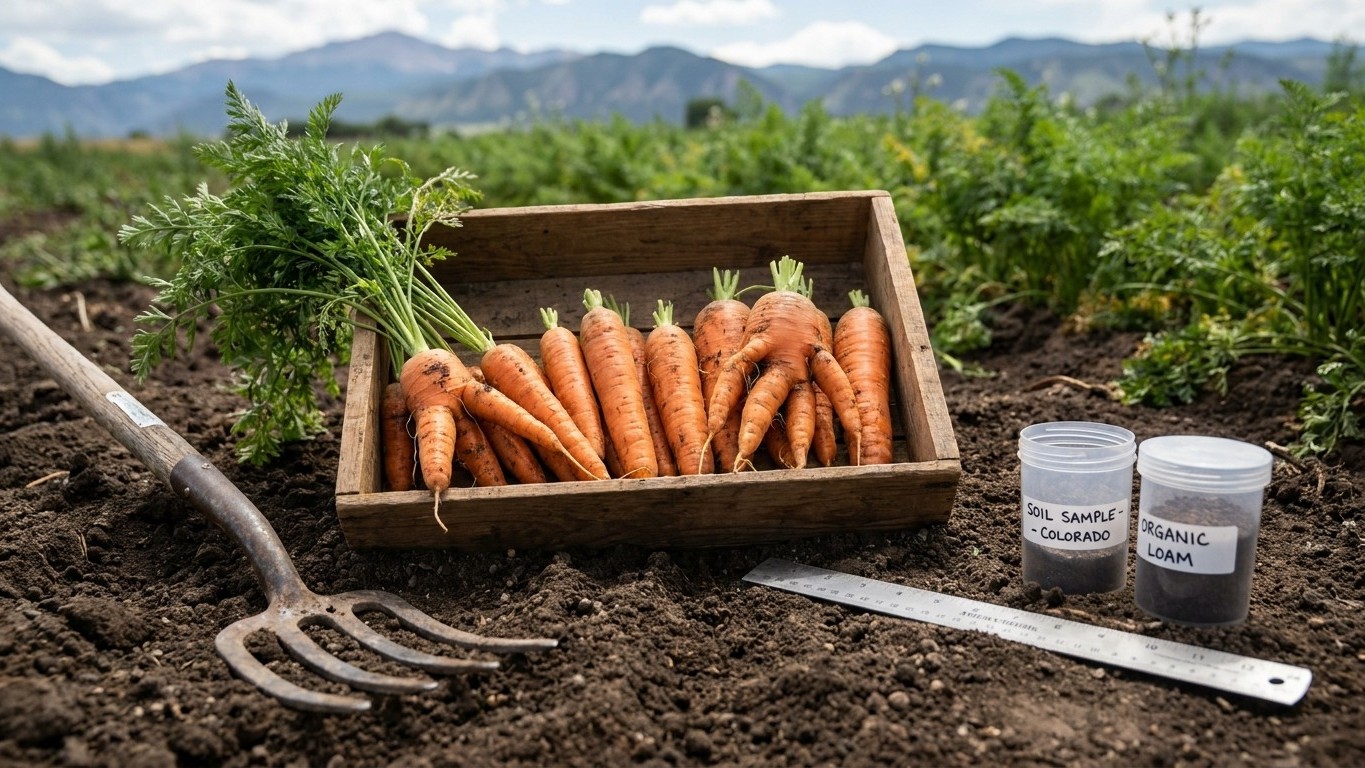

Colorado’s representative soil (the Seitz series) is a loam-to-silt Alfisol that’s well drained but leans just acidic and light on clay. That’s a decent starting point for carrots, but the state soil is a benchmark, not your backyard. Whether your carrots grow straight or fork depends on what’s actually in your bed, and on When to Sow Carrots in Colorado, timing sowing to a frost window that runs from May 1 to May 11.
The short answer
The soil USDA lists as representative of Colorado is the Seitz series, an Alfisol, a forest-derived soil that holds nutrients at a moderate rate. Its surface horizon runs 42 percent sand, 21 percent clay and 37 percent silt, a loam-to-silt texture, with a surface pH around 5.6, slightly acid. Drainage class is well drained. Those numbers come from USDA NRCS Soil Data Access, averaged across 32 mapped components of the series, so they describe a broad regional pattern, not a single field.
One number needs a flag before you use it: the organic matter figure USDA records for this surface horizon runs around 70 percent. That’s not a typo, but it’s also not something a vegetable bed will ever show. An organic-matter reading that high means the mapped surface layer is a natural organic deposit, peat, muck or forest litter, not a worked garden soil. A cultivated bed built from this series would carry nowhere near that much organic matter once it’s been dug, planted and tilled for a season or two. Treat that figure as a description of undisturbed ground, not a promise about your raised bed.
What matters for a carrot is the mineral texture underneath: 21 percent clay is moderate, not heavy, and well drained ground with that much sand and silt shouldn’t crust badly or hold standing water. Utah State University Extension is blunt about what carrots need regardless of state: deep, sandy, well-drained soil rich in organic matter, because heavy or rocky ground makes the taproot fork as it hits resistance and splits around it. So will carrots fork in Colorado soil? A loam-to-silt texture like the Seitz series sits closer to friendly than hostile for a straight root, but 21 percent clay is enough to cause trouble in a compacted bed, especially where a foundation, a driveway cut or years of foot traffic have packed the surface hard.
If your ground runs heavier than that, or if you hit rock or dense clay within the top foot, the fix Utah State names is straightforward: work in plenty of compost and double dig the bed, breaking up the profile a spade deeper than usual so the root has room to run straight. Where the ground is shallow over bedrock or hardpan and double digging isn’t practical, a raised bed filled with a loose, sandy mix sidesteps the problem entirely. Colorado spans hundreds of mapped soil series from the eastern plains to the mountain valleys and the western slope, and the ground under any one garden could be sandier, rockier or far more compacted than this state average. This is a starting point for guessing what you’re dealing with, not a diagnosis of your bed.
The test that settles it in your own garden
State-level soil data can’t tell you what’s eighteen inches under your own carrot bed. A short dig answers the questions that actually matter for root shape and drainage.
- Dig a test hole at least a foot deep where you plan to sow. Carrots need that much clear, loose depth to grow straight; anything that stops your shovel, rock, hardpan, a buried paver, tells you exactly where a taproot will hit resistance and fork.
- Look at what comes out. Note any stones, chunks of clay, or construction debris mixed into the soil. A handful of small pebbles is normal almost anywhere; a layer of rubble or dense clay a few inches down is the kind of obstacle that splits roots.
- Feel the texture between your fingers. Squeeze a moist handful. Soil that forms a slick, sticky ribbon is high in clay and tends toward forking unless it’s loosened. Soil that falls apart and feels gritty leans sandy, which drains fast and suits a straight root but may need more organic matter to hold moisture.
- Watch how water drains. Fill the same hole with water and time how long it takes to disappear. Water that lingers for hours points to poor drainage and a compacted or clay-heavy layer below the surface, the kind of ground that calls for a raised bed rather than fighting the native soil.
None of these steps require lab equipment, and none of them will hand you a precise clay percentage the way a soil survey does. What they give you is a direct, physical read on the two things that decide whether a carrot grows straight in your garden: how deep the loose ground runs, and how fast it sheds water.
When to sow here
Carrots are sown directly in the ground, there’s no transplanting step to work around, so every date here counts from the seed going into soil, not from a seedling going outside.
- Start with the local frost window. NOAA’s climate normals for a Colorado station put the last spring frost between May 1 and May 11, based on the standard 32 F freeze-probability band. That range is the anchor for every date that follows.
- Count back two to three weeks from that window. Carrots tolerate cool soil better than many vegetables, so the general guidance is to sow two to three weeks before the last expected frost. Three weeks before May 1 lands around April 10; two weeks before May 11 lands around April 27. That puts a reasonable direct-sowing window somewhere in the second half of April for most of the region covered by this frost data.
- Check the soil Temperature before you trust the calendar. Seed needs the ground at a minimum of 40 F to germinate at all, and germination is fastest and most even between 55 and 65 F. A calendar date means little if a late cold snap has kept the soil colder than that; a simple soil thermometer pushed a couple of inches down settles the question faster than guessing.
- Remember the elevation caveat. Denver sits at 5,280 feet on the plains, and the frost dates above reflect that kind of station. Mountain towns run noticeably shorter seasons and can see frost even in July, and the western slope follows its own pattern again. Anyone gardening outside the immediate Front Range plains should treat these dates as a rough anchor, not a fixed rule, and lean harder on the soil-temperature check.
Sowing into ground that’s still too cold doesn’t kill carrot seed outright, but it stalls germination and opens the door to rot before the seedling ever breaks the surface. Waiting for that 40 F floor, and ideally the warmer 55 to 65 F range, costs a week or two but buys a much more even stand.
What goes wrong here
- Forking in heavy or compacted ground. Where clay content runs higher than the state average or where the bed has been compacted by traffic or equipment, the taproot meets resistance and splits into two or more legs. Utah State University Extension’s remedy is direct: work in generous compost and double dig the bed a spade deeper than usual, or switch to a raised bed filled with a loose, sandy mix if the native ground is too shallow or rocky to rework.
- Poor germination during a hot, dry spell. Carrot seed needs the top inch of soil to stay consistently moist to sprout, and germination slows sharply once soil temperature climbs well past the 55 to 65 F range where it performs best. A stretch of hot, dry weather right after sowing can crust the surface and stop seedlings before they emerge; light, frequent watering that keeps the surface damp without waterlogging it carries seed through that window.
- Splitting from uneven watering. Roots that grow through a dry spell and then get hit with a heavy soak swell too fast and crack along the length of the root. Steady, even moisture through the growing season, rather than occasional deep floods after neglect, keeps the root growing at a consistent rate and avoids the split.
Checking this against your own county
Everything above works from state-level and station-level data: one representative soil series and one regional frost window. Neither one is a substitute for what’s actually happening in a specific county, at a specific elevation, in a specific year. Colorado State University Extension is the land-grant extension service for the state and the right place to check local frost records, soil test recommendations and planting calendars adjusted for a particular county or elevation band. A quick call or visit to the local extension office can confirm whether the April sowing window discussed here fits a given garden, or whether elevation and microclimate push it later.
Common questions
Can I sow carrots earlier than the frost window suggests?
Carrot seed can go in the ground before the last frost date since the crop tolerates cool soil, but germination stalls below 40 F regardless of the calendar. Checking soil temperature directly is more reliable than pushing the date earlier on faith.
Does the state’s representative soil mean my garden has that exact texture?
No. The Seitz series figures describe an average across 32 mapped soil components and represent Colorado at the state level. Colorado contains hundreds of distinct soil series, and river bottoms, hillsides and any lot that’s been graded or filled during construction can differ completely from that average.
Why would my carrots fork even in loose-looking soil?
Forking usually comes from something the eye misses at the surface: a buried rock, a compacted layer a few inches down, or old construction debris. Digging a test hole a foot deep before sowing catches obstacles that a quick look at the topsoil won’t.
Is the high organic-matter figure for the state soil something I should try to match?
No. That figure describes an undisturbed natural surface layer, not a cultivated bed, and a worked garden soil built from this series would show far less organic matter once it’s been dug and planted for a season or two.