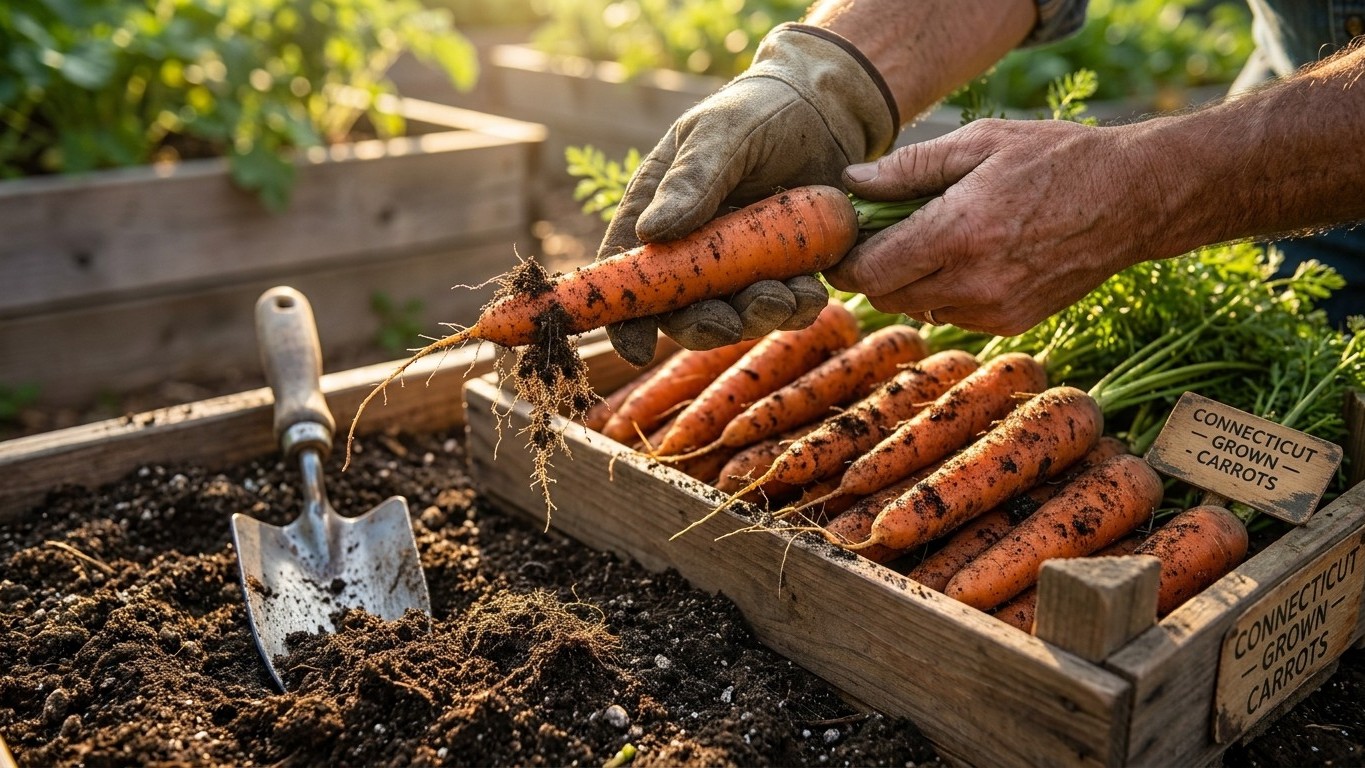

Connecticut’s most representative soil, the Windsor series, is sandy and sharp-draining, the opposite of the heavy, waterlogged ground that twists a carrot root into a fork. That’s good news on paper. But your backyard almost certainly isn’t sitting on pure Windsor soil, so the real answer to straight carrots here comes from a shovel test, a frost calendar, and a little patience with the weather.
The short answer
USDA’s soil survey names the Windsor series as the soil representative of Connecticut, and it’s about as far from “heavy clay” as garden soil gets. Sampled across 188 mapped components, the surface horizon runs 82 percent sand, 2 percent clay, and 16 percent silt, classified as an Entisol, USDA’s term for a young soil with almost no layered profile. It’s rated excessively drained, meaning water moves through it fast, and surface pH averages around 5.1, which is strongly acid. Reported organic matter for that mapped surface sits near 95 percent, but that figure describes a natural forest-litter or duff layer as surveyed in the field, not a dug-over vegetable bed. A cultivated garden strips or mixes that layer away, so don’t expect anything close to that number once you’ve turned the soil for planting.
Set against Utah State University Extension’s guidance on carrots, which calls for deep, sandy, well-drained soil rich in organic matter and warns that heavy or rocky ground makes roots fork, Windsor-type soil is close to the ideal texture. Sand and silt dominate, clay is nearly absent, and drainage is excessive rather than sluggish. On soil like this, forking is less likely to come from the texture itself and more likely to come from stones, compaction from foot traffic, or a poorly loosened planting bed. The Utah State guidance is clear on the fix for heavy or rocky ground: work in plenty of compost and double dig the bed, or skip the fight entirely and build a raised bed filled with a loose, sifted mix.
None of this is a diagnosis of your yard. Connecticut, like every state, is mapped across hundreds of distinct soil series, from river-bottom silt loams to compacted glacial till on hillsides to whatever mix of fill and topsoil a builder left behind a suburban lot. Windsor is simply the series USDA highlights as representative of the state as a whole. Treat the numbers above as a starting point for what the region’s ground tends to do, sandy and acidic in the areas that resemble Windsor, and go find out Will Carrots Fork in Connecticut Soil? in your own case before you commit to a planting plan, and check When to Sow Carrots in Connecticut so your timing matches your soil conditions.
The test that settles it in your own garden
The state soil profile tells you what’s typical, not what’s true for your particular raised bed or back corner of the yard. A short hands-on check answers the question the survey data can’t.
- Dig a test hole in the exact spot you plan to sow, going as deep as a shovel will comfortably reach, and pay attention to what you hit along the way, whether that’s clean loose soil the whole way down, a sudden layer of rock, a dense clay pan, or standing water.
- Check depth and stones. Carrots need a clear, unobstructed run straight down. If your shovel keeps striking gravel or a hard compacted layer partway down, that’s the layer a taproot will hit too, and that’s where forking starts.
- Feel the texture. Grab a handful of moist soil from the hole and squeeze it. If it falls apart gritty and won’t hold a shape, you’re dealing with something sandy, similar to the Windsor profile described above. If it smears between your fingers and rolls into a ribbon, you’ve got meaningful clay content, and that changes your plan.
- Watch how water drains. Fill the hole with water, let it soak in once, then fill it again and simply watch. Soil that drinks the water down steadily is behaving like the excessively drained Windsor type. Soil that leaves standing water sitting for a long stretch is telling you drainage is poor, and that’s the same condition that produces forked and stunted roots.
Run this test in more than one spot if your yard has any slope or visible variation in plant growth. Two beds ten feet apart can sit on different soil entirely, especially on lots that were graded or filled during construction.
When to sow here
Carrots are sown directly into the ground where they’ll grow, never started as transplants and moved later, so every day of their 70 to 100 day maturity window counts from the moment seed goes into soil. Timing that seeding date correctly matters more for carrots than for crops you can start indoors and delay outside.
- Start from your last spring frost window. NOAA’s 1991-2020 Climate Normals, using 32°F freeze probabilities at the Bridgeport station, place Connecticut’s last spring frost between April 2 and April 12. That’s a coastal reading from the mildest part of the state; inland and northwest Connecticut push that date later in spring, so adjust accordingly if you’re gardening away from Long Island Sound.
- Count backward two to three weeks from that date. Carrot seed tolerates cool soil better than most root vegetables, so the recommended sowing window falls before the last frost rather than after it, roughly mid to late March along the coast and later the farther inland or north you garden.
- Check soil temperature before you sow. Carrot seed needs soil at a minimum of 40°F to germinate at all. Pushing seed into colder ground just means a longer wait, or none at all.
- Aim for the germination sweet spot. Germination performs best with soil temperatures between 55°F and 65°F. Very early sowings, right at that 40°F floor, will sit in the ground longer before sprouting than seed sown once soil has warmed further into that range.
- Mark the date you actually sow. Since there’s no transplant step to reset the clock, that sowing date is the one you count 70 to 100 days from when you’re estimating harvest.
What goes wrong here
- Forking in heavy ground. On any patch of Connecticut soil that runs heavier or rockier than the sandy Windsor type, a taproot meeting compacted clay or a stone splits into two or three legs instead of growing straight down. The fix Utah State Extension recommends is working in generous compost and double digging the bed before sowing, or bypassing the problem with a raised bed filled with a loose, stone-free mix.
- Poor germination during a hot spell. Once soil temperature climbs well above the 55-65°F range that favors germination, the surface can crust and dry out faster than seed can sprout, leaving gaps in the row. Keeping the seedbed consistently moist through a warm stretch, and timing sowing to avoid the hottest part of a heat wave, keeps germination more even.
- Splitting from uneven watering. A dry spell followed by a heavy soak causes roots to swell suddenly and crack along their length. A steady watering routine, backed by a layer of mulch to buffer the soil against swings between wet and dry, prevents the kind of stop-start growth that splits roots.
- Stubby or forked roots from buried stones. Even sandy soil can carry embedded rocks that a shovel test misses on a single pass. Sifting the top layer of a bed before sowing, or checking more than one spot in the row, catches obstructions before they deform the crop.
Checking this against your own county
Everything above describes Connecticut in general terms, one representative soil series and one coastal frost station standing in for a state that varies block by block. For a reading specific to your county, soil type, and local frost pattern, contact UConn Extension at extension.uconn.edu. Extension offices work from county-level soil surveys and local frost records that go well beyond what a statewide overview can offer, and they can point you toward a soil test if you want lab numbers for pH and texture rather than a shovel-and-water field check.
Common questions
Does Connecticut’s acidic soil hurt carrots?
The representative Windsor series runs strongly acid at a surface pH around 5.1. Carrots generally prefer soil closer to neutral, so acidic ground can affect nutrient availability. A soil test through UConn Extension will tell you your actual pH and whether liming makes sense for your bed.
Can I sow carrots earlier than the frost window suggests?
Only if your soil has already warmed to at least 40°F. Sowing into colder ground doesn’t speed things up, it just delays or prevents germination, so check soil temperature directly rather than sowing by the calendar alone.
Why do my carrots come out forked even in loose soil?
Forking isn’t only about overall texture. A single buried stone, a root, or a compacted pocket a few inches down can split a taproot even in an otherwise sandy bed. Sifting the top layer before sowing catches most of these obstructions.
Is a raised bed worth it for carrots in Connecticut?
If your shovel test turns up clay, hardpan, or standing water, yes. A raised bed filled with a loose, stone-free mix sidesteps the drainage and compaction problems that cause forking, without needing to rebuild the native soil underneath.