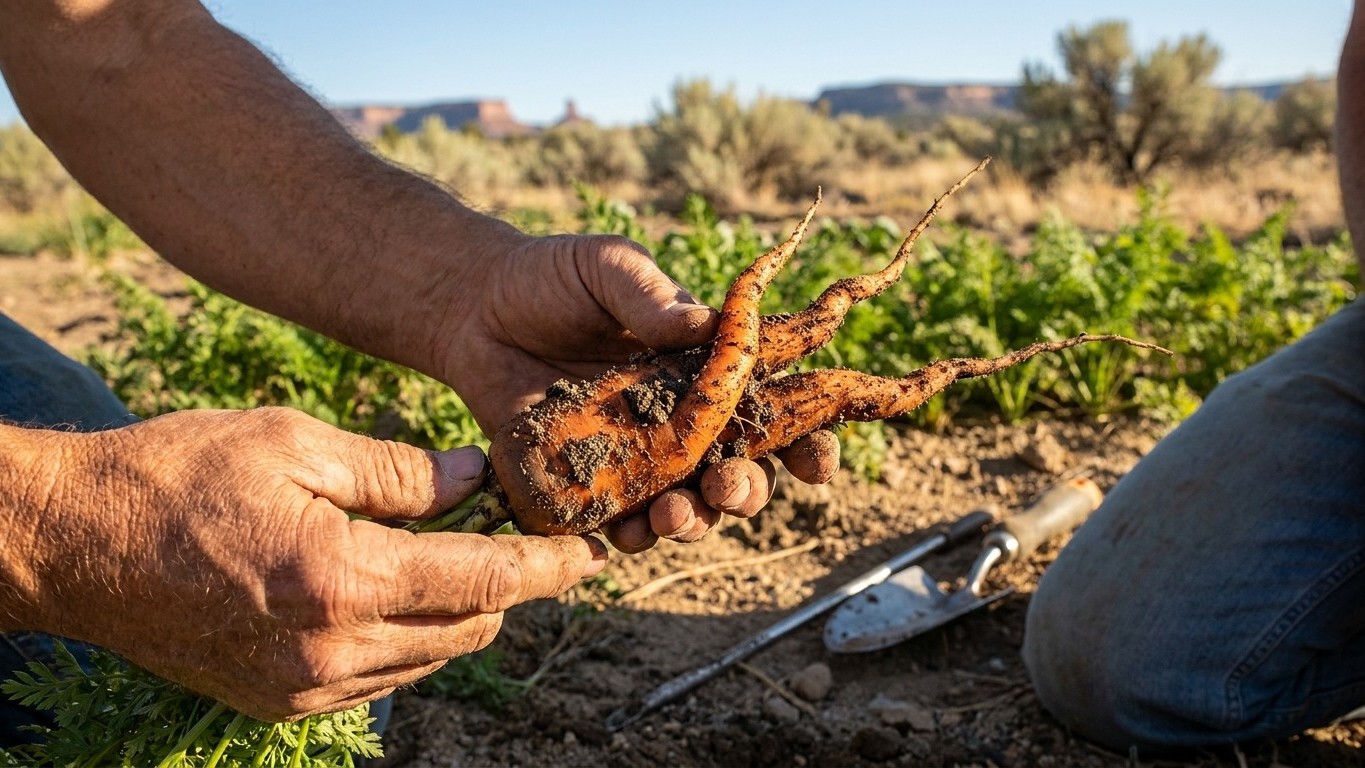

Wyoming’s benchmark soil, the Forkwood series, is a well-drained loam rather than the dense clay that twists carrot roots into knots. That’s a decent starting point, but it’s only a starting point. The real question is what’s under your own boots, and that takes a shovel, not a soil survey map.
The short answer
USDA’s soil survey lists the Forkwood series as representative of Wyoming ground. It’s an Aridisol, the kind of soil that forms under dry skies and often carries some salt near the surface. The surface horizon runs 42 percent sand, 20 percent clay and 38 percent silt, a loam texture with a surface pH around 7.2, close to neutral but leaning alkaline the way dryland soils often do. Organic matter sits at about 1.5 percent. Drainage is classed as well drained.
For carrots, that texture is workable news. A true loam, sand-heavy but not sandy, drains well and doesn’t pack into the hard crust that forces a taproot to split around an obstruction. Forking happens when a growing root meets resistance it can’t push through: a rock, a clod of unbroken clay, a compacted layer left by a tiller that never goes deep enough. Twenty percent clay is moderate, not the 35 to 40 percent that turns a garden bed into a brick after a dry spell. So on paper, and answering the broader question of Will Carrots Fork in Wyoming Soil?, Forkwood ground shouldn’t fork carrots the way a heavy clay-belt garden would.
What it will do is starve them a little. Utah State University Extension notes that carrots want soil rich in organic matter, and 1.5 percent is thin. That’s the number to work on before sowing, not the texture. A few inches of compost worked into the top foot of soil, ahead of planting, does two things at once: it feeds the young roots and it lightens whatever clay is present, which lowers the forking risk even further. Timing this soil prep around When to Sow Carrots in Wyoming matters too. If a gardener digs down and hits a hardpan, or the ground is riddled with the kind of rock common on Wyoming’s high plains and foothills, double digging or building a raised bed sidesteps the problem entirely rather than fighting it season after season.
None of this is a verdict on any one backyard. Wyoming spans hundreds of mapped soil series, and Forkwood is simply the one USDA’s records treat as representative of the state as a whole. River bottoms, old floodplains, land near the mountains and anything a builder graded, filled or trucked in with topsoil can look nothing like it. Treat this number the way a weather forecast treats a regional average: useful for packing the right gear, not a promise about what’s happening on your particular block.
The test that settles it in your own garden
The Forkwood numbers describe a mapped average, not the twelve inches of dirt where seeds are actually going. Settling the question at home takes about twenty minutes and no lab.
- Dig a hole a foot deep. Carrots need at least that much loose, unobstructed soil to grow straight. Note where the shovel starts fighting you: that depth is the ceiling on root length, no matter what variety gets planted.
- Look at what’s in the hole. Rocks, gravel, or a hard compacted layer partway down are the most common cause of forked and stubby roots. If the walls of the hole are glazed or the bottom is noticeably harder than the top, that’s a compaction line worth breaking up.
- Feel the texture. Take a handful of moist soil and rub it between your fingers. Gritty and loose suggests sand dominance; sticky and moldable into a ribbon suggests clay. Somewhere in between, holding a shape loosely without smearing, is the loam carrots prefer.
- Watch how water drains. Fill the same hole with water and let it drain once, then fill it again and time how long it takes to disappear. Water that sits for hours points to a clay-heavy, poorly drained spot; water that vanishes almost instantly points to loose sand that will need more frequent watering and more organic matter to hold moisture.
This test won’t produce a lab-grade percentage of sand, silt and clay, and it shouldn’t be forced to. What it gives is the practical answer a gardener actually needs: whether the bed is loose enough, deep enough and drains evenly enough to grow a straight root, or whether compost, tilling, or a raised frame needs to come first.
When to sow here
Carrots go into the ground as seed, directly where they’ll grow. There’s no transplanting step to count from, so every date here runs from the day seed hits soil.
- Start with the frost window. NOAA’s 1991-2020 climate normals put the last spring frost for this region between May 7 and May 18, based on 30 to 70 percent freeze probabilities at a Wyoming reporting station.
- Count backward two to three weeks. Carrot seed tolerates cool soil better than most vegetables, so the sowing window opens before the frost date itself, not after it. Two to three weeks ahead of May 7 lands in the second half of April; two to three weeks ahead of May 18 lands closer to the end of April or the first days of May, depending on where in the state a garden sits.
- Check soil temperature before trusting the calendar. Seed needs the ground at 40 degrees Fahrenheit at minimum to have any real chance of sprouting. A calendar date means nothing if a cold snap has kept the soil colder than that; a simple soil thermometer pushed a couple inches down settles the question in seconds.
- Expect the best germination between 55 and 65 degrees. Seed sown at the 40-degree floor will come up slowly and unevenly compared to seed sown once soil has warmed closer to that 55 to 65 degree range. Patience matters more than speed here.
Wyoming’s elevation adds a wrinkle the calendar can’t capture on its own. At around 6,000 feet, the growing season runs roughly 130 frost-free days, and frost is possible in any month at higher elevations. That’s not a reason to delay sowing past the window above, but it is a reason to have row cover or a cold frame ready if a late cold snap follows an early warm spell.
What goes wrong here
- Forking in heavy or compacted ground. Even on a generally loamy soil, localized clay pockets, buried rock or a compacted layer from previous tilling will split a root in two. The fix is the same one Utah State University Extension recommends for heavy soil generally: work in plenty of compost and double dig the bed, or skip the fight altogether with a raised bed filled with loose, blended soil.
- Poor germination during a hot, dry stretch. Wyoming’s dry climate, the same dryness that shapes the Forkwood series as an Aridisol, means the soil surface can crust and dry out fast once temperatures climb. Carrot seed sown shallow needs consistent surface moisture to sprout; a few hours of drying wind can undo a week of careful watering. Keeping the seedbed damp with light, frequent watering, or a thin layer of straw or fine mulch over the row, keeps the surface from crusting before seedlings emerge.
- Split roots from uneven watering. A dry spell followed by a heavy soak makes carrot roots swell suddenly and crack along their length. This is a watering-schedule problem more than a soil problem: a steady, even watering routine through the growing season prevents the boom-and-bust cycle that causes splitting, regardless of how good the underlying soil is.
Checking this against your own county
The Forkwood numbers on this page describe one representative soil series, not the ground behind any particular house. Wyoming’s growing conditions shift enough between the high plains, the foothills and the river valleys that a local check is worth the phone call. The University of Wyoming Extension office is the right place to start: it can point to county-level soil test options, recommended sowing windows adjusted for local elevation, and any frost patterns specific to a given valley or bench that a statewide average can’t capture.
Common questions
Do carrots need full sun in Wyoming’s climate?
Carrots generally grow best with plenty of direct sun, and nothing in the state’s soil data changes that guidance. The bigger variable in Wyoming is soil temperature and moisture consistency, both of which matter as much as sun exposure for a straight, unsplit root.
Can I sow carrots earlier if I use a cold frame?
A cold frame or row cover can buffer against a late frost, but it doesn’t change the 40-degree Fahrenheit soil minimum seed needs to germinate. Check actual soil temperature with a thermometer rather than assuming a cover alone moves the sowing date up significantly.
Is the Forkwood soil series present on every property?
No. Forkwood is the series USDA treats as representative for the state as a whole, not a description of every garden in it. A state contains hundreds of mapped soil series, and a home garden could easily sit on ground with a different texture, drainage rate or pH.
How deep should a raised bed be for carrots in heavy soil?
The dig-a-hole test in this article is the way to find out what depth is needed on a given property, since it reveals exactly where rock, clay or compaction starts limiting root growth. There’s no single depth figure published here that applies everywhere, so testing the actual bed is the reliable step.