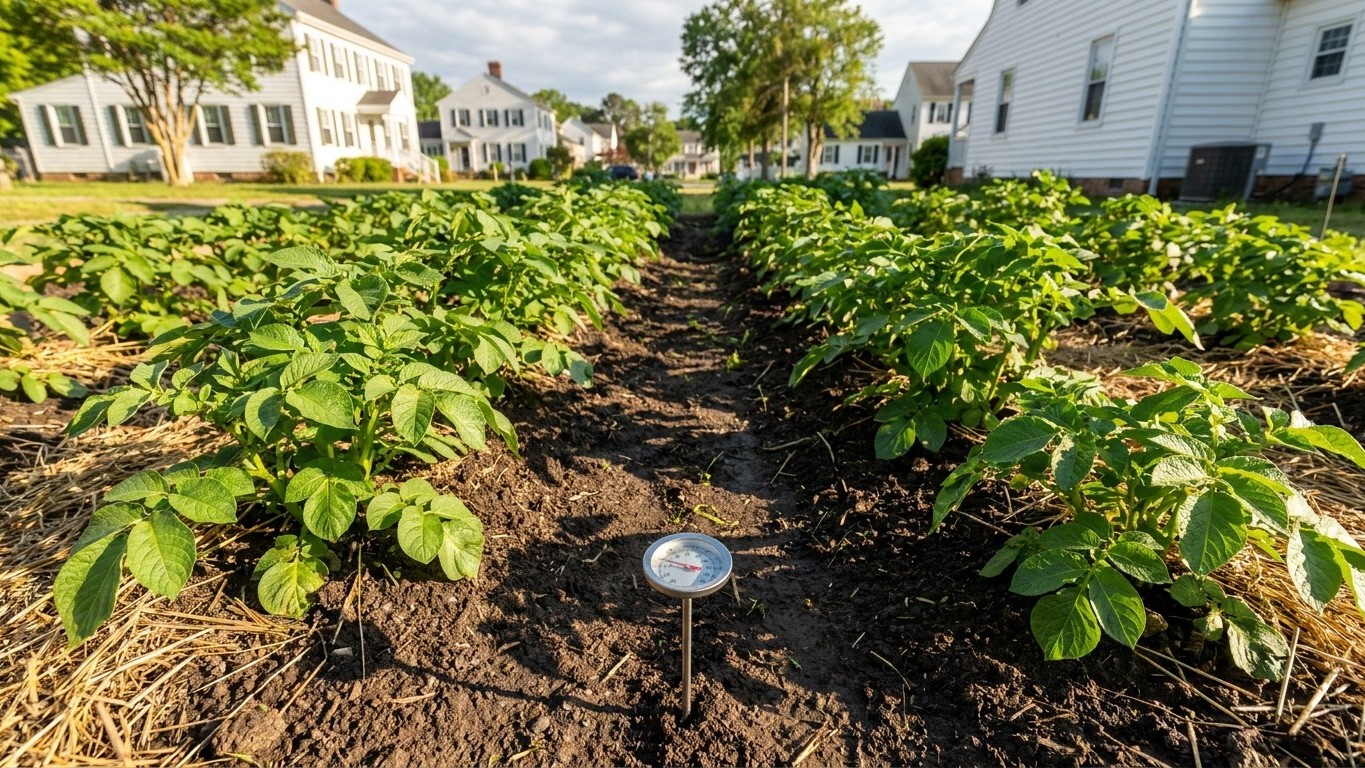

Virginia Beach averages 26.0 days a year above 90°F, mild by Southern standards, and the last spring frost falls between March 20 and April 3 near the coast. That combination makes potatoes here a spring-timed crop built to size up before the hottest stretch of summer, not a season-long project. Get the planting date right and heat stops being a problem. Get it wrong and tubers stall no matter how much you water.
The short answer
Twenty-six days above 90°F a year sounds like a lot until you compare it to the Deep South, where some counties clear 60 or more. Virginia’s coastal plain sits in a middle zone: hot enough to punish a potato patch that runs into July and August unprepared, mild enough that a well-timed spring crop clears the danger window before the worst heat lands. The number comes from NOAA NCEI Climate Normals for 1991-2020 at the Virginia Beach reference station, and it matters less as a temperature reading than as a load count, how many days the plant has to survive at the edge of its tolerance.
That tolerance has a hard line. Utah State University Extension’s potato fact sheet is direct about it: tuber set and fill shut down once soil runs above 90°F. Not air temperature, soil temperature, which lags behind the thermometer by hours but climbs just as high under full sun on bare or lightly mulched rows. Once the ceiling is crossed, the plant doesn’t slow production, it stops it. That’s the fact this whole growing plan is built around.
What this means for a Virginia garden
With 26 days a year likely to push past that 90°F air mark, and soil running hotter still, the safe strategy is to treat potatoes as an early crop. Plant as soon as soil conditions allow, let the plants bulk tubers through the cooler weeks of late spring and early summer, and dig before the heaviest heat of July sets in, following sound practices for Harvesting and Storing Potatoes in Virginia. A crop planted late, chasing a longer season into August, runs straight into the days that stop tuber growth cold.
Variety choice supports that plan. University of Maine Cooperative Extension groups potatoes by season class, early, mid-season, and late, rather than by a fixed day count, because maturity shifts with soil temperature and daylight. In a state with Virginia’s heat load, early and some mid-season varieties give the plant the best chance to finish its bulking before the ceiling closes the door, and knowing which Potato Varieties That Suit Virginia helps narrow that choice further. Extension guidance also separates varieties by use rather than by texture labels like waxy or floury: some are described as suited to baking, others to boiling, and that use-based description is what growers can actually plan a menu around.
When to plant here
Work backward from the frost date instead of forward from a calendar guess, and the math holds for any county once you know the local last-frost window, a full breakdown of When to Plant Potatoes in Virginia walks through those regional dates in detail.
- Start with the last spring frost date for your area. Near the coast, NOAA NCEI’s 1991-2020 data puts that window between March 20 and April 3.
- Subtract 14 to 21 days. Utah State University Extension and University of Maine Cooperative Extension both give this as the standard lead time for potatoes, planted once soil reaches 50°F rather than tied to a fixed date.
- If the last frost lands on April 3, count back 14 to 21 days and the planting window opens between March 13 and March 20.
- If the last frost lands on the earlier end of the window, March 20, the same subtraction puts planting between February 27 and March 6.
- Check soil temperature directly with a soil thermometer at a 4-inch depth rather than relying on air temperature or the calendar alone. Fifty degrees is the trigger, not a guess.
- Plant once that 50°F mark holds for a few consecutive days, rather than after a single warm afternoon.
Potatoes tolerate a light frost after emergence better than the seed piece tolerates cold, waterlogged soil before it sprouts. That’s why the trigger is soil temperature, not the frost date itself. Planting into ground that hasn’t reached 50°F invites rot before the eyes even break dormancy, and it’s a more common failure near the coast than gardeners expect, because a mild afternoon in late February can fool a thermometer sitting in the sun rather than in the soil.
What the heat does to the crop
The mechanism is simple and unforgiving. Above 90°F in the soil, the plant redirects its energy away from tuber set and fill, the two processes that actually put a potato on the plate. Utah State University Extension identifies this threshold plainly: it isn’t a slowdown, it’s a stop. A potato plant that hits that wall doesn’t resume normal growth once temperatures drop back down for a day or two, it has already lost ground it won’t fully recover.
In Virginia’s case, that 26.0 day count at the Virginia Beach reference station means the risk window is real but bounded, mostly clustered in July and August rather than spread across the whole growing season. A crop planted on the backward-counted schedule above, and dug in early to mid-summer, largely avoids that window. A crop left in the ground chasing a longer season runs the plant straight through the hottest weeks with no way to recover the tuber growth it lost.
Watering doesn’t change this equation. Irrigation cools soil marginally and keeps the plant from wilting, but it doesn’t lower soil temperature enough to reopen tuber set once the ceiling has been crossed. Gardeners who respond to a stalled crop by increasing water are treating a symptom that isn’t the actual problem. The fix is upstream: plant early enough, and dig early enough, that the crop’s bulking phase never has to cross into the state’s hottest stretch at all.
What goes wrong here
- Uncertified seed potatoes. Seed sold without certification can carry viruses that stunt growth and cut yield long before heat becomes a factor. Buying certified seed potatoes from a known supplier each season, rather than replanting grocery-store potatoes or last year’s leftovers, removes this risk at the source.
- Planting into cold, wet soil. Getting eager in a mild February stretch and planting before soil reaches 50°F invites the seed piece to rot rather than sprout. Checking soil temperature directly, rather than trusting the calendar or a warm afternoon, prevents this loss.
- Skipping the hilling. Tubers that develop near the surface and catch sunlight turn green and produce solanine, a compound that makes them unsafe to eat. Mounding soil or mulch over the row as plants grow keeps developing tubers covered and out of the light.
- Digging too early. Pulling potatoes before the plant has finished bulking, out of impatience or fear of the next hot spell, trades size and storage quality for an early harvest that didn’t need to be early. Waiting until foliage naturally yellows and dies back, within the window this state’s heat load allows, gives the crop its full sizing time without running it into the danger zone.
Checking this against your own county
A statewide frost window is a starting point, not an instruction for a specific yard. The March 20 to April 3 range comes from a coastal station near Virginia Beach, and Virginia’s terrain runs from sea level to well over 4,000 feet in the southwest and the Blue Ridge. Elevation and latitude both push these dates later in spring and earlier in fall, sometimes by several weeks, which shifts the entire backward-counting math laid out above.
Rather than guess at how far that shift moves the window for a specific county, the more reliable step is checking with Virginia Cooperative Extension, which maintains local frost data and planting guidance tuned to conditions well outside what a single coastal reference station can capture.
Common questions
Can potatoes handle a light frost after planting?
Established plants tolerate a light frost better than the seed piece tolerates cold, wet soil before sprouting, which is why the 50°F soil trigger, not the frost date itself, decides planting time.
Does mulching lower soil temperature enough to avoid the 90°F ceiling?
Mulch moderates soil temperature swings and helps retain moisture, but neither Utah State University Extension nor University of Maine Cooperative Extension publishes a figure for how much it reduces peak soil temperature, so it should be treated as a supporting practice, not a way to extend the growing window into the hottest weeks.
Should gardeners in Virginia try a fall potato crop?
The facts used here cover spring planting timed to the last frost window; a fall-crop timeline isn’t part of the sourced guidance for this state, so that decision is best checked directly with Virginia Cooperative Extension.
Why do certified seed potatoes matter more than variety choice?
A virus carried in uncertified seed limits yield regardless of how well-suited the variety’s season class is to Virginia’s heat load, which is why certification is treated as a first step rather than an optional upgrade.