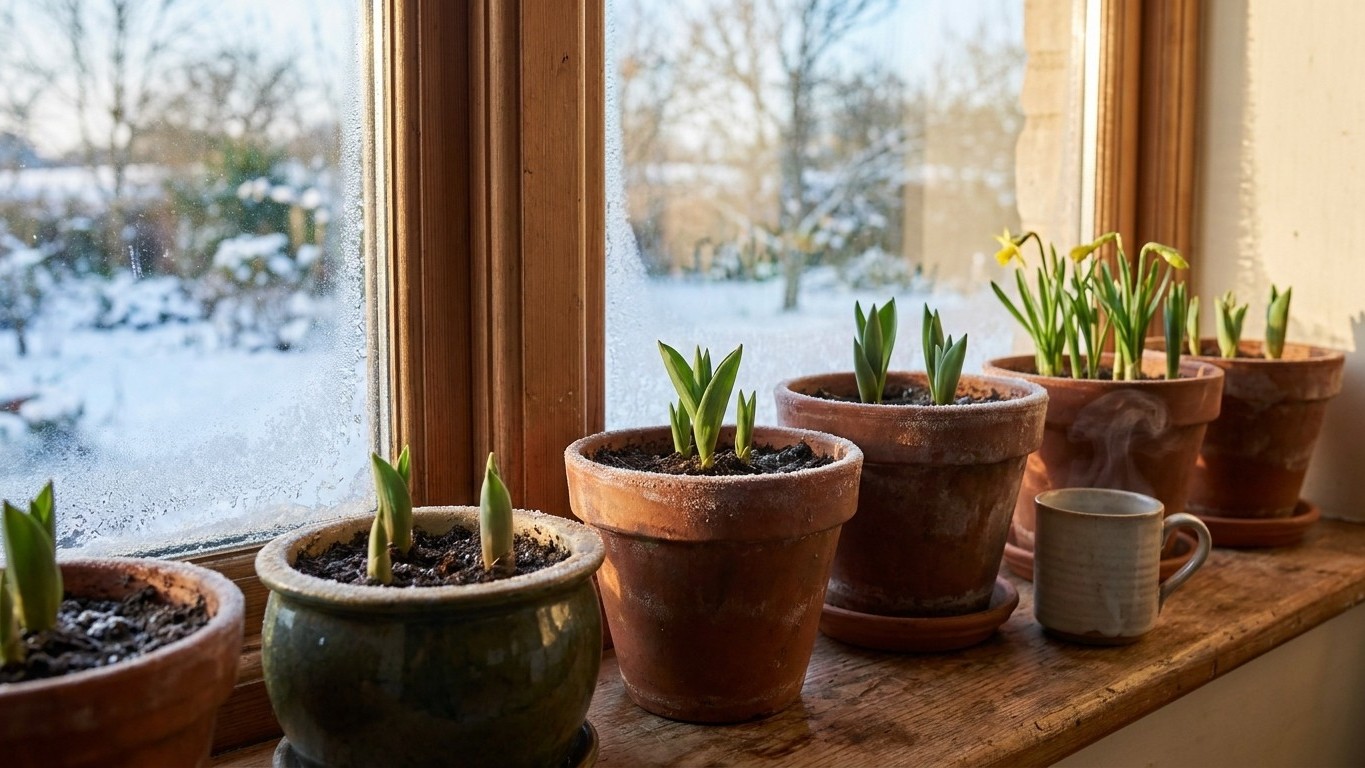

Forcing spring bulbs indoors works in Virginia, but not for the reason most guides assume. The state’s coldest month delivers a mean daily minimum of 31.6°F, plenty of chill for bulbs planted in the ground. The real obstacle is the container itself: a pot freezes through in a way garden soil never does, which is what makes indoor forcing worth doing here.
Why this matters in Virginia

Start with the number: 31.6°F. That’s the mean daily minimum for the coldest month at the Virginia Beach reference station, drawn from NOAA NCEI’s 1991-2020 climate normals. A spring bulb needs roughly twelve to fourteen weeks below 45°F to complete its chilling requirement and bloom on schedule. At 31.6°F, Virginia’s ground temperature during the heart of winter sits well under that ceiling. Planted in a bed, a tulip or daffodil bulb gets all the cold it needs without any help from a gardener.
That fact changes what “forcing” means here. In places where winter never gets cold enough, forcing is a rescue: the gardener supplies artificial chill because the outdoors won’t. Virginia isn’t that place. Ground-planted bulbs across the state, from the coastal plain to the western highlands, receive adequate natural chilling. So forcing indoors in Virginia isn’t compensating for a missing winter. It’s a scheduling trick, used to bring hyacinths or daffodils into bloom on a windowsill in the dead of winter instead of waiting for the garden to catch up in April.
The problem that actually matters here is the container. A garden bed is insulated by the earth around and beneath it, so even during a hard freeze, only the top few inches lock up solid while roots several inches down stay buffered. A pot has no such protection. Cold reaches it from every side, and a container left outside during a cold snap can freeze straight through, roots and all, killing a bulb that would have survived the same temperature in open ground.
Virginia’s hardiness zone range runs from 5a in the western mountains to 8b along the coast, according to the USDA Plant Hardiness Zone Map (2023 edition, built on 1991-2020 normals). That’s a wide spread, and the zone printed on a bulb bag was calculated for in-ground planting, not for a pot sitting on a porch. A bulb rated hardy for a Virginia Beach dated recommendation of zone 8a can still die in a container during the same winter that leaves its garden-planted twin untouched, simply because the pot offers no insulation. That’s the situation this territory is actually in: not a shortage of cold, but a container that experiences cold differently than the bed does.
How to do it here
The sequence below assumes bulbs suited to forcing (tulips, hyacinths, daffodils, crocus, or paperwhites) and a chilling location the reader can check with a thermometer, not guess at.
- Choose bulbs sized for chilling. Firm, full bulbs with no soft spots or mold force more reliably than anything already showing shriveling.
- Pot them shallow and close together. Use a container with a drainage hole, set bulbs so their tips sit just below the soil surface, and pack them nearly touching for a fuller display.
- Water once, thoroughly, right after potting. The soil should be moist but never waterlogged going into the cold period.
- Move the pot to a consistently cold spot for twelve to fourteen weeks. An unheated garage attached to the house often works, since shared walls typically keep it above freezing even when outdoor lows drop close to that 31.6°F range. A refrigerator drawer works too, but keep it away from ripening fruit: the ethylene gas fruit releases will damage the flower bud inside the bulb before it ever gets a chance to open.
- Check the soil monthly. Water lightly if it’s gone dry; the goal is cool and slightly moist, not soggy, for the full chilling period.
- Look for roots and pale shoots at the twelve-week mark. Tip the pot to check for roots at the drainage hole, and watch for shoots pushing up an inch or two. That’s the sign the chilling requirement is met.
- Bring the pot into bright, indirect light for a few days before full warmth. Skipping straight from a cold garage to a sunny window shocks the bulb and rushes the bloom stalk.
- For pots staying outdoors instead of coming inside, treat the container as two zones colder than its hardiness rating, or move it into that same unheated garage and mulch it heavily. Given how wide Virginia’s 5a-8b range runs, a pot left outdoors anywhere in the state should be planned around the coldest zone in that range, not the mildest.
Which bulbs are worth it
Not every bulb rewards the effort of forcing. The ones that work fastest have a short natural chilling requirement and a stem that stays upright in a shallow pot. The ones that disappoint usually need a long chill, grow tall, or simply weren’t built for container life.
Reliable forcers
- Paperwhite narcissus, which needs no chilling at all and blooms in three to four weeks from potting
- Hyacinths, with a short eight- to ten-week chill requirement and a sturdy, compact stem
- Crocus, small and fast, rarely needs staking
- Muscari (grape hyacinth), short-stemmed and dependable
- Small species tulips, which stay compact enough to avoid toppling indoors
Bulbs that sulk
- Tall Darwin hybrid tulips, whose stems stretch and flop in a shallow pot without garden soil to anchor the roots
- Large trumpet daffodils, which need a long chill and often produce floppy stems indoors
- Amaryllis, which isn’t a chilling bulb at all and follows a different process entirely
Worth noting: most bulbs forced indoors, especially tulips and hyacinths, rarely rebloom well after the ordeal of forcing and are typically discarded once the flowers fade. That’s not really a downside in Virginia. Paperwhites in particular aren’t hardy outdoors here regardless of zone, so forcing them indoors costs nothing in the long run. The bulb was never going to survive a Virginia winter in the ground either way.
What goes wrong, and when you can still fix it
Leaves but no flower
This means the cold period was too short, or the storage spot warmed above 45°F at some point during the twelve to fourteen weeks. The bulb built foliage but never finished the chilling that triggers a flower bud. Nothing rescues this season’s plant. The fix is a full, uninterrupted chill next time, checked with a thermometer rather than assumed.
A flower buried low in the foliage, on a stem too short to see
The bulb was warmed too fast after chilling, straight from a cold garage into full sun or a heated room, so the flower opened before the stem had time to elongate. This bloom can’t be salvaged. Next attempt, move the pot into bright but indirect light for several days before full warmth and direct sun.
Rot in the pot
Soft, moldy bulb bases mean the container sat too wet for too long, usually from a missing drainage hole or overwatering during the cold weeks. Once the base has turned soft, the bulb is finished, not salvageable this season or next. Repotting with proper drainage and a lighter watering hand during chilling prevents the repeat.