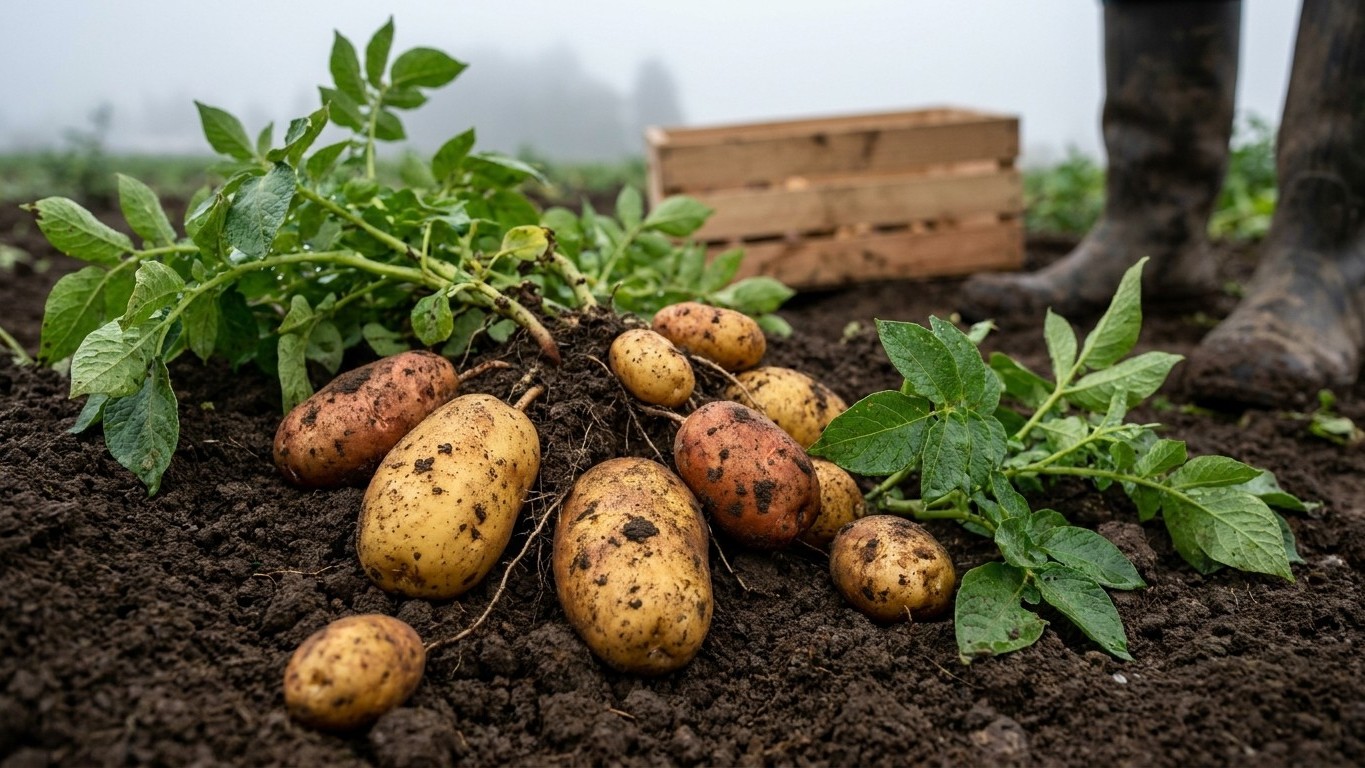

Washington’s potato season is decided by cold, wet spring soil, not summer heat. West of the Cascades, Seattle averages just 3.0 days a year at 90 F or above (NOAA NCEI, 1991-2020), so tuber sizing rarely gets shut down by heat. The harder question is timing a planting into a maritime spring that stays cold and soggy long after the last frost has passed.
The short answer
Two numbers set the frame here. The first is heat load: Seattle’s reference station logs an average of 3.0 days a year at 90 F or hotter, according to NOAA NCEI Climate Normals covering 1991-2020. That is a trivial heat load compared with the interior West or the Southern Plains. The second is the frost calendar: at station USW00024233, the last spring freeze at 32 F falls somewhere between February 27 and March 18, based on the 30-70% probability band in the same NOAA NCEI dataset.
Put those two together and the answer for western Washington is that summer heat almost never stops a potato crop from sizing. Utah State University Extension’s fact sheet on garden potatoes identifies the mechanism gardeners in hot states have to plan around: soil temperatures above 90 F inhibit tuber set and fill. With only 3.0 days a year reaching that air temperature in Seattle, and soil lagging behind air temperature besides, the western part of the state essentially never brushes up against that ceiling. A gardener here can run a full-season crop from spring planting through Harvesting and Storing Potatoes in Washington without the crop stalling from heat the way it would in a desert climate, though choosing among Potato Varieties That Suit Washington still matters for matching maturity length to this cool, wet spring window.
Why the frost date Matters More Than the heat number
That does not make Washington an easy state to plant early in. The frost window itself, February 27 to March 18, sounds mild, and it is, but a mild frost date is not the same thing as workable soil. Western Washington’s spring is defined by persistent rain and low light more than by cold snaps, and soil can stay too wet and too cool to plant well past the point when the last freeze has technically passed. The frost date tells a gardener when the air stops freezing. It does not tell them when the ground is ready.
One more caveat matters before moving to dates: this whole picture, the 3.0-day heat count and the February-to-March frost window, comes from a station in western Washington. East of the Cascades, the climate turns to high desert with a shorter, more temperature-swingy season, and neither of these figures should be assumed to carry over. There is no substitute there for checking a local station.
When to plant here
For specifics on When to Plant Potatoes in Washington, the planting date for potatoes is not a calendar date at all. It is a soil temperature trigger, and the frost window is only the tool used to estimate when that trigger will likely be met. Here is how to work it out for western Washington, and how to redo the same math for any other county.
- Start from the local last-frost window. For the Seattle reference station, NOAA NCEI’s 1991-2020 normals place the last 32 F freeze between February 27 and March 18.
- Count backward 14 to 21 days. Utah State University Extension and the University of Maine Cooperative Extension (Bulletin #2077) both describe planting potatoes 14 to 21 days ahead of the last frost date, timed to soil conditions rather than the calendar. Applied to the early end of the window, February 27 minus 14 to 21 days lands in early to mid-February. Applied to the later end, March 18 minus 14 to 21 days lands in late February to early March.
- Confirm the soil, not just the date. The actual go signal is soil temperature at 50 F, measured a few inches down, not a date on paper. In a wet, slow-warming Puget Sound spring, that 50 F mark can arrive later than the frost-date arithmetic suggests, especially in a cold or rainy year.
- Delay rather than force it. Planting seed potatoes into soil that is still cold and saturated invites rot before the eyes ever sprout. If the calculated window arrives during a stretch of heavy rain, waiting a week costs far less than replacing rotted seed.
The takeaway for anyone outside the Seattle area: run the same backward count using your own county’s frost window, then let the soil thermometer make the final call.
What the heat does to the crop
The mechanism behind this entire page is simple, and it is worth stating plainly because it is the one thing watering cannot undo. Utah State University Extension and the University of Maine Cooperative Extension both describe the same threshold: once soil temperature climbs above 90 F, tuber set and tuber fill are inhibited. The plant does not just slow down, it effectively stops adding size to the tubers already forming underground. No amount of irrigation reverses that once the soil has crossed the line, because the block is thermal, not a matter of moisture.
For most of Washington west of the Cascades, this ceiling is close to irrelevant in practice. An average of 3.0 days a year above 90 F air temperature at the Seattle reference station means soil temperatures crossing 90 F are rare events, not a routine summer condition. That is a very different situation from states where 90 F afternoons stack up for weeks, forcing gardeners to plant early and dig before the hottest stretch of summer arrives.
The practical result is that a gardener in western Washington can generally treat this as a full-season crop rather than a race against a spring-only window. Plant when the soil hits 50 F, let the plants run through the growing season, and expect the heat ceiling to matter only in an unusually hot year or in a warm microclimate, such as a south-facing slope or a spot shielded from marine air. That is a real difference from the interior West, where the same Utah State University Extension guidance pushes gardeners toward digging a spring crop before the summer heat arrives, because there the 90 F threshold gets crossed routinely rather than rarely. In Washington, the constraint sits at the start of the season, in cold wet soil, not at the end of it in scorching afternoons.
None of this applies with confidence to the dry side of the state. Eastern Washington’s high-desert climate almost certainly runs hotter through summer, but no verified day-count for that region is included in the figures behind this page, so it should not be assumed to match Seattle’s 3.0-day average.
What goes wrong here
- Planting uncertified seed potatoes. Grocery-store potatoes and seed saved from a home garden can carry viruses that stunt yield and spread through the soil. Certified seed potatoes are inspected for these problems before sale, and buying certified stock is the single easiest way to avoid inheriting a disease problem before the season even starts.
- Planting into soil that is still cold and wet. Western Washington’s slow, rainy spring makes this the most common mistake in the state. Seed pieces sitting in cold, saturated soil are prone to rot before they sprout. Waiting until soil temperature reaches 50 F, even if that means planting later than the frost-date arithmetic suggested, protects the seed piece.
- Skipping the hilling and ending up with green tubers. Potatoes that develop near the soil surface and get exposed to sunlight turn green and produce solanine, a compound that makes them unsafe to eat. Hilling soil up around the base of the plants as they grow keeps developing tubers covered and light-blocked.
- Digging the crop too early. Because Washington’s mild heat load allows a full-season crop rather than forcing an early spring harvest, there is little reason to rush the dig. Pulling tubers before they have finished sizing trades yield for impatience, when the state’s climate does not require that trade-off the way a hot-summer state would.
Checking this against your own county
A statewide frost window is a starting point, not a working instruction for every backyard. Elevation changes, and the split between the mild, maritime west side and the high-desert east side, can move planting windows by weeks in either direction from the Seattle figures used here. A garden in the foothills of the Cascades, or anywhere east of them, is working with a different frost calendar entirely, even though it shares a state border with Seattle.
The reliable way to confirm actual dates for a specific county is to check with Washington State University Extension, which maintains local guidance tuned to conditions well outside what a single reference station in Seattle can capture.
Common questions
Does Washington’s summer heat ever stop potatoes from sizing?
Rarely in the western part of the state. With an average of only 3.0 days a year at 90 F or above at the Seattle reference station, the soil-temperature ceiling that inhibits tuber set and fill is seldom reached. Eastern Washington’s high-desert conditions are not covered by this figure and may behave differently.
Should I plant as soon as the last frost passes?
No. The frost date only marks when freezing air becomes unlikely. Actual planting should wait until soil temperature reaches 50 F, which in a cold, wet Puget Sound spring can lag well behind the calendar date.
What potato variety types suit this climate best?
Rather than a days-to-maturity number, which neither Utah State University Extension nor the University of Maine Cooperative Extension publishes, choose by season class and use. Early-season types suit gardeners who want a quicker harvest; mid-season and late-season types suit a full-length growing season, which Washington’s mild heat load generally allows. Within those classes, choose by intended use, such as baking or boiling, since that is the distinction the extension sources actually document.
Why does uncertified seed matter so much?
Uncertified seed potatoes can carry viruses invisible to the eye that reduce yield and persist in garden soil for future seasons. Certified seed has been inspected specifically to avoid that risk, which makes it worth the extra cost.