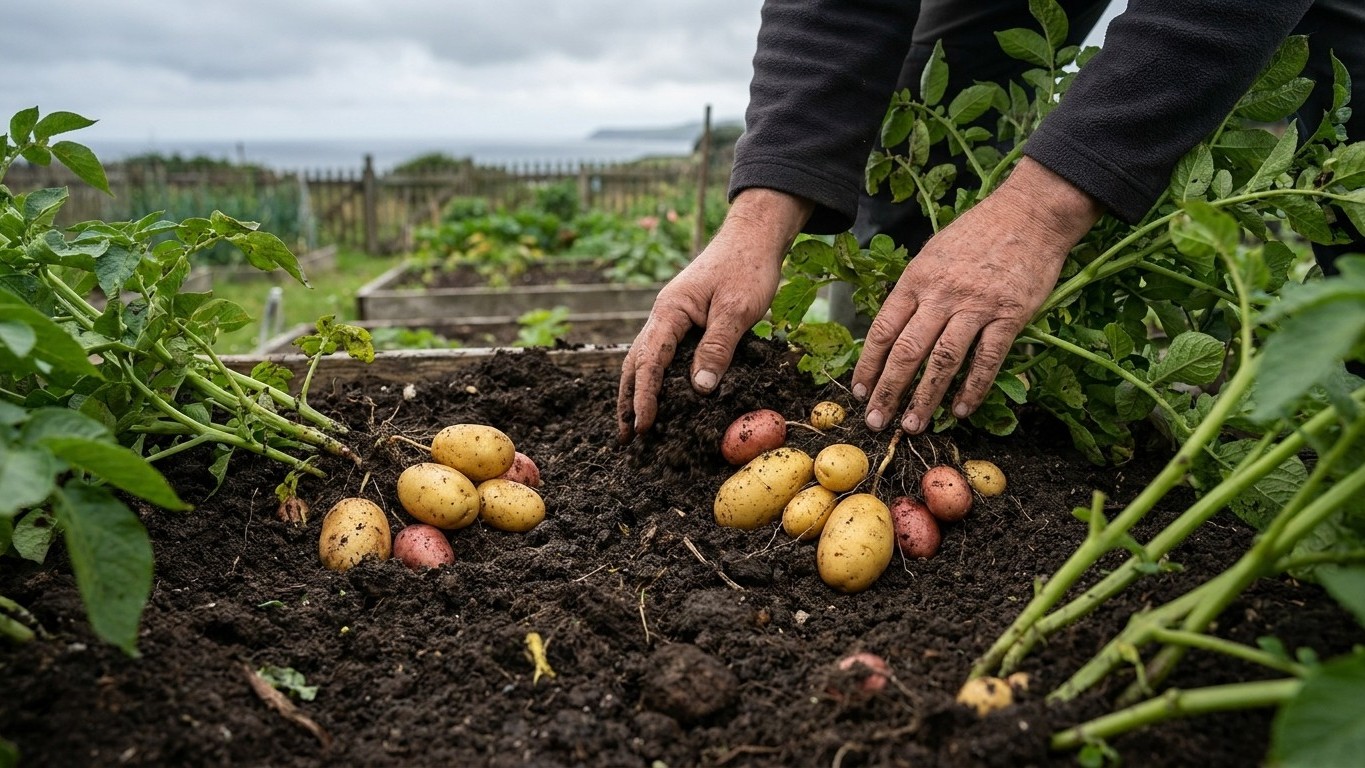

Newfoundland and Labrador never gives potatoes a heat problem. St. John’s averages 0.0 days a year at 90 F or above under the 1981-2010 climate normals, so the threshold that stops tuber set and fill in Utah State University Extension’s guidance simply doesn’t apply here. The real clock on this crop is the frost window: soil needs to hit 50 F, 14 to 21 days before the mean last spring frost of May 30 at St. John’s.
The short answer

Two numbers set the terms for growing potatoes in this province, and neither of them is a heat number. St. John’s records 0.0 days a year reaching 90 F or higher, according to the Canadian Climate Normals for 1981-2010. Compare that to the interior of a hot-summer state, where a grower might count thirty or forty such days and plan around them, and the difference is total: heat load simply isn’t part of the equation on the Avalon Peninsula or most of the island.
The second number is the mean last spring frost date at the ST JOHN’S A station: May 30, from the same 1981-2010 normals published by Environment and Climate Change Canada. That date is a mean, not a guarantee. In roughly half the years on record, frost arrived after it. Treat it as the middle of a window, not a line you can plant right up against, and consult a When to Plant Potatoes in Newfoundland and Labrador guide before setting your dates, and plan ahead using a Harvesting and Storing Potatoes in Newfoundland and Labrador guide for the other end of the season.
Put the two together and the picture is clear. Utah State University Extension identifies 90 F soil temperature as the ceiling above which tuber set and fill shut down, a threshold that matters enormously in hot states and barely at all here. With St. John’s sitting at zero days a year above that mark, a Newfoundland and Labrador gardener isn’t racing to get a crop out of the ground before summer heat arrives. There’s no such heat to outrun.
So what actually limits the crop
What limits potatoes here isn’t heat, it’s the length and coolness of the growing season itself, and the timing of that late spring frost. A grower in this province plants when soil warms enough for the seed piece to sprout, not when a heat ceiling forces an early harvest. That single distinction, drawn from Utah State University Extension’s own framework for reading a climate against this crop, is the reason the planting calendar and the failure list further down look the way they do.
Because tuber fill is never at risk from soil overheating, a gardener here has more flexibility on variety choice than a grower in Georgia or Texas. Both University of Maine Cooperative Extension and Utah State University Extension classify varieties by season length, early, mid-season, or late, rather than by a day count, and in a province with no 90 F days, a late-season type has room to complete its cycle without running into the heat wall that would stop it elsewhere, a point worth weighing against this list of Potato Varieties That Suit Newfoundland and Labrador. The tradeoff moves to the other end of the calendar: whether the season is long enough, cool as it is, for a late variety to finish before fall frost returns.
When to plant here
Work backward from the frost date instead of forward from a date on a seed packet. That’s the method both extension sources point to, and it travels to any county once you know your own local frost mean.
- Start with the mean last spring frost for your reference station. For St. John’s, that’s May 30, per Environment and Climate Change Canada’s 1981-2010 normals.
- Remember that figure is a midpoint. In about half the years on record at that station, frost fell later than May 30, so treat the date as the center of a window, not a safe cutoff.
- Subtract 14 to 21 days from that mean date. That’s the window Utah State University Extension and University of Maine Cooperative Extension both point to for potato planting, timed to when soil temperature reaches 50 F rather than to the calendar alone.
- Check soil temperature directly instead of guessing from air temperature. A soil thermometer pushed a few inches into the row is the only way to know the ground has actually reached 50 F, since a warm afternoon can mislead you about what’s happening below the surface.
- Plant once soil sits at or above 50 F within that 14 to 21 day window before your local mean frost date, accepting that a late frost in any given year may still nip early growth, which the plant generally shrugs off if the frost is light.
Run the same arithmetic for a county with a different mean frost date and the method still holds. A location in Labrador or an inland, elevated part of the island will run its own mean frost date later than St. John’s, which pushes this whole sequence later by however many days or weeks that difference amounts to.
What the heat does to the crop
The mechanism matters more than the province it’s applied to, because it’s the same mechanism everywhere potatoes grow. Utah State University Extension is explicit: once soil temperature climbs above 90 F, tuber set and fill are inhibited. The plant doesn’t just slow down, it stops putting size onto the tubers already forming, and no amount of irrigation reverses that. Watering keeps the plant alive and green, but it does not restart tuber bulking once soil heat has shut it off.
That’s the mechanism a gardener in Arizona or inland California has to plan an entire season around, often digging a spring crop before the heat arrives rather than trying to carry potatoes through a hot summer. It’s also the reason a state’s day count at 90 F or higher is the single most useful number on this topic: it tells you whether you’re fighting that ceiling at all.
In Newfoundland and Labrador, the fight doesn’t exist. St. John’s averages 0.0 days a year at 90 F or above, so soils here essentially never cross the line where tuber set and fill are inhibited by heat. A gardener planting in this province isn’t digging a rushed spring crop to beat a heat wave that never comes. The growing window is bounded by the cool, short season and by frost at either end, not by a heat ceiling in the middle of summer.
That doesn’t mean watering becomes unimportant. Potatoes still need consistent moisture through tuber formation regardless of temperature, and a dry stretch in a Newfoundland summer can still stunt bulking even without any heat stress involved. The point is narrower: if a crop underperforms here, soil overheating from a 90 F event is not the explanation, because that event essentially doesn’t happen at this reference station.
What goes wrong here
- Uncertified seed potatoes. Seed saved from a grocery-store potato or an unverified source can carry viruses that stunt the whole crop and persist in your soil for future plantings. Buy certified seed potatoes from a reputable supplier every season rather than reusing your own tubers indefinitely.
- Planting into cold, wet soil. Pushing seed pieces into ground that hasn’t reached 50 F, chasing an early date on the calendar rather than a soil reading, invites rot before the plant ever sprouts. Check soil temperature directly and wait for it, even if that means planting later than a neighbor in a warmer microclimate.
- Skipping the hilling. Tubers that form close to the surface and get exposed to light turn green and develop solanine, a compound that makes them unsafe to eat. Hill soil up around the stems as the plants grow so developing tubers stay covered throughout the season.
- Digging too early. In a cool, short-season climate, pulling potatoes before the plant has had its full time to bulk leaves you with small, immature tubers. Wait for the foliage to yellow and die back before harvesting the main crop, rather than digging on an assumed date.
Checking this against your own county
A province-wide frost mean is a starting point, not an instruction you can apply everywhere from Corner Brook to Labrador City. Elevation changes soil warm-up speed, and a location further north or further inland from the moderating effect of the Atlantic will run its frost dates later, sometimes by weeks rather than days. The May 30 mean is drawn from the ST JOHN’S A station specifically, and it describes that station’s climate, not the whole territory’s.
Before locking in a planting date, check conditions against your own location through the Newfoundland and Labrador Department of Fisheries, Forestry and Agriculture. Local guidance there will reflect your county’s actual frost pattern and soil conditions far better than a single reference station can.
Common questions
Does summer heat ever limit potato yields in Newfoundland and Labrador?
Essentially no. St. John’s averages 0.0 days a year reaching 90 F or above under the 1981-2010 climate normals, and that’s the threshold Utah State University Extension identifies as the point where tuber set and fill are inhibited. Yield problems here trace back to season length, moisture, or frost timing, not soil overheating.
What variety season class should I choose here?
Because heat never forces an early harvest in this climate, a late-season variety has room to complete its cycle, provided the cool season itself is long enough. Both Utah State University Extension and University of Maine Cooperative Extension classify varieties as early, mid-season, or late rather than by a specific day count, and neither publishes a days-to-maturity figure to plan against.
How reliable is the May 30 frost date for planning?
It’s a mean, not a guarantee, drawn from the ST JOHN’S A station’s 1981-2010 normals. In roughly half the years on record, frost occurred after that date. Use it as the center of a planning window and lean toward planting a little later rather than a little earlier if you’re unsure.
Can I reuse my own potatoes as seed next season?
It’s a common shortcut, but it carries real risk. Home-saved tubers can harbor viruses invisible to the eye that will weaken next year’s plants and can build up in your soil over successive seasons. Certified seed potatoes from a verified supplier remove that risk each time you plant.
Related guides
- Forcing Spring Bulbs Indoors in Newfoundland and Labrador
- The Best Melons to Grow in Newfoundland and Labrador
- The Newfoundland and Labrador Apple Calendar, Stage by Stage
- Newfoundland and Labrador Garden
- Growing Potatoes in Washington: Dates, Varieties and Summer Heat
- Growing Potatoes in Alabama: Dates, Varieties and Summer Heat