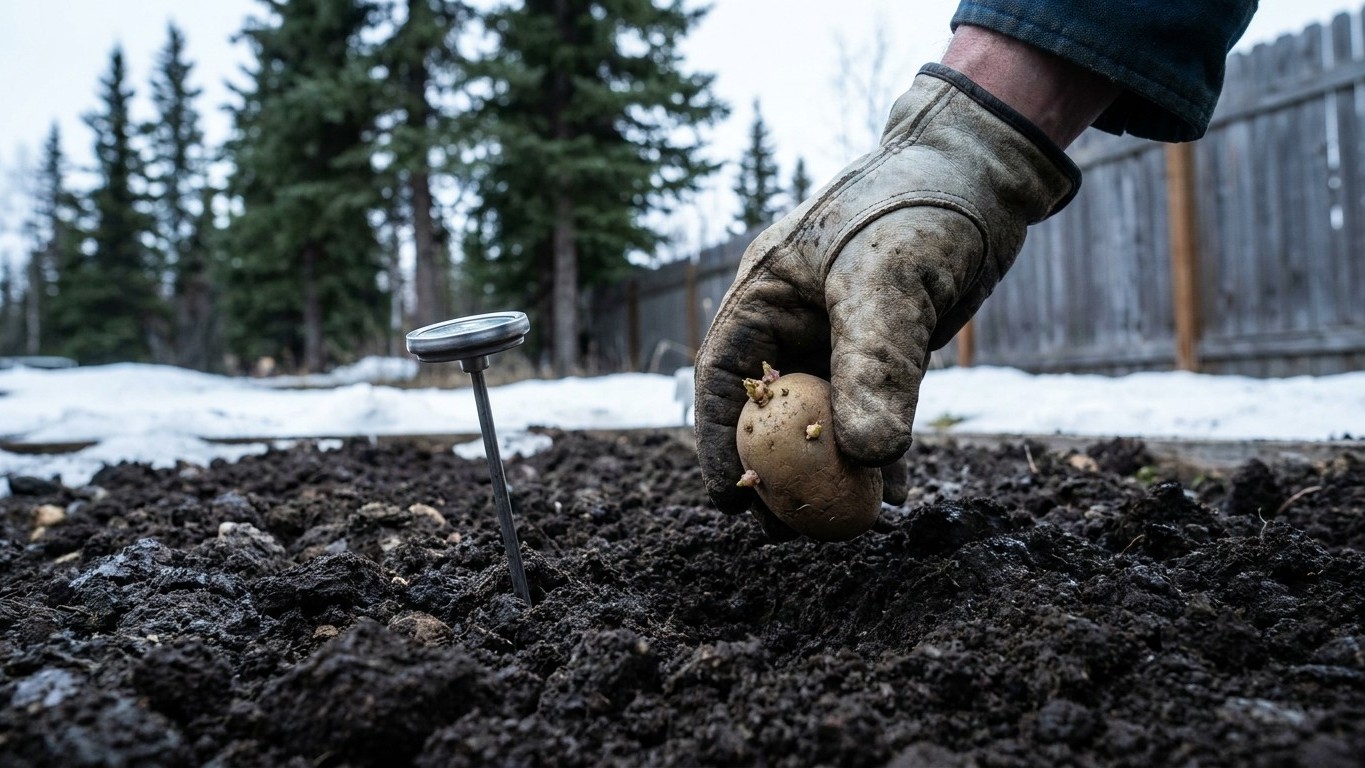

Plant Potatoes in Anchorage between April 12 and April 28, counting back 14 to 21 days from the local last-frost window of May 3 to May 12 (NOAA NCEI 1991-2020 Climate Normals, station USW00026451). The actual trigger isn’t a date on a calendar, it’s soil temperature: seed potatoes go in once the ground reaches 50°F, according to Utah State University Extension. That window shifts with elevation, slope, and how fast a particular garden’s soil warms each spring.
The short answer
Anchorage’s last spring frost falls somewhere between May 3 and May 12, based on the 1991-2020 Climate Normals from NOAA NCEI for station USW00026451. That’s a range, not a single day, because frost probability is a curve, not a switch. Subtract 14 to 21 days, the lag Utah State University Extension and the University of Maine Cooperative Extension both cite between soil hitting 50°F and the calendar reaching last frost, and the planting window lands between April 12 and April 28 for anyone gardening near that Anchorage reference point.
That’s the number worth writing on the shed calendar, but it belongs to Anchorage specifically, not to Alaska as a whole. NOAA NCEI ties this frost data to a single station, and a state this size holds enormous variation. Anchorage also sits with roughly 143 frost-free days a year, which puts it among the mildest inhabited parts of the state. Move into the Interior, and that count drops hard. Move north, and it drops further still. A gardener in Fairbanks or Bethel working from the Anchorage figure will plant too late, then wonder why the crop never sizes up before fall.
Long daylight is the part of this equation that doesn’t show up in a frost table but changes how the season plays out anyway. Alaska’s summer light hours run far longer than the Lower 48 at the same calendar point, and that extra light partly offsets the short frost-free window. It doesn’t move the planting date. It does mean a crop planted on time can catch up faster than the frost-free day count alone would suggest, which is one reason Alaska growers can still bring in a respectable potato harvest despite a growing season most of the country would consider unworkably short.
None of this replaces checking a local soil thermometer. The 50°F soil threshold is the real gatekeeper, and it can arrive earlier or later than the frost-date math suggests depending on how a specific plot drains, whether it faces south, and how much snow sat on it that spring.
What actually decides it
Soil temperature, not the calendar
The date on the wall is a proxy. What actually decides planting is whether the top several inches of soil have reached 50°F, the threshold Utah State University Extension and the University of Maine Cooperative Extension both use for potatoes. Two gardens ten minutes apart can hit that mark days apart. A raised bed with dark soil, good drainage, and southern exposure warms faster than a low, wet, shaded plot even if both sit under the identical last-frost window. This is why the 14-to-21-day count-back is a starting estimate to confirm with a thermometer, not a fixed appointment.
The heat ceiling nobody warns you about
Alaska’s problem is almost never too much heat, but the mechanism still matters everywhere potatoes grow, and it flips the whole planning logic in warmer states. Above 90°F soil temperature, tuber set and fill shut down, according to Utah State University Extension, and watering does not reverse it once it happens. In places where summer soil regularly crosses that ceiling, the right move is to plant early and pull a spring crop before the heat arrives, not to keep watering a plant through a hot stretch expecting it to catch up. Alaska’s short, cool season rarely pushes soil that high, which is actually a structural advantage even though the frost-free window itself is tight.
What changes the answer for a case this page doesn’t cover
Any Alaska garden outside the Anchorage reference point needs its own frost data and its own soil check, because elevation, distance from the coast, and local microclimate all move the last-frost date independently of each other. A garden a few hundred feet higher than the valley floor near it can run a week or two behind. A plot next to a large body of water often lags behind one further inland, since water moderates temperature swings on both ends of the season. None of these local shifts change the underlying rule: soil at 50°F triggers planting, and the count-back from the local last frost is only as accurate as the frost data behind it.
How to do it
- Confirm the local last-frost window using NOAA NCEI Climate Normals for the closest available station, not a statewide average, since frost dates vary by station.
- Count back 14 to 21 days from that window to get a planting range, per Utah State University Extension and the University of Maine Cooperative Extension.
- Check actual soil temperature at planting depth with a soil thermometer rather than relying on the count-back alone; 50°F is the trigger both extension sources cite.
- Buy certified seed potatoes rather than saving grocery-store tubers or last year’s harvest; uncertified seed carries virus that builds up in a plot over time and quietly reduces yield year after year.
- Choose a season class suited to a short growing window: an early or mid-season type gives more margin than a late one where the frost-free stretch runs around 143 days near Anchorage.
- Cut larger seed potatoes into pieces with at least one eye each, then let the cut surfaces callus for a day or two before planting, reducing rot risk in cool spring soil.
- Plant into soil that has already reached the 50°F threshold, spacing pieces to allow room for hilling as plants grow.
- Hill soil up around the stems as the plants develop, which protects new tubers from light exposure and from any late, shallow frost that reaches the surface.
- Watch soil temperature again in mid-summer; if a stretch pushes soil unusually warm, that’s the mechanism to monitor even though Alaska rarely crosses the 90°F ceiling that stalls tuber fill elsewhere.
What goes wrong
- Planting by a statewide date instead of a local one. A single “Alaska” planting date doesn’t exist; NOAA NCEI ties frost data to specific stations, and Anchorage’s May 3-12 window says nothing about the Interior or the north. Pull frost data for the closest reference city, not the state as a whole.
- Trusting the calendar over the soil. Counting back 14 to 21 days gives an estimate, but a cold, wet spring can leave soil below 50°F even after the estimated date arrives. Check with a thermometer before planting rather than defaulting to the calculated date.
- Planting uncertified seed. Grocery-store potatoes and saved tubers can carry virus that doesn’t always show symptoms the first season but builds up in the soil and in future seed stock. Buy certified seed potatoes each time.
- Choosing a late-season variety in a short-season location. Utah State University Extension and the University of Maine Cooperative Extension classify varieties as early, mid-season, or late rather than publishing exact days to maturity, and a late type asks for more of the growing season than a roughly 143-frost-free-day window near Anchorage may reliably provide. Favor early or mid-season types where the season runs short.
- Assuming long daylight fixes a late start. Alaska’s extended summer light helps a properly timed crop grow fast, but it doesn’t rescue a planting that went in weeks late. The daylight advantage compounds a good decision; it doesn’t replace one.
- Ignoring how a specific plot’s exposure changes its frost timing. Two gardens under the same regional frost window can still differ by a week or more once elevation, shade, and proximity to water are factored in. Treat the station-based date as a starting range, then confirm locally.
Common questions
Is May 3 to May 12 the last frost date for all of Alaska?
No. That range comes from NOAA NCEI Climate Normals for a single Anchorage-area station (USW00026451). It reflects one of the mildest inhabited parts of the state; other regions have their own, often much later, frost windows that this data doesn’t cover.
Can I plant potatoes as soon as the snow melts?
Not reliably. Snowmelt doesn’t mean the soil has reached the 50°F threshold that Utah State University Extension and the University of Maine Cooperative Extension identify as the real planting trigger. Check soil temperature directly rather than using snow cover as a proxy.
Does Alaska’s long summer daylight let me plant later and still get a crop?
The extended daylight helps a properly timed planting grow quickly once it’s underway, but it doesn’t substitute for hitting the planting window. A late start still starts late; the daylight advantage compounds good timing rather than replacing it.
Why does the season class of a variety matter more in Alaska than elsewhere?
With roughly 143 frost-free days near Anchorage, and shorter windows elsewhere in the state, a late-season variety may not have enough time to finish before fall frost returns. Choosing an early or mid-season class, the classifications Utah State University Extension and the University of Maine Cooperative Extension actually publish, leaves more margin than guessing at exact maturity length.