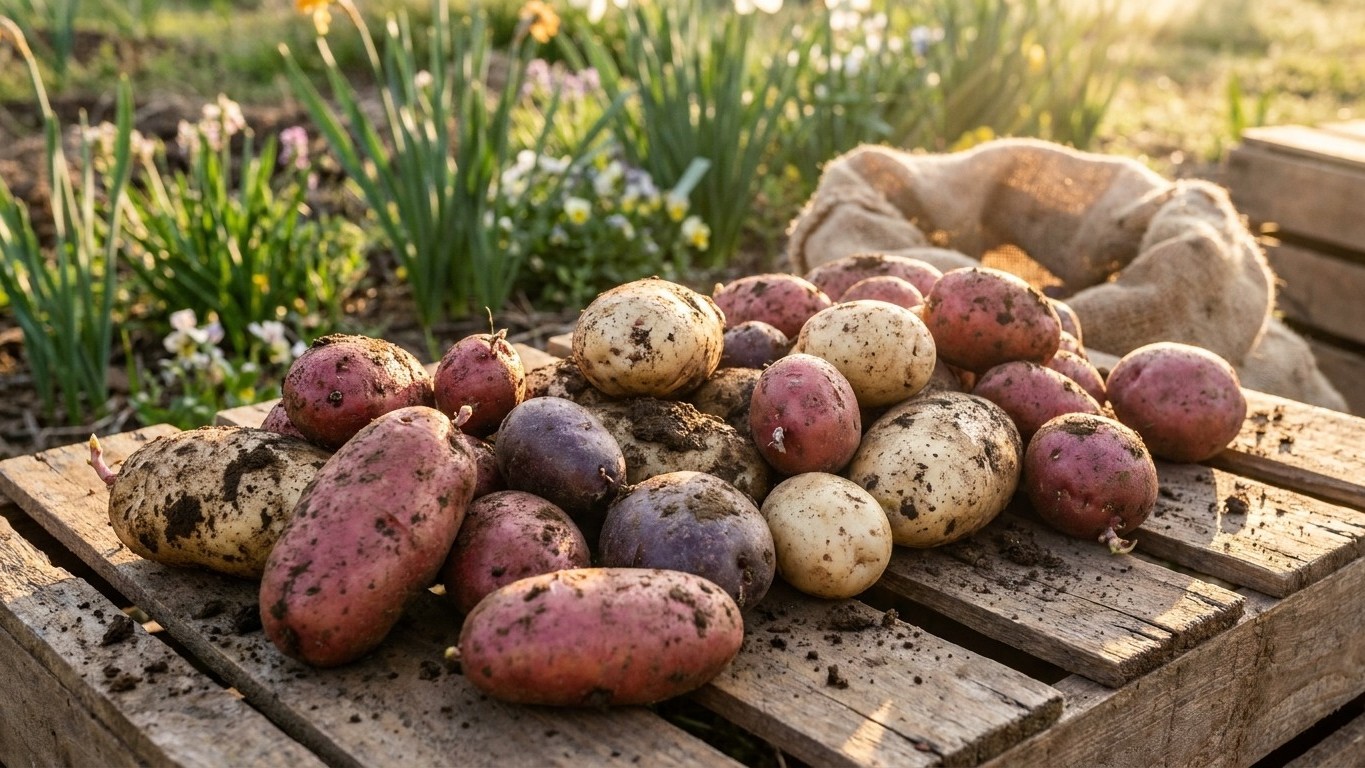

Arkansas gardeners who want potatoes worth digging up should lean toward early to mid-season varieties chosen for baking or boiling, planted as a spring crop rather than a summer one. The state’s soil warms into potato range weeks before frost risk fully clears, then keeps climbing past the point where tubers stop sizing. That timing, not the cultivar name on the seed bag, decides whether the harvest is worth the trouble. Get the planting window and the season class right, and variety choice mostly takes care of itself.
The short answer
At Little Rock, the reference station for central Arkansas, the 32°F last spring frost falls somewhere between March 12 and March 28, according to NOAA’s National Centers for Environmental Information, using the 1991-2020 Climate Normals for station USW00013963. That fifteen-day spread isn’t a rounding error to shrug off. It’s the difference between a crop that sizes up before summer heat shuts tuber growth down, and one that doesn’t.
Potatoes don’t wait for frost to clear before they go in the ground. Soil is planted as soon as it reaches 50°F, which lands 14 to 21 days before that last frost date, according to Utah State University Extension’s fact sheet on potatoes in the garden and the University of Maine Cooperative Extension’s Bulletin #2077. Run that math against the Little Rock window and the planting date for much of central Arkansas sits in late February to mid-March, well before the ground has fully stopped flirting with frost.
That part of the answer doesn’t change: plant early, using soil temperature rather than the frost date itself as the trigger. What does change, county by county, is how much runway that early start buys before the other side of the thermometer becomes the problem. Above 90°F, soil temperature stalls tuber set and fill outright, and watering doesn’t reverse it, per the same Utah State and Maine sources. Arkansas summers cross that line often and for long stretches, which is exactly why a spring-dug crop beats a summer-dug one here.
So the variety question folds into the timing question. Extension guidance groups potatoes by season class (early, mid-season, or late), not by a fixed number of days to maturity; neither source publishes that figure, because it shifts with soil temperature, moisture, and daylight. Both sources agree that an early or mid-season class gives Arkansas gardeners the best odds of finishing tuber bulking before soil temperatures climb past that 90°F ceiling. A late-season class, bred for cooler, longer summers, is working against the Arkansas calendar from the day it’s planted.
What actually decides it
Soil temperature, not the calendar
Two thresholds run this decision, and neither one is a date on a page. The floor sits at 50°F: that’s when Utah State University Extension and the University of Maine Cooperative Extension say seed potatoes go in the ground. The ceiling sits at 90°F: soil above that temperature inhibits tuber set and fill, and no amount of irrigation talks it back down. Everything about variety choice in Arkansas is really a question of how much space exists between those two numbers in a given spot, in a given season.
The frost window sets the countdown
The 32°F last-frost date at Little Rock, March 12 to March 28 per NOAA NCEI, matters less for the planting decision itself and more for how much cushion the gardener has if planting runs early. Because potatoes go in 14 to 21 days ahead of that date, based on soil temperature, a gardener working from the early edge of the window is planting into ground that may still see a hard freeze. That’s a known, accepted tradeoff in the extension guidance, not an error: foliage frost damage is usually recoverable, a stalled tuber crop from summer heat is not.
Where the reference station stops applying
USW00013963 describes Little Rock, not the whole state. The Ozark highlands in the north warm later in spring and hold cooler soil longer into early summer, stretching the workable window before that 90°F ceiling arrives. The Delta and south Arkansas warm earlier and hit the ceiling sooner. A gardener in Fayetteville working from a Little Rock frost date is off by enough days to matter; the fix is checking soil temperature directly rather than borrowing a date from a station across the state.
| Season class | Typical use | Fit for Arkansas’s soil-heat ceiling |
|---|---|---|
| Early | Baking or all-purpose | Usually finishes tuber fill before soil nears 90°F across most of the state |
| Mid-season | Baking or boiling | Workable in the northern Ozarks; a tighter margin in southern and Delta counties |
| Late | Boiling or storage | Frequently caught by rising soil temperature before tubers finish filling |
How to do it
- Check soil temperature directly at planting depth with a soil thermometer, rather than relying on the calendar or air temperature.
- Once the reading holds at 50°F, treat that as the planting signal; it typically arrives 14 to 21 days before the local last spring frost date, so use it to confirm timing rather than override it.
- Buy certified seed potato rather than saving tubers from a previous crop or using grocery store potatoes, because uncertified seed carries virus that weakens the whole planting.
- Choose an early or mid-season class matched to what the crop will be used for, baking or boiling, since Arkansas’s compressed cool season favors classes that finish before soil crosses 90°F.
- Plant as soon as the 50°F soil threshold holds, accepting the small remaining chance of a late frost against foliage rather than waiting for frost risk to disappear entirely.
- Track soil temperature through the growing season and watch for the point it starts pushing toward 90°F, since that’s when tuber set and fill stall regardless of watering or care.
- Dig the crop once soil is approaching that ceiling rather than leaving it in the ground hoping for more size, because heat doesn’t reverse and continued delay mostly invites disease or splitting.
What goes wrong
- Planting by the calendar instead of the soil. Waiting for a marked date on a chart means missing the 50°F window entirely some years. The fix is a soil thermometer at planting depth, checked directly, not a date circled in advance.
- Treating the Little Rock frost window as a statewide rule. The March 12 to March 28 last-frost range from NOAA NCEI applies to station USW00013963, not to the whole state. A gardener in the Ozarks planting on that schedule risks the ground still being too cold; one in south Arkansas risks planting too late to beat summer heat. The fix is checking soil conditions locally rather than importing someone else’s date.
- Buying uncertified seed potatoes. Tubers held over from a previous crop, or potatoes bought for eating, often carry virus that stunts growth and cuts yield. Certified seed potato is the only reliable way around that problem.
- Choosing a late-season class out of habit. A class bred for longer, cooler summers elsewhere is often still filling tubers when Arkansas soil crosses 90°F. Switching to an early or mid-season class matched to the state’s compressed cool window fixes this before planting even happens.
- Leaving the crop in the ground through peak summer heat. Once soil sits above 90°F, tuber fill has already stalled, and extra time in the ground mostly adds risk of rot or pest damage rather than more size. Dig as the ceiling approaches, not after it’s been crossed for weeks.
Common questions
Can Arkansas gardeners get a fall crop of potatoes?
Neither Utah State University Extension nor the University of Maine Cooperative Extension publishes fall-planting guidance for potatoes on this page’s sourcing, so that specific timing isn’t covered here. What both sources do establish is the 90°F ceiling on tuber fill, which means any second planting would need soil to cool back down out of that range before tubers could size, regardless of the calendar month.
Which season class is best for baking, and which for boiling?
Extension guidance classifies potatoes by what they’re for, baking or boiling, rather than by days to maturity. For Arkansas’s short workable window, early and mid-season classes are the practical choices in both categories; a late-season class bred for a longer cool stretch struggles to finish before the state’s soil crosses 90°F, whatever it’s intended for at the table.
How do I know when my soil has actually reached 50°F?
The extension fact sheets used here point to soil temperature at planting depth as the trigger, checked directly with a soil thermometer, rather than air temperature or a fixed date. Beyond that, specific measurement technique isn’t detailed in the sources cited for this page.
Is certified seed potato really necessary, or is it just an upsell?
It matters. Seed potatoes saved from a previous harvest, or tubers bought for eating, commonly carry virus that a home gardener can’t see or test for. Certified seed is grown and inspected specifically to keep that virus load out of the planting, which is the reason extension guidance treats it as a starting requirement rather than an optional upgrade.