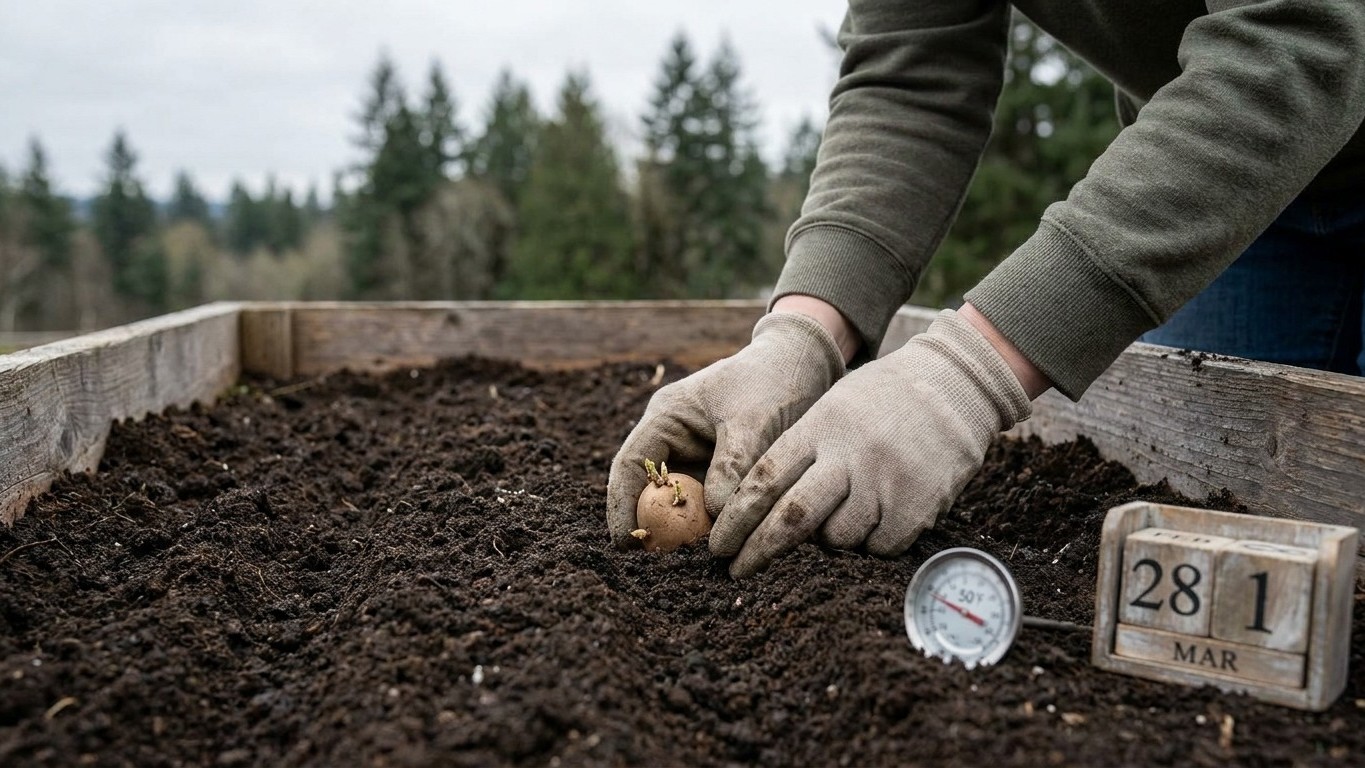

The average last spring frost at Vancouver Int’l A is March 18, according to Environment and Climate Change Canada’s Canadian Climate Normals (1981-2010). Counting back 14 to 21 days from that date, as both Utah State University Extension and the University of Maine Cooperative Extension recommend, puts potato planting near the end of February to early March at that coastal reference point. But that’s one station, one average, and British Columbia isn’t one climate.
The short answer
Start with the number itself: March 18 is the mean last spring frost date recorded at Vancouver Int’l A, based on the 1981-2010 Canadian Climate Normals published by Environment and Climate Change Canada. Potatoes go into the ground when the soil itself reaches 50 degrees Fahrenheit, and that point typically arrives 14 to 21 days before the last frost date, per Utah State University Extension and the University of Maine Cooperative Extension. Run that math against Vancouver’s average and you land somewhere in late February through early March for that specific reference city.
That figure deserves a plain warning before anyone circles a date on a calendar. A mean last frost date is exactly what it sounds like: the midpoint of a range, not a guarantee. In one year out of two, frost at Vancouver Int’l A arrives later than March 18. The other half of the time, it comes earlier. Treat the date as the center of a window, not a line you can plant right up against.
Vancouver Int’l A also isn’t a stand-in for the whole province. British Columbia stretches from mild coastal lowlands to interior valleys with sharp temperature swings to northern districts where spring arrives on its own schedule. A gardener in the Okanagan or the Peace region working from a Vancouver-based frost date is working from the wrong number entirely. The mechanism (count back from your local last frost, watch the soil, not the sky) stays the same everywhere. The date itself does not travel.
One more note on precision: the Canadian Climate Normals used here cover 1981 to 2010. If you’ve read planting guidance for US states on this site, those figures come from the 1991-2020 normals published by NOAA. The two periods aren’t identical, and stacking a Canadian 1981-2010 average directly against a US 1991-2020 average isn’t a fair comparison. Each number is sound on its own; they just weren’t built from the same clock.
So the short answer holds only as a starting point: late February to early March near Vancouver, adjusted hard for wherever you actually garden, and always checked against soil temperature before the spade goes in.
What actually decides it
The calendar date is a convenience. The soil is what actually runs the schedule, and understanding why changes how you’d answer this question for a garden this page never mentions.
Soil temperature, not the calendar
Potatoes are planted as soon as the soil reaches 50 degrees Fahrenheit, according to Utah State University Extension. That threshold is a biological one, not an aesthetic one: below it, seed pieces sit in cold, often wet ground and rot before they sprout. The 14-to-21-day window before the average last frost exists because soil in most temperate regions typically crosses 50 degrees around that time, not because the frost date itself matters to the tuber. Two gardens with the same last-frost date can hit 50-degree soil weeks apart if one has heavier, wetter clay and the other has light, quick-draining loam that warms faster in the same weak spring sun.
The 90-degree ceiling at the other end
The other boundary is heat, and it’s the one gardeners underestimate. Tuber set and fill are inhibited once soil temperatures climb above 90 degrees Fahrenheit, per Utah State University Extension and the University of Maine Cooperative Extension’s Bulletin #2077. This isn’t a wilting problem that more water solves. Once the soil bakes past that ceiling, the plant simply stops sizing tubers, no matter how much irrigation follows. In a region where summer soil regularly crosses 90 degrees, the answer isn’t to plant later and coddle a summer crop through the heat. It’s to plant as early as the 50-degree threshold allows and treat the harvest as a spring crop, finished and dug before the ceiling arrives.
Local geography changes the frost date
Elevation, distance from the coast, and valley versus open-slope position all shift a local last-frost date away from any single reported station. A property tucked in a low frost pocket can see frost weeks after a station just a few miles away reports its average has passed. That’s the reasoning to carry forward: find the mechanism (soil temperature bracketed by a frost floor and a heat ceiling), then apply it to your own ground, not to a station report from across the region.
How to do it
- Identify the last-frost data closest to your actual garden, not a province-wide figure, since a single average like Vancouver’s March 18 only describes that station’s location.
- Buy a soil thermometer and start checking it at planting depth once the ground has begun to thaw and dry out in spring.
- Mark a target window 14 to 21 days before your local last-frost date, using that window as a planning range rather than a fixed date.
- Wait for the soil reading itself to reach 50 degrees Fahrenheit before planting, letting that measurement override the calendar window if the two disagree.
- Buy certified seed potatoes rather than saving pieces from a previous harvest or using grocery-store potatoes, since uncertified seed carries virus that weakens the crop from the start.
- Choose a season class, early, mid-season, or late, based on how much heat your local growing area accumulates before soil regularly exceeds 90 degrees Fahrenheit.
- Plant the seed pieces once soil temperature and timing align, and hill the rows as the plants grow to keep developing tubers covered and shielded from light.
- Track soil temperature again as summer approaches, and plan the harvest of an early or mid-season crop before soil consistently climbs past the 90-degree ceiling in hotter interior regions.
What goes wrong
- Planting strictly by the calendar date. A gardener who plants exactly on or near March 18 because it’s “the frost date” ignores that the figure is an average, not a forecast, and that soil, not the sky, decides readiness. Check a soil thermometer at planting depth instead of trusting the date alone.
- Treating the average as a safe date. Because frost falls later than March 18 in roughly half of all years at that station, planting tender growth right at the average invites a frost hit. Build in a buffer, and don’t rush the earliest possible date just because it’s circled.
- Using saved or grocery-store potatoes as seed. Uncertified seed potatoes carry virus that certified stock is bred and inspected to avoid, and that virus can undercut yield before the plant even breaks the surface. Buy certified seed potatoes each season instead.
- Applying a coastal frost date to an interior or northern garden. A Vancouver Int’l A average doesn’t describe a valley in the Interior or a garden farther north, where spring lags well behind the coast. Find local data for your own area, or at minimum, add a generous margin before trusting a coastal figure.
- Letting soil exceed 90 degrees Fahrenheit before harvest. Once soil temperature crosses that ceiling, tuber set and fill stop, and no amount of watering restarts it. In regions where summer soil runs hot, plant as early as the 50-degree threshold allows and dig the crop as a spring harvest rather than pushing it into summer.
Common questions
Is March 18 a safe planting date for all of British Columbia?
No. It’s the average last spring frost date recorded specifically at Vancouver Int’l A, based on Environment and Climate Change Canada’s 1981-2010 Canadian Climate Normals. It doesn’t describe the Interior, the north, or even every microclimate around Vancouver itself, and in about half of all years frost arrives later than that average.
What soil temperature should I look for before planting potatoes?
Utah State University Extension states potatoes are planted as soon as the soil reaches 50 degrees Fahrenheit, which typically falls 14 to 21 days before the local last frost date. Measure this with a soil thermometer at planting depth rather than estimating from air temperature or the calendar.
Should I plant early, mid-season, or late potatoes in British Columbia?
Neither Utah State University Extension nor the University of Maine Cooperative Extension publishes a specific days-to-maturity figure for varieties, but both describe season classes: early, mid-season, and late. In areas where soil regularly climbs above 90 degrees Fahrenheit in summer, an early or mid-season class harvested before that heat sets in typically fits the mechanism better than a late class pushed through the hottest stretch.
Why does certified seed matter so much?
Uncertified seed potatoes, including pieces saved from a previous harvest or potatoes bought for eating, commonly carry virus that weakens plant vigor and reduces yield. Certified seed potatoes are inspected specifically to keep that virus out of the seed line, which is why both university extension sources treat certified stock as a baseline requirement rather than an optional upgrade.