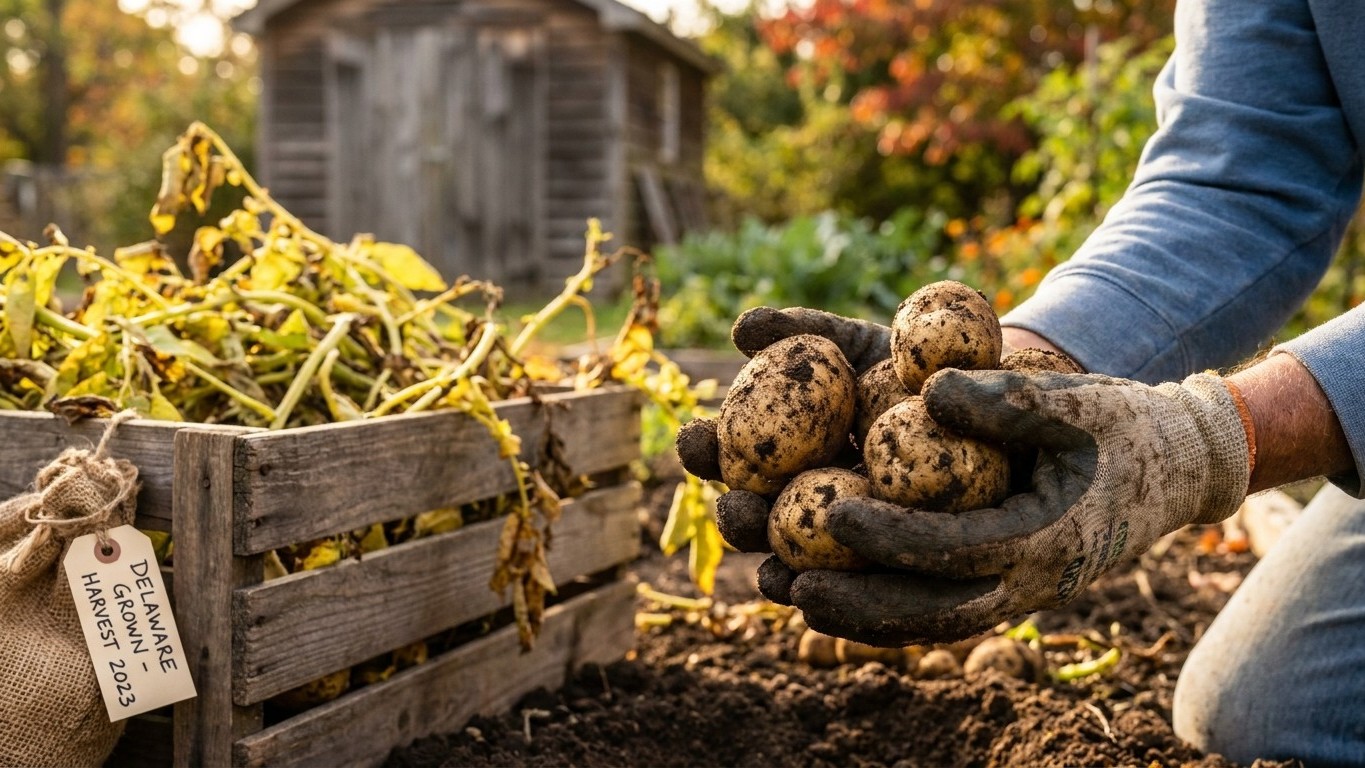

Delaware gardeners can expect first fall frost between October 26 and November 7, depending on the county, which sets the outside deadline for getting potatoes out of the ground. But the number that actually determines whether your harvest survives the winter is the coldest month’s mean minimum: 25.6°F. That’s roughly 15 to 20 degrees below what a stored potato needs, which means an unheated shed or garage will not hold 40-45°F through a Delaware winter. It will freeze.
The short answer
Most Delaware gardeners pull their main crop in September, well ahead of that October 26 to November 7 frost window, once the vines have yellowed and died back on their own. There’s no reason to race the frost with potatoes the way you might with tomatoes or peppers; tubers underground are insulated by soil and generally unaffected by a light frost on the foliage above. What actually forces the harvest is vine dieback, or the calendar running out before a hard freeze locks up the ground. If you’re gardening near Wilmington, use that October 26 to November 7 window as your backstop, but check your own county, because inland and low-lying spots often see frost a week or two earlier than the reference station shows.
Once the crop is out of the ground, the real problem starts. That mean minimum of 25.6°F for the coldest month, taken at the Wilmington-area reference station, describes what an average night looks like in the depth of winter, not a rare cold snap. A detached garage, an uninsulated shed, or a three-season porch will track close to outdoor air on cold nights, which means those spaces will regularly sit well below freezing for weeks at a stretch. Potatoes held at those temperatures don’t just get chilly and fine, they suffer cell damage, turn sweet and discolored as starches convert to sugar, and can rot outright once they thaw. An unheated space in Delaware will not reliably hold the 40-45°F range that Utah State University Extension recommends for storage. It will freeze on the coldest nights of January, and that’s usually enough to ruin whatever’s stored there.
So the short answer is this: harvest in September, cure before you store, and plan on an insulated or partially heated space, like a basement, for the storage months. A root cellar dug into the ground works too, since soil temperature several feet down stays far more stable than air temperature, but very few Delaware properties have one. For most gardeners here, the basement is the practical answer, and the garage is not.
Curing, and where
Utah State University Extension recommends curing freshly dug potatoes at 55-60°F with high humidity for 2 to 3 weeks before storage. Curing lets the skins toughen and heals small nicks and scrapes from digging, which matters because a potato with broken skin is an open door for rot once it’s packed away for months. Skip curing, and you’re storing produce that’s already halfway to spoiling.
Timing this in Delaware is manageable, since the harvest window in September lines up with mild late-summer and early-fall air temperatures, but you still need to pick the right spot rather than assume any shady corner will do.
- Dig on a dry day and let the potatoes sit on the soil surface for an hour or two to air-dry, brushing off loose dirt but not washing them.
- Move them out of direct sun immediately. September sun in Delaware can still push surface temperatures well past the curing range, and light exposure also greens the skins, which you want to avoid.
- Choose a spot that holds 55-60°F. An enclosed, shaded porch often works in early September when outdoor lows are still mild, but as the month wears on and nights cool toward the 50s, that same porch can drift below the target range. A basement, especially an unfinished one with some ambient warmth from the house above, tends to hold this range more consistently through the full curing period. A garage can work in early fall but gets unreliable once nighttime temperatures start falling toward the 40s.
- Keep humidity high during the 2 to 3 week cure, either with damp burlap over the bins or by curing in a space that isn’t bone-dry, like a basement rather than an attic.
- Check for softening or bad odors partway through and remove any potato that’s clearly breaking down, since one rotting tuber can spread trouble to its neighbors in a bin.
Basements come out ahead of porches and garages here mainly because they’re buffered from the day-to-night temperature swings that define a Delaware September and October. A porch might nail the range at 6 p.m. and miss it badly by 5 a.m.
Storing through this winter
Once cured, potatoes want a dark, 40-45°F space, per Utah State University Extension, or 38°F at 95% humidity, per the University of Maine Cooperative Extension. Both ranges sit comfortably above freezing but well below room temperature, which is exactly the band that’s hard to find naturally in a Delaware home once winter sets in.
Here’s where that 25.6°F mean minimum for the coldest month becomes the deciding factor. An attached garage might stay in the 40s during a mild stretch in November, but once the coldest weeks of winter arrive, typically January in Delaware, an unheated or minimally insulated space will spend plenty of nights well under 40°F and likely under freezing outright. Potatoes stored in a garage that freezes even once or twice over the winter will show it: soft spots, blackened tissue, a sweet smell that signals starch breaking down. A shed is worse, since it has even less thermal mass and no shared wall with a heated structure.
A basement is the more reliable choice for most Delaware homes. An unfinished basement, particularly one away from the furnace and any heating ducts, often sits naturally in the high 40s to low 50s through winter, which is close to the target range even if it runs a few degrees warm. Adding a layer of insulation around a storage bin, or tucking it into the coolest, darkest corner farthest from the furnace, can pull that closer to 40-45°F. Root cellars, where they exist, do this job better still, since below-grade soil temperature in Delaware stays far more stable than either outdoor air or an above-ground room, but most gardeners here are working with a basement corner, not a purpose-built cellar.
Darkness matters as much as temperature. Any light, even the low light from a basement window or a bare bulb left on, triggers greening and sprouting over a long storage period, so cover bins with burlap or store them in an opaque container rather than open crates near a window.
What goes wrong here
- Garage storage freezes the crop. An unheated or attached-but-uninsulated garage regularly drops below freezing once the coldest weeks of winter hit, given the 25.6°F mean minimum for the season. The remedy is simple: move stored potatoes to an insulated basement corner before the first hard cold snap, not after.
- Curing gets skipped because the porch feels warm enough in September but then swings well below 55°F on cool fall nights. Check an actual thermometer in the curing spot rather than trusting how the air feels, and move the crop to a basement if the porch can’t hold the range overnight.
- Digging too early, chasing an assumed frost date. Since Delaware’s first fall frost can land anywhere from October 26 to November 7 depending on county, and can hit earlier in low-lying or inland spots, gardeners sometimes harvest before the vines have actually died back, leaving tubers with thinner, less-cured skins that don’t store well. Watch the vines, not the calendar, and dig once they’ve yellowed and collapsed.
- Pest and disease pressure at harvest. Wet Delaware falls can leave soil damp at digging time, raising the risk of soft rot and other storage diseases entering through skin breaks. An appropriate fungicide applied earlier in the season, and careful handling at harvest to minimize bruising and cuts, both reduce what makes it into storage. Insect damage to tubers, when present, should be addressed during the growing season with an appropriate insecticide rather than after digging, since chemical treatment doesn’t fix damage already done.
- Humidity too low in a dry basement. A finished, heated basement near a furnace often runs too dry for the 95% humidity the University of Maine Cooperative Extension recommends, which shrivels tubers over a long winter. Covering bins with damp burlap, rechecked periodically, helps close that gap without needing specialized equipment.
Common questions
Can I store potatoes in an outdoor shed in Delaware?
Not reliably through the coldest part of winter. Given a mean minimum of 25.6°F in the coldest month, an outdoor shed with no insulation or heat source will drop below freezing on many nights, which damages or ruins stored tubers. A basement is a more dependable choice for the full storage season.
When should I dig potatoes in Delaware relative to the first frost?
Dig once the vines have yellowed and died back, which in most years happens well before the first fall frost window of October 26 to November 7. There’s little benefit to leaving tubers in the ground until frost threatens, since dieback, not frost, is the real signal that the crop is mature.
Does curing really matter if I’m eating the potatoes soon after harvest?
If you’re eating them within a week or two, curing matters less. But for anything meant to last through the winter, skipping the 2 to 3 week cure at 55-60°F recommended by Utah State University Extension leaves the skins thin and more prone to rot in storage.
What’s the difference between the 40-45°F guidance and the 38°F guidance?
Utah State University Extension recommends 40-45°F for general storage, while the University of Maine Cooperative Extension gives a slightly cooler 38°F at 95% humidity. Both sources agree the space should be dark and well above freezing; the small difference reflects two separate extension programs’ recommendations rather than a contradiction you need to resolve. Either range beats the alternative of an unheated Delaware garage in January.