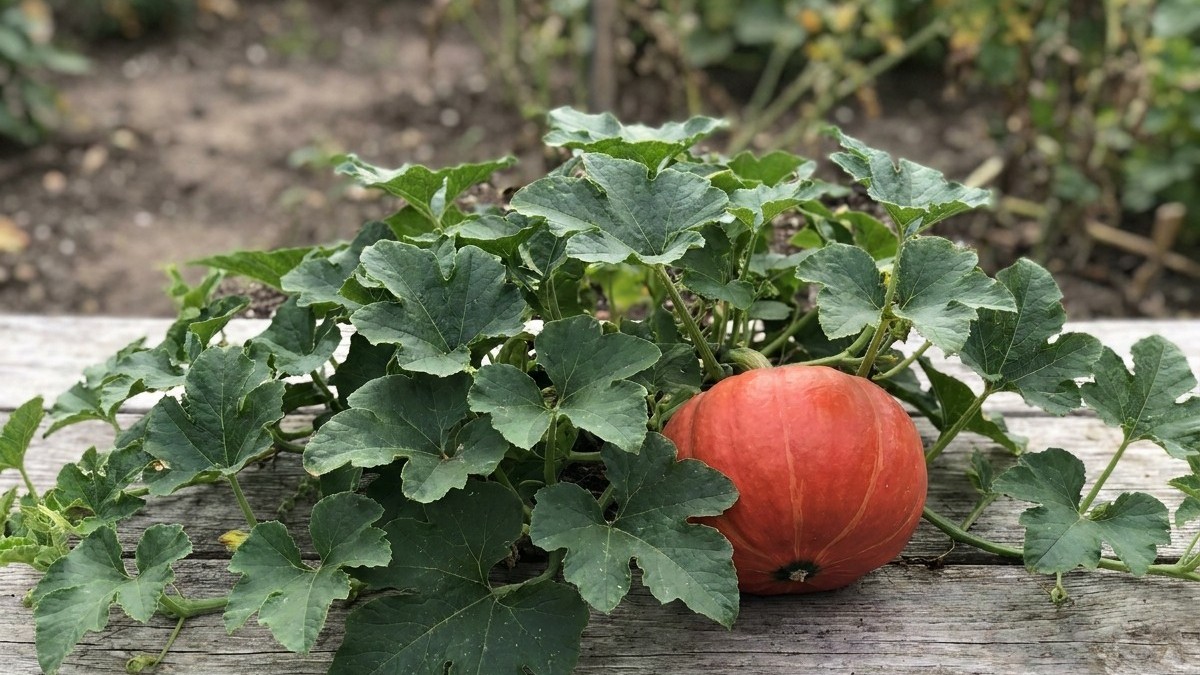

Cut a pumpkin when the rind has taken its full color and hardened, the stem has dried to a woody brown, and the first fall frost is still ahead. Off the vine, a whole pumpkin can last three to six months at best, but only in a cool, dark spot between 45 and 50 F, away from ripening fruit.
When pumpkins are ready in North Carolina
A pumpkin is ready when the rind is fully colored, resists a thumbnail, and the stem has gone dry and woody, which happens 45 to 55 days after the flower opened. In the Piedmont around Charlotte, flowers that open from late July through August put harvest between early September and late October.
How do you count the 45 to 55 days?
The count starts when the flower opens, and the day you pushed the seed into the ground has nothing to do with it. A vine can run for weeks before it opens a flower that will actually become fruit, so a sowing date tells you little about harvest. Once you see a female flower (the one with a tiny pumpkin swelling at its base) open, write the date on a tag and tie it near the stem. Then add 45 to 55 days. That tag will tell you more than the seed packet.
What does the first fall frost do to the window?
NOAA’s NCEI climate normals for Charlotte put the first fall 32 F freeze between October 30 and November 8, the band where a freeze becomes roughly a 30 to 70 percent bet. Pumpkins need to be off the vine before that. A flower that opens in mid-September gets about 45 days before the early edge of the band, which is marginal. One that opens after that tends to yield a green fruit that never finishes. Late fruit that is still green when frost approaches is covered in Will Pumpkins Ripen Before Frost in North Carolina?
When is the soil warm enough to sow?
Sow when the soil reaches 65 F. That is a soil reading, and it arrives well after the last spring frost, which at Charlotte falls between March 23 and April 5. Soil lags the air by weeks, so a mild week in late March means little to a seed. Push a soil thermometer in at seed depth in the morning and wait for 65 F.
Charlotte sits in the Piedmont, so the dates shift with the ground. The Blue Ridge mountains to the west run several weeks later in spring, and the coastal plain runs earlier. Your county extension office can tell you how far your yard sits from the Charlotte numbers.
How should you cut a pumpkin from the vine?
Use pruning shears and leave the stem attached. Utah State University Extension recommends harvesting with the stem on and before frost, and a pumpkin with its stem broken off is more likely to rot from the scar. Carry it by the body. Pumpkins with scarred rinds or chewed stems often trace back to squash bugs or cucumber beetles; the signs and timing are in What Eats Pumpkin in North Carolina, and When. For the full growing picture, start with Growing Pumpkins in North Carolina.
Keeping them, and for how long
University of Illinois Extension says a whole pumpkin keeps for three to six months in a cool, dark location between 45 and 50 F. Read that as a ceiling. It describes a sound, mature pumpkin held at those conditions the whole time, and a pumpkin with a bruise, a soft spot or a missing stem will give out sooner. Six months is the best case, and plenty of pumpkins will not get there.
What shortens a pumpkin’s storage life?
Heat is the obvious one. A pumpkin sitting well above the 45 to 50 F range will age faster than the low end of the three-to-six-month span suggests. Freezing is the opposite danger. Utah State University Extension says to store pumpkins where they will not freeze, and a frozen pumpkin turns to mush once it thaws. Even a single hard night can finish one off.
The second hazard surprises most people. University of Illinois Extension says to keep pumpkins away from ripening fruit and vegetables such as apples, potatoes and tomatoes. Ripening produce gives off a gas that ages the pumpkin faster. That makes the porch beside the apple crate, or the pantry shelf under a bowl of tomatoes, about the worst place to keep one.
Condition at harvest matters just as much. A pumpkin cut with the stem attached and no cracks in the rind has a head start, since an open wound gives rot an entry point. If you find one with a soft spot, use it first, and keep it out of the group you plan to store.
How long does a carved pumpkin last?
The 45 to 50 F guidance and the three-to-six-month span apply to a whole pumpkin only. Once you cut into the rind, the flesh is exposed and the pumpkin is in a different category. It will not keep for months, and no storage figure for whole pumpkins carries over to it. Carve as close as you can to the day you plan to show it, and keep the uncarved ones in storage until then.
Where in the house that actually is
A kitchen refrigerator runs colder than the 45 to 50 F range, and most pumpkins are too big to fit anyway. A heated living space is too warm. A garage swings with the weather: it can sit near the right range on a cool October afternoon, climb in an early warm spell, and fall below freezing on a cold winter night. The best spot is a room that stays cool and dark without much change from day to night.
Which room comes closest?
An unheated interior room, a basement or a cool back bedroom with the vent closed usually does better than any other spot in a typical Carolina house. Basements are common in parts of the Piedmont and the mountains, and they hold a steady temperature because the surrounding ground does. In the coastal plain, where basements are rarer, an interior closet or a spare room on the shaded side is the better bet. Avoid any room with a heating vent, an exterior wall that gets afternoon sun, or a spot near the kitchen where fruit sits on the counter.
Light matters less than temperature, but the source calls for a dark location, so an interior closet or a shelf behind a closed door works. Lay the pumpkins in a single layer, not touching, so one soft pumpkin does not spoil its neighbor.
What should you check with a thermometer?
Leave a min-max thermometer on the shelf for a few days before you move the pumpkins in, and read both the low and the high. Skip that step and you are guessing, and a spot that feels cool to your hand at noon can still dip to freezing or climb well past 50 F at other times of day. If the low is near freezing or the high is much above 50 F, try another room.
The porch is fine as a display for the weeks before the first freeze, which at Charlotte tends to arrive between October 30 and November 8. Bring the pumpkins in when a freeze shows up in the forecast, because frost on a whole pumpkin ends its keeping time.
Common questions
How can I tell a pumpkin is ripe if I never noted the flowering date?
Check the rind and stem. The rind should be fully colored and too hard to dent with a thumbnail, and the stem should be dry and woody. If the skin is still glossy and gives under pressure, the fruit needs more time, provided frost is not in the forecast.
Is the last frost date the day to sow pumpkins?
No. Pumpkin seed goes in when the soil reaches 65 F, and soil lags the air by weeks. At Charlotte the last spring frost falls between March 23 and April 5, so sowing happens well after that. The Blue Ridge mountains run several weeks later still, and the coastal plain runs earlier.
Can I store pumpkins next to apples or potatoes?
Keep them apart. Apples, potatoes and tomatoes give off a gas as they ripen, and University of Illinois Extension advises storing pumpkins away from them. The gas ages the pumpkin and cuts into its three to six months.
Do the storage figures apply to a carved pumpkin?
They do not. The 45 to 50 F range and the three-to-six-month span are for whole pumpkins. A carved pumpkin has exposed flesh and spoils much sooner, so carve it close to display day.