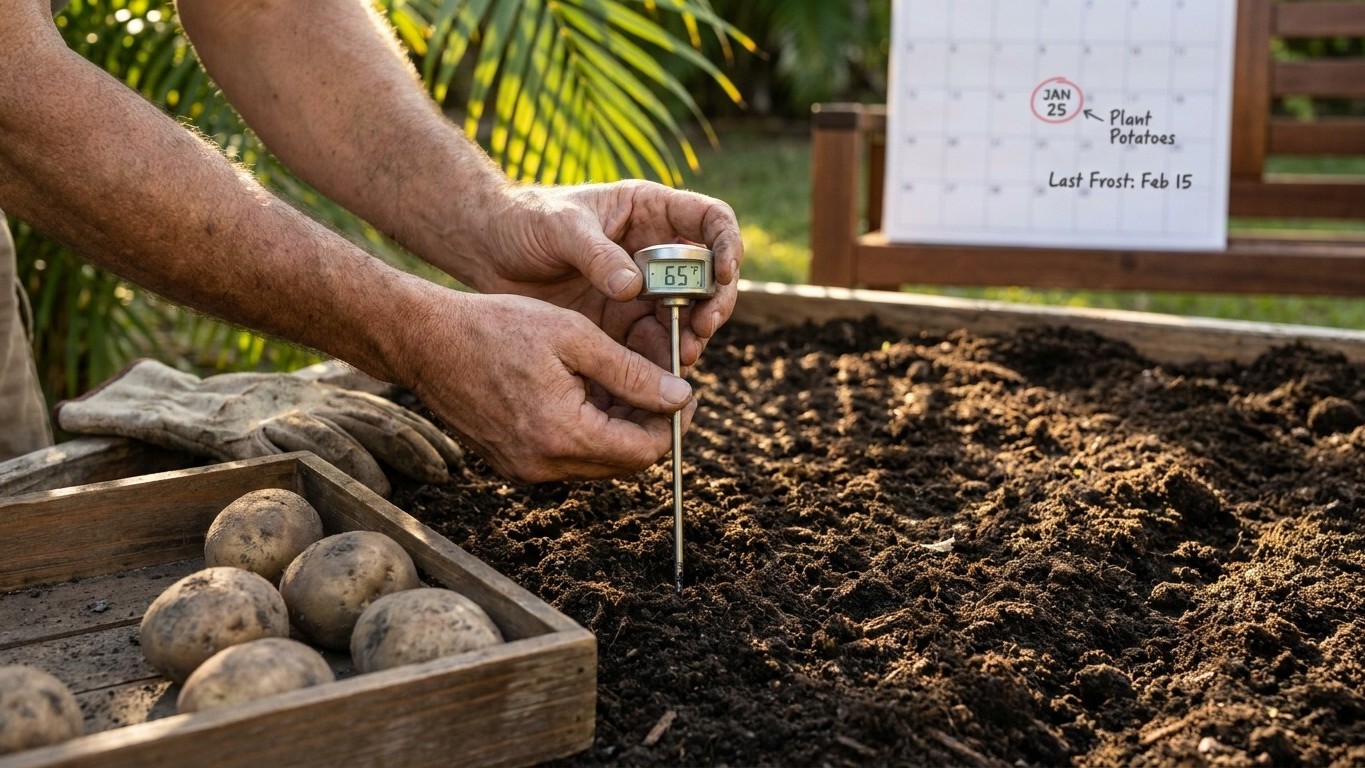

The last-frost window for north Florida, referenced to Jacksonville (NOAA station USW00013889), runs February 16 to March 7. Counting back the 14 to 21 days that potatoes need for soil to warm to 50°F puts planting in late January to mid-February for that region. Central and south Florida don’t use this math at all: they’re effectively frost-free, and the calendar flips entirely.
The short answer
For a gardener near Jacksonville, the frost-counting math is straightforward once you have the right number. NOAA NCEI’s 30-year Climate Normals for station USW00013889 put the 32°F freeze probability window at February 16 to March 7. Potatoes are planted as soon as the soil reaches 50°F, which lands 14 to 21 days ahead of that last frost date. Run the count backward from February 16, the early edge of the window, and you land in late January. Count from March 7, the late edge, and mid-February still works. That’s the whole method for north Florida: find the local frost window, subtract two to three weeks, plant when the soil (not the air) hits 50°F.
But that math only holds where frost actually occurs on a predictable schedule. Jacksonville’s airport site is inland, and three of the thirty years in the NOAA record saw no freeze at all. That’s not a rounding error, it’s nearly one year in ten where the entire frost-counting exercise was moot. Anyone gardening closer to the coast, where marine air moderates cold snaps, should expect their own local window to run even later or thinner than the airport data suggests.
North Florida versus the rest of the state
Move south past roughly the Ocala-to-Orlando line and the frost calculation stops applying. Central and south Florida don’t get a reliable freeze most years, so there’s no last-frost date to count back from. The growing season for cool-weather crops like potatoes inverts: it runs through the mild, dry winter months instead of starting after a spring thaw. The limiting factor down there isn’t cold, it’s heat arriving too early in spring.
| Region | Reference point | Frost pattern | Planting logic |
|---|---|---|---|
| North Florida (Jacksonville) | NOAA station USW00013889 | Last frost Feb 16 to Mar 7 | Count back 14-21 days, plant at 50°F soil |
| Central & south Florida | Not covered by this frost dataset | Effectively frost-free | Plant through winter, finish before soil exceeds 90°F |
That distinction Matters More Than the exact date. A gardener in Miami who plants by a Jacksonville frost calendar isn’t just off by a few weeks, they’re using the wrong framework entirely.
What actually decides it
Two separate temperature thresholds govern a Florida potato crop, and they pull in opposite directions depending on where you garden. Understanding both lets you reason about a location this page never names.
The cold threshold: frost sets the start line, but only where frost exists
Frost dates matter only where freezes are common enough to plan around. NOAA’s Climate Normals give a 30-70% probability band for a 32°F freeze at a given station. Where that band is meaningful, as it is at Jacksonville’s airport station, the last-frost date sets the earliest safe planting window, and gardeners count backward from it to time soil warming. Where freezes are rare or nonexistent, as in most of central and south Florida, this threshold simply doesn’t apply, and there’s no frost line to count from.
The heat ceiling: the mechanism that ends the season everywhere
Tuber set and fill stop when soil temperatures climb above 90°F, according to Utah State University Extension’s potato fact sheet and the University of Maine Cooperative Extension’s Bulletin #2077. This is a hard biological ceiling, not a stress that irrigation solves. Once soil crosses that line, the plant may still look green above ground, but it stops sizing tubers below it. This is the mechanism that actually decides a Florida potato crop’s success, more than the frost date does, because Florida’s spring heat arrives fast and doesn’t wait for the calendar to catch up.
Why the two thresholds interact differently by region
In north Florida, the frost window and the heat ceiling are close enough together that the planting window is genuinely narrow: too early risks frost damage to emerging shoots, too late risks the soil crossing 90°F before tubers finish filling. In central and south Florida, frost isn’t a factor, so the entire planting decision rests on working backward from when soil will hit 90°F in spring, which is why the season runs through winter instead of starting after it. Wherever spring heat builds quickly, the safer move is planting early and harvesting a spring crop rather than trying to push a summer one.
How to do it
- Determine whether you garden in north Florida, where frost is common enough to plan around, or in central/south Florida, where it’s effectively frost-free and the frost-counting method doesn’t apply.
- If you’re in north Florida, find the last-frost window for a station near you. For the Jacksonville area, NOAA NCEI data puts it at February 16 to March 7.
- Buy a soil thermometer and check soil temperature directly rather than relying on air temperature or the calendar alone.
- Count backward 14 to 21 days from the earliest date in your frost window to establish your target planting window.
- Confirm the soil is approaching 50°F within that window before planting; if it’s still colder, wait rather than planting on a fixed date.
- Source certified seed potato stock rather than grocery store potatoes, since uncertified stock can carry virus.
- Choose a season class, early, mid-season, or late, based on how quickly your local soil is likely to climb toward 90°F in spring; where that happens fast, favor earlier classes.
- If you’re in central or south Florida, skip the frost calculation entirely and plant during the cooler winter months, timing the crop so tuber fill finishes before soil temperatures push past 90°F.
What goes wrong
- Applying north Florida frost dates to Orlando or Miami. The calendar inverts in those regions: the main season runs through winter, and summer is the hard part. Using a Jacksonville-based frost window there produces a planting date built on a threshold that barely exists locally. The fix is to plant by the winter growing season, not by counting back from a frost date that isn’t reliable that far south.
- Planting by a fixed calendar date instead of measured soil temperature. Frost windows shift year to year, and three of thirty years at the Jacksonville station saw no freeze at all. The remedy is a soil thermometer: plant once soil approaches 50°F, whatever the date happens to be that year.
- Using grocery store potatoes as seed stock. They aren’t certified and can carry virus that undermines the whole crop before it starts. Buy certified seed potato instead; it costs more but removes a risk that no amount of good timing can fix.
- Planting too late in the window. Waiting until the late edge of the frost-counting window can let soil temperatures cross 90°F before tuber fill finishes, especially in warmer inland spots. The remedy is to plant toward the earlier edge of the 14-to-21-day range and favor an earlier season class where spring heat builds fast.
- Treating one station’s frost date as true for the whole state. A figure tied to Jacksonville’s airport station describes that reference city, not Tallahassee, Gainesville, or the coast. Check data for a station near your own location before counting backward from it.
Common questions
Does the frost-counting method work anywhere in Florida besides the north?
No. Central and south Florida are effectively frost-free, so there’s no reliable last-frost date to count back from. The growing calendar there runs through winter instead.
What happens if my soil crosses 90°F before the tubers finish filling?
Tuber set and fill are inhibited above that threshold, according to Utah State University Extension and University of Maine Cooperative Extension. Watering doesn’t reverse it; the practical fix is planting earlier so the crop finishes before soil gets that hot.
Can I plant potatoes bought at a grocery store?
It’s not advisable. Uncertified stock can carry virus that certified seed potato is bred and inspected to avoid.
How do I choose between early, mid-season, and late varieties for Florida timing?
Neither Utah State nor the University of Maine publishes a days-to-maturity figure for varieties, only the season class. Where soil warms toward 90°F quickly in spring, an early class gives the crop the best chance to finish before that ceiling hits.