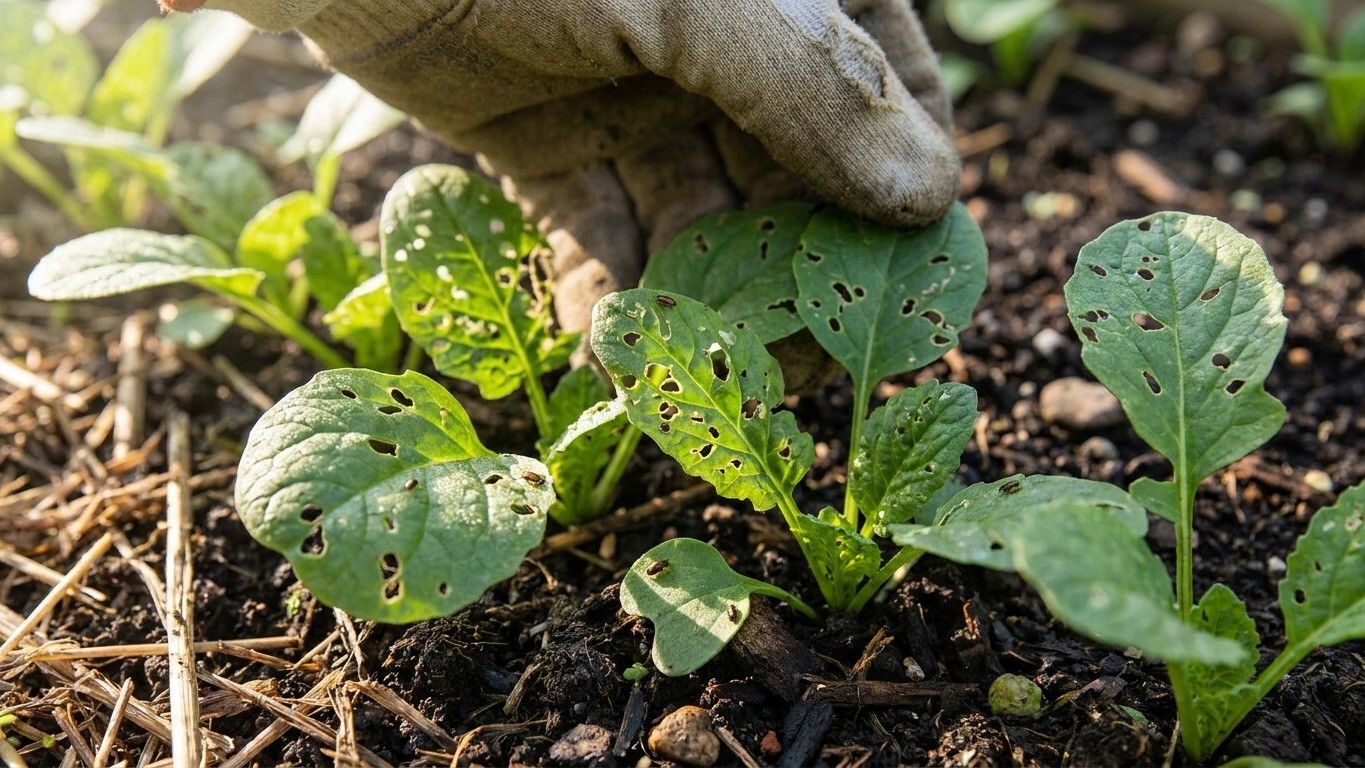

Flea beetle control works when it targets the right life stage with the right method, not a single spray for every situation. The shotgun pattern of tiny holes and skeletonized leaves shows up because adult beetles feed for weeks, and by the time damage is obvious, the timing window for the easiest fixes may already be closing. Effective control combines physical barriers, biological allies, and, when justified, a targeted product applied at the correct stage.
Timing beats product
Nothing matters more in flea beetle control than knowing which stage you’re looking at. Adults chew the shot-hole pattern that gives the pest its name, jumping like fleas when disturbed. Larvae, meanwhile, work underground on roots and tubers, invisible until a plant wilts for no obvious reason. A spray aimed at adults does nothing to larvae feeding below the soil line, and a soil treatment timed for larvae won’t touch an adult population already skeletonizing your seedlings.
Why seedlings take the worst hit
Young transplants and freshly emerged seedlings carry the most damage because they have so little leaf tissue to spare. A mature plant can lose a percentage of its canopy to feeding and barely slow down. A two-inch seedling with the same number of holes can die outright. That’s why the window right after transplanting or emergence is the highest-stakes period for this pest, and also the period where the wrong intervention wastes the most time.
Start with the life cycle, not the damage
Before choosing any tactic, it helps to know where the population sits in its cycle: overwintered adults emerging, egg-laying underway, larvae developing in soil, or a new adult generation about to appear. This site’s flea beetle life cycle page breaks down each stage and what it looks like in the field, because guessing at timing is the single most common reason a treatment fails. Get the stage right, and even a modest tactic works. Get it wrong, and the strongest product on the shelf won’t help.
What works without a product
Several tactics control flea beetles without any pesticide label, and most cost more effort than money. None of them are magic, but stacked together they reduce pressure enough that many home gardens never need anything else.
- Row covers and barriers: installed at planting or transplant, before adults find the crop. Once beetles are already established under the cover, it traps them with the plants, so timing at the start is everything.
- Hand removal and shaking: effective on small plantings during cool mornings when beetles are sluggish. Shake plants over a container of soapy water. Laborious, and it needs repeating every few days through the peak activity window.
- Trap crops: a sacrificial planting of a preferred host, seeded slightly ahead of the main crop, draws adults away. This only works if the trap crop is up and attractive before the main planting emerges, otherwise beetles simply move to whichever plant is available first.
- Planting date adjustments: shifting transplant or seeding dates to avoid the peak adult emergence window sidesteps the worst pressure entirely. This requires knowing local emergence timing, which varies by region and season.
- Fall and season-end cleanup: removing crop debris and weedy hosts after harvest cuts down overwintering sites. This is a once-a-year task, but skipping it season after season lets local populations build.
Being honest about the labor
Row covers and hand removal both demand attention at exactly the moments a garden gets busiest, planting season and the first weeks after. Trap crops require planning a second planting schedule. None of these are set-and-forget. They work because they interrupt the beetle’s access to food or shelter at a specific moment, not because they’re passive.
The allies you already have
Flea beetle populations have natural checks, and most gardens already host some of them without anyone noticing. Ground beetles and rove beetles hunt eggs and larvae in the soil surface layer. Certain parasitic wasps target flea beetle larvae directly, reducing the next generation before it ever reaches adulthood. Birds, particularly ground-foraging species, pick off adults in open soil and mulched beds. None of these predators eliminate a heavy infestation on their own, but they keep low-to-moderate populations from becoming a recurring problem.
What keeps these allies around
Ground beetles and rove beetles need undisturbed soil surface and some plant litter to shelter in during the day. Mulch, reduced tillage, and leaving a few weedy field margins intact all support them. Parasitic wasps need nectar and pollen sources nearby, so a strip of flowering plants near the vegetable rows does real work here, not just for pollinators but for this pest’s own predators.
The trap that undoes it all
A broad-spectrum insecticide applied at the first sign of shot-holes kills flea beetle adults, but it also kills the ground beetles, rove beetles, and parasitic wasps working the same bed. Those predators reproduce more slowly than flea beetles do. The result, a season later, is a garden with fewer natural checks and the same pest returning in larger numbers, because the balance that used to suppress it is gone. This pattern, control the pest, wipe out its predators, watch the next generation explode, is one of the most common ways a manageable flea beetle problem becomes a chronic one. Anyone reaching for a spray should weigh this trade-off before the first application, not after the second one fails.
When a product is the answer
There’s a legitimate case for a targeted product, and it’s narrower than most people expect. It applies when non-chemical tactics have been tried at the right timing and pressure is still high enough to threaten a crop’s survival, particularly on young seedlings with little tissue to spare. It also applies when a trap crop or barrier strategy has failed because the population was already established before those tactics went in.
The stage still decides everything
Even with a product in hand, the same rule from the first section applies: match the treatment to the life stage present. A treatment aimed at adult feeding will not help a plant whose roots are already compromised by larvae, and vice versa. Scouting the actual damage pattern, foliage versus roots, before choosing anything is the difference between a treatment that works and one that’s wasted.
Why this site won’t name a product here
Permitted products for flea beetle control differ by state, by crop, and by year, because registrations and label restrictions change on schedules set by each state’s regulatory agency, not by season. A product legal on a home vegetable garden in one state may be restricted or unavailable in another, and labels get updated more often than most gardeners check. That’s why the accurate answer to “which product” isn’t a name, it’s a source: your state’s university extension service, which tracks current registrations, action thresholds, and application timing specific to your region and your crop. This site maintains a state-specific flea beetle control page that names the extension contact for each territory, and that page is the right next stop once you’ve confirmed the stage and pressure through scouting.
Common questions
How do I know if it’s flea beetles and not another pest?
Look for a scattered pattern of small, round or irregular holes across leaves, often described as shot-hole damage, concentrated on young or newly emerged plants. Adults are small, dark, and jump when disturbed rather than fly away slowly, which distinguishes them from many other leaf-feeding beetles.
Do flea beetles come back every year in the same garden?
They can, especially where crop debris and weedy hosts near the beetles’ preferred plants aren’t cleared at season’s end. Adults overwinter in soil and plant litter nearby, so cleanup after harvest reduces, but doesn’t guarantee against, a returning population the following season.
Are flea beetles present everywhere in the country?
Various species in genera such as Phyllotreta, Epitrix, and Altica occur widely across North America, with the specific species and their peak activity timing varying by region and crop. No area should assume it’s exempt; local emergence dates are what differ.
Will one round cover or one treatment solve the problem for the whole season?
Rarely. Adult flea beetles can produce more than one generation in a season depending on region and climate, so a single tactic applied once often needs reinforcement, whether that’s reapplying a barrier at a second planting or scouting again for a later adult flush.