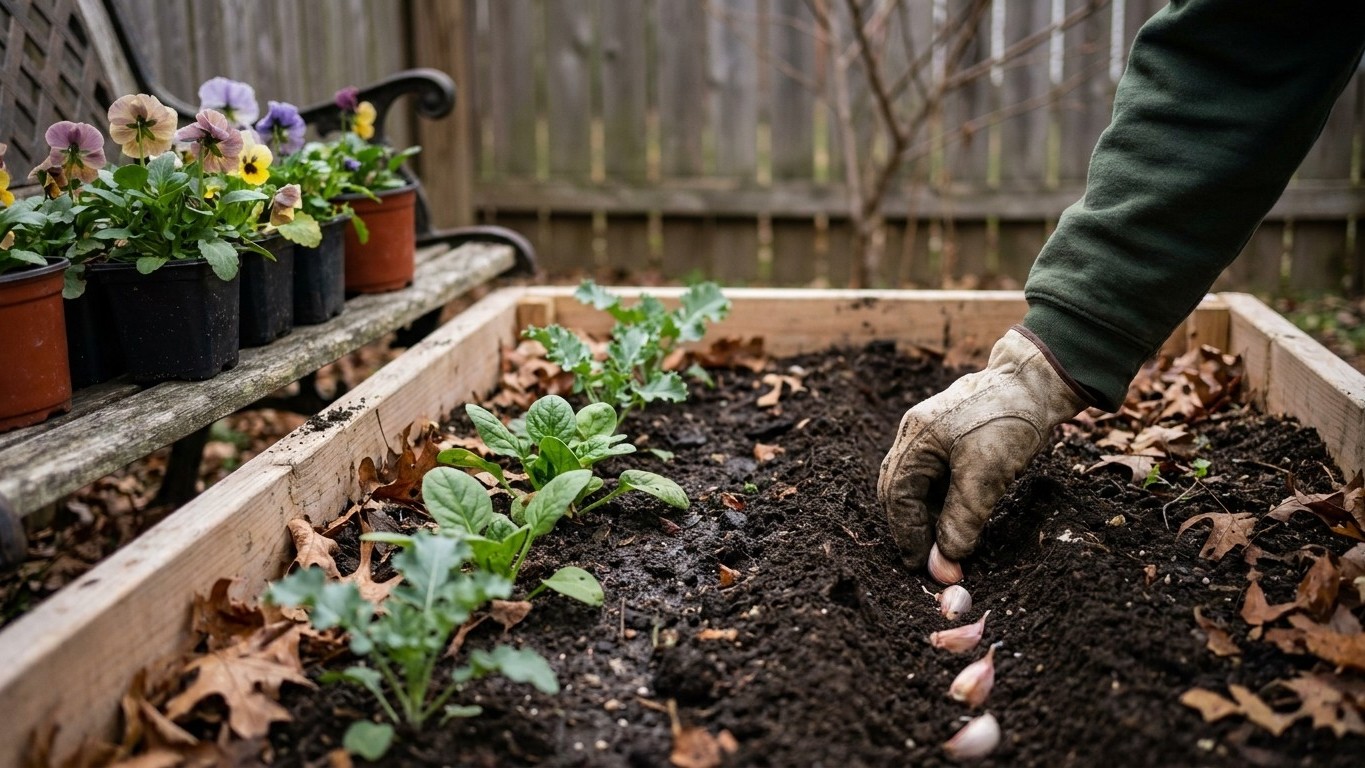

October is a planting month in Oklahoma, not a shutdown month. Garlic, shallots, and cool-season greens still go in the ground across most of the state, while the first fall frost is still weeks away in early October. What changes week to week is soil temperature and how close you are to that frost window, not the date on the calendar.
What goes in the ground in October

The number that actually matters this month is the first fall frost window: October 29 to November 8, based on the Oklahoma City airport weather station (NOAA NCEI 1991-2020 normals). That’s a 30-70% probability band for a 32°F freeze, not a hard line, and gardens outside the metro area, especially at higher elevation or in low-lying spots that trap cold air, often see frost one to two weeks earlier. Early October sits comfortably ahead of that window across most of the state, which is why it’s one of the better planting stretches of the fall calendar rather than a scramble to beat the cold.
Garlic and shallots are the anchor crop. Push cloves into loosened, well-drained soil now so roots establish before the ground cools further; they’ll sit quietly through winter and push up green shoots as days lengthen. Spinach, mâche, and turnips sown directly in the first half of October have enough runway to size up before growth slows, and all three tolerate a light frost without complaint once they’re established.
Peas are the other safe bet for early-month sowing in the southern two-thirds of the state, where the growing window stretches a bit longer before that late-October to early-November frost arrives. Radishes and arugula work as quick fillers in any open bed, since both can go from seed to harvest in three to four weeks, well inside the safe stretch even in a cooler October.
What doesn’t belong outdoors this month is anything warm-season: tomatoes, peppers, squash, and beans have no business going into open ground now, no matter how mild a particular stretch of weather feels. Oklahoma’s USDA Plant Hardiness Zone range runs from 6a in the Panhandle to 8a in the southeast (USDA Plant Hardiness Zone Map, 1991-2020 normals), and that spread means a frost-safe planting date in Tulsa can be a full week or more different from one near Idabel.
What to start under cover
Cold frames and low tunnels earn their keep in October. With the first fall frost sitting somewhere in that October 29 to November 8 band, seed started under cover in the first week or two of the month has roughly four to five weeks to size up before hard cold sets in, enough time for baby lettuce, spinach, and mustard greens to reach a usable harvest size while protected from the coldest nights.
Count backward from your own expected frost date rather than the calendar page. If you know frost typically lands in your county around a certain week, subtract 30 to 40 days for baby greens or 45 to 60 days for something like a small head of lettuce, and that tells you the latest safe sowing date under cover. Gardens north of the I-40 corridor or at higher elevation should shave a week or more off that math, since their frost window tends to run earlier than the Oklahoma City reference figures.
The two ways this goes wrong are familiar to anyone who’s tried season extension before. Start too early under a warm cover and you get leggy, rootbound seedlings sitting in cramped cells with nowhere productive to go. Start too late and the plants stall out just as they’re gaining size, leaving you with a cold frame full of half-grown greens that never quite finish. Splitting a planting into two smaller sowings, one at the start of the month and one a week or so later, hedges against guessing wrong on either end.
Cover crops sown now under row cover, like clover or hairy vetch, aren’t for eating but for the bed itself: they hold soil structure and add organic matter over winter with minimal effort once established.
What is ready to pick
Winter squash and pumpkins are the headline harvest this month. The tell is the stem: it should be hard and dry, not green and pliable, and a fingernail pressed into the skin shouldn’t leave a mark. Leave them in the field a few extra days if the stem still gives, since squash pulled too early won’t cure or store well.
Sweet potatoes come out before that first frost touches the foliage, since cold-damaged vines can let rot travel down into the tubers. Dig on a dry day, brush off soil rather than washing it, and let them cure in a warm spot for a week or two before moving to cold storage; that curing step is what turns a bland sweet potato into a sweet one.
Late tomatoes and peppers still on the vine need attention before the frost window arrives. Green tomatoes wrapped individually in newspaper and stored in a cool, dark spot will ripen slowly over weeks, which is a better outcome than losing the whole vine to a hard freeze overnight.
Greens planted earlier in the fall, along with anything sown in September, are usually ready for a first cutting by mid-to-late October. Check stored onions and any early-dug potatoes from summer for soft spots or sprouting; a single onion going soft in a mesh bag can speed up rot in its neighbors, so pull it before it spreads.
The jobs that matter this month

Frost protection planning tops the list, since the window for it is genuinely narrow. Row cover, old sheets, or cardboard boxes staged near the garden before frost actually threatens save a scramble in the dark when the forecast shifts. Waiting until the night before to go looking for cover material is how tender herbs and late peppers get lost to a frost that was forecast for a week.
Soil testing pays off more in October than almost any other month, because results come back in time to amend beds before winter and let those amendments work into the soil over the cooler months. A basic test through the Oklahoma State University extension system tells you where pH and nutrients actually stand, rather than guessing based on last year’s yields.
Compost turned now keeps breaking down through the cooler weeks instead of sitting inert, and finished compost worked into beds that are going fallow for winter gives it months to integrate before spring planting. Garlic beds especially benefit from a compost topping right after planting.
Mulch goes down heavier this month than in summer, both to insulate garlic and overwintering greens and to suppress the winter annual weeds that germinate the moment soil temperatures drop. Shredded leaves, which are usually free and abundant in October, work as well as bagged straw for this.
Tool cleaning and sharpening, bed edge repair, and fence checks are the unglamorous jobs that are easiest to do now, before winter weather makes outdoor work miserable and before spring rushes in with everything else demanding attention at once. A pruning saw or hoe cleaned and oiled in October is ready to go the first mild day of late winter without a trip to the shed to deal with rust.
What not to do in October
The most common mistake is trusting a warm afternoon over the actual frost data. A run of 70-degree days in early October doesn’t push the frost window back; it just makes the eventual cold snap feel more sudden when it lands somewhere in that October 29 to November 8 range. Warm-season transplants set out on the strength of good weather almost always get caught.
Uncovering cold frames or row cover too early after a mild stretch is the inverse mistake. Greens that have adjusted to a protected, slightly warmer microclimate under cover can take real damage if exposed suddenly to a cold night, even one that wouldn’t have hurt them if they’d been hardened off gradually. Vent covers on warm days instead of pulling them off entirely.
Nitrogen-heavy fertilizer is the wrong input this month for anything meant to overwinter. Garlic, perennial herbs, and fruit trees and canes going dormant don’t need a push of soft new growth right before cold weather; that tender growth is exactly what frost damages first. A balanced or phosphorus-leaning feed, or none at all, serves those plants better than a nitrogen boost timed for October.
Leaving winter squash, pumpkins, or sweet potatoes in the ground past the point of ripeness in hopes of a few more days of growth is a bet that rarely pays off once frost is close; a single hard freeze on unharvested tubers or vines can undo weeks of good growing in one night.
Checking this against your own county
Everything above is a starting point built on figures from one weather station, not a guarantee for your specific yard. Oklahoma’s hardiness zones alone span 6a to 8a (USDA Plant Hardiness Zone Map, 1991-2020 normals), and elevation, local low spots, and simple distance from the Oklahoma City metro can shift a frost date by a week or two in either direction. Panhandle gardens should generally plan around an earlier frost than the reference figures here; far southeastern counties often see it later.
The Oklahoma State University Extension service (extension.okstate.edu) publishes county-level guidance and has offices staffed with agents who know local soil and microclimate quirks far better than any statewide date range can capture. A call or visit to the county office is worth more than another week of guessing off a calendar.
Gardeners who plant by the Moon can check the October 2026 moon planting calendar, a tradition rather than a proven method.
Common questions
Is it too late to plant garlic in Oklahoma in October?
No. Early to mid-October is close to ideal in most of the state, giving cloves several weeks to root before the ground cools further, well ahead of the October 29 to November 8 frost window at the Oklahoma City reference station.
Can I still start tomatoes or peppers outdoors this month?
No. Both are warm-season crops with no frost tolerance, and October is moving toward, not away from, the first fall frost across the state. Any warm-season transplant set out now is a gamble against a frost window that’s already close.
How do I know when winter squash is ready to pick?
Check the stem: it should be dry, hard, and brown rather than green, and the skin shouldn’t dent under a fingernail. Squash left in the field with a still-green stem hasn’t finished maturing and won’t cure well in storage.
Does frost date really vary that much within Oklahoma?
Yes. The Oklahoma City airport figures used here are a reference point, not a statewide rule, and Panhandle or higher-elevation gardens commonly see frost noticeably earlier than the October 29 to November 8 window cited for that station. County extension data is the more accurate source for a specific location.
Elsewhere? See what to plant in October in every state and province.