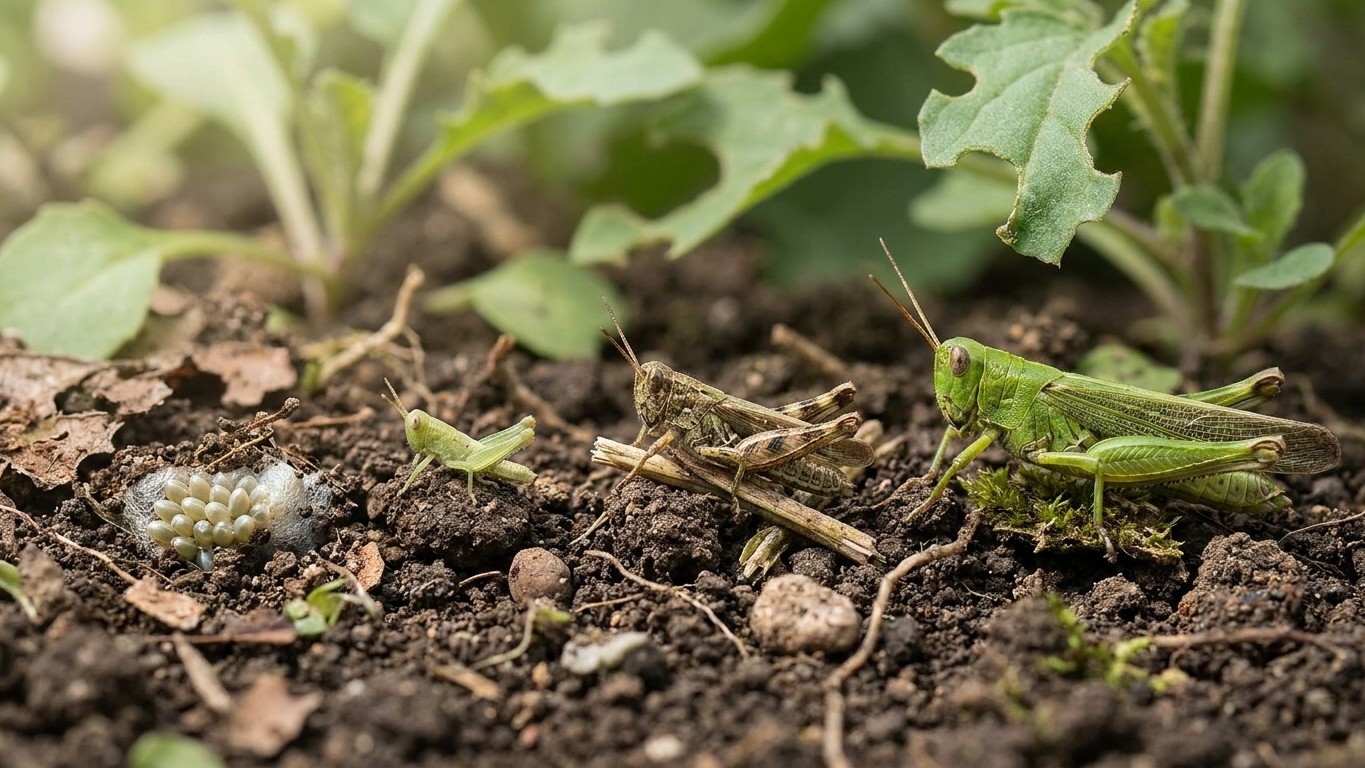

Grasshoppers don’t sneak up on a yard the way aphids or mites do. They hatch from eggs buried in the soil the previous fall, grow through a series of wingless nymph stages that look like miniature adults, then become the winged, mobile insects that strip gardens and pastures in mid-to-late summer. There’s no cocoon, no hidden pupal stage. What you see is what’s happening, and by the time you notice damage, the population has usually been building for weeks.
The stages, in order
Grasshoppers (family Acrididae, genus Melanoplus for most pest species in North America) skip the larva-and-pupa routine entirely. They go through what entomologists call incomplete metamorphosis: egg, nymph, adult. No caterpillar phase, no chrysalis. A nymph hatching in spring is already shaped like a grasshopper, just smaller, wingless, and pale. It molts five or six times over several weeks, growing wing pads and size with each molt, until it emerges as a fully winged, reproductively mature adult.
The egg stage is the one a gardener never sees. Females drive the tip of their abdomen into undisturbed soil in late summer or fall and deposit a pod of eggs an inch or two below the surface, usually in ground that hasn’t been tilled: field margins, roadsides, fence lines, dry weedy pastures. Those pods sit through winter, invisible, and that’s exactly why grasshopper outbreaks feel like they come out of nowhere. There’s no visible sign of the population until hatching starts.
Which stage causes the damage
Both nymphs and adults feed on foliage, but the pattern differs. Young nymphs feed close to where they hatched, often on grasses and weeds before moving into gardens and crops as they grow. Feeding damage accelerates through the later nymphal instars because each molt brings a bigger appetite. Adults do the most visible damage of the season for a simple reason: they’re larger, they fly, and they range much farther than nymphs ever do. A garden that looked fine in June can look shredded by August once winged adults move in from a dried-out field or roadside.
This is also why grasshopper outbreaks track weather and land conditions more than they track anything happening in a particular garden. Warm, dry springs favor egg survival and nymph development; wet, cool ones don’t. A homeowner can do everything right and still see a bad year if the surrounding rangeland or unmowed lots had ideal conditions for a population boom the season before. That distinction matters for how you think about control: this isn’t a pest you out-garden. It’s a pest whose numbers are set months earlier, somewhere else.
When it appears, and why that varies
Hatching isn’t triggered by a date on the calendar. Grasshopper eggs break diapause and start developing once the soil around them warms past a threshold, and how quickly they reach hatching after that depends on accumulated heat over the following weeks, what extension entomologists track as degree-days. That’s why the “same” grasshopper species can show up as tiny nymphs in one region while it’s still an egg pod three states north. The insect isn’t reading a calendar. It’s responding to soil temperature accumulated day after day.
Elevation and local microclimate matter as much as latitude here. A sunny, south-facing slope with sandy soil warms faster than a shaded, clay-heavy field a few miles away, so hatching can vary by weeks even within the same county. Depth of the egg pod plays a role too. Pods laid slightly deeper stay cooler longer and hatch later than shallower ones in the same field, which is part of why grasshopper emergence tends to stretch over several weeks rather than arriving all at once.
Why this site won’t give you a date
Degree-day thresholds and expected hatch windows are published and updated by university extension services at the state level, because they’re built from local soil temperature data and adjusted as spring weather unfolds. A number that’s accurate for one state’s growing region can be off by weeks for another. Rather than print a threshold here that might be stale or wrong for your area by the time you read it, the practical move is to check the extension page for your own territory, where this site’s state-level pages point you to the official source. Watching for the first small nymphs in weedy margins near your property is still the most reliable ground-truth signal, regardless of what the degree-day model says on a given week.
One generation or several
Most pest grasshopper species in the United States produce a single generation per year. That’s a meaningfully different problem than a pest that cycles through three or four generations between spring and fall. With a univoltine species like this, there’s one hatch, one nymphal development period, and one adult population that feeds, mates, and lays eggs before the season ends. There isn’t a second wave of freshly hatched nymphs showing up in August to restart the clock.
That doesn’t make the season short, though. Because egg pods hatch on a staggered schedule depending on depth and microclimate, and because adults can live and keep feeding for many weeks after reaching maturity, the practical window during which grasshoppers are actively damaging plants can stretch from late spring nymphs through late-summer adults. A single generation, spread out, still adds up to a long stretch of vigilance. The population you’re managing in July is the same cohort you saw as tiny nymphs in May, just bigger, winged, and hungrier.
What this means for how long you watch
The one-generation structure changes the strategy in a useful way. Knock back a serious infestation early, while grasshoppers are still small, wingless nymphs concentrated near hatching sites, and you’re dealing with the entire year’s problem at once rather than fighting a rolling series of reinfestations. Miss that window and let nymphs mature into flying adults, and control gets harder simply because adults move, disperse from surrounding fields, and are less vulnerable to the same tactics that work on nymphs. There’s no second generation coming to bail out a missed early window, but there’s also no second generation coming to make a well-timed early response fall apart later in the season.
Natural enemies matter more here than a lot of gardeners expect. Blister beetle larvae feed specifically on grasshopper egg pods in the soil, and populations of ground-nesting blister beetles can meaningfully cut next year’s hatch in a given field. Robber flies, birds, and parasitic flies in the family Tachinidae go after nymphs and adults through the season. None of these replace direct action against a heavy infestation, but avoiding broad-spectrum treatments in field margins where blister beetles and ground beetles live helps keep that background pressure working in your favor year after year.
Where it spends the winter
Grasshoppers overwinter as eggs, not as adults and not as nymphs. Adults die off with the first hard frosts of fall, after spending their final weeks mating and laying pods. The eggs inside those pods are what carry the species through winter, sitting an inch or two underground in a state of diapause until soil temperatures rise enough the following spring to restart development.
Location matters as much as depth. Females strongly prefer undisturbed soil for egg-laying: dry pasture edges, roadside strips, fence rows, weedy field borders, and other ground that doesn’t get tilled or heavily disturbed. Tilled garden beds and regularly cultivated cropland are far less common egg-laying sites, which is part of why grasshopper pressure often builds from the outside in, moving from an unmanaged field or vacant lot into a cultivated garden rather than originating within it.
This is exactly why fall land management around a property has more influence on next year’s grasshopper numbers than anything done during summer feeding damage. Egg pods concentrated in known undisturbed strips are vulnerable to disruption; leaving those same strips untouched year after year lets populations build quietly, invisibly, through a mild winter. It’s not a fix that shows results the same season, but it’s the piece of the life cycle that actually explains why some properties see grasshopper pressure return, worse, year after year, while similar ones nearby don’t.
Common questions
Do grasshoppers go through a pupal stage like moths or beetles?
No. Grasshoppers develop through incomplete metamorphosis: egg, nymph, adult. There’s no larval or pupal phase, and nymphs already resemble small, wingless versions of the adult from the moment they hatch.
Can I tell how bad a season will be before nymphs even hatch?
Not precisely without local data, but a warm, dry fall and mild winter generally favor higher egg survival, and a warm spring speeds hatching. Extension services in many states publish fall or early-spring outlook estimates based on the previous year’s adult populations and egg-laying activity.
Why do grasshoppers seem to arrive suddenly in my garden with no warning?
Because the eggs and early nymphs typically develop off-property, in undisturbed field margins or vacant land nearby, not in the garden itself. What looks sudden is usually winged adults dispersing in from those sites once nymphs mature.
Does one generation per year mean the problem ends once adults die in fall?
The visible adult population ends with frost, but the eggs they laid carry the population directly into next year. A heavy adult year in fall is a reasonable warning sign for a heavy nymph hatch the following spring.