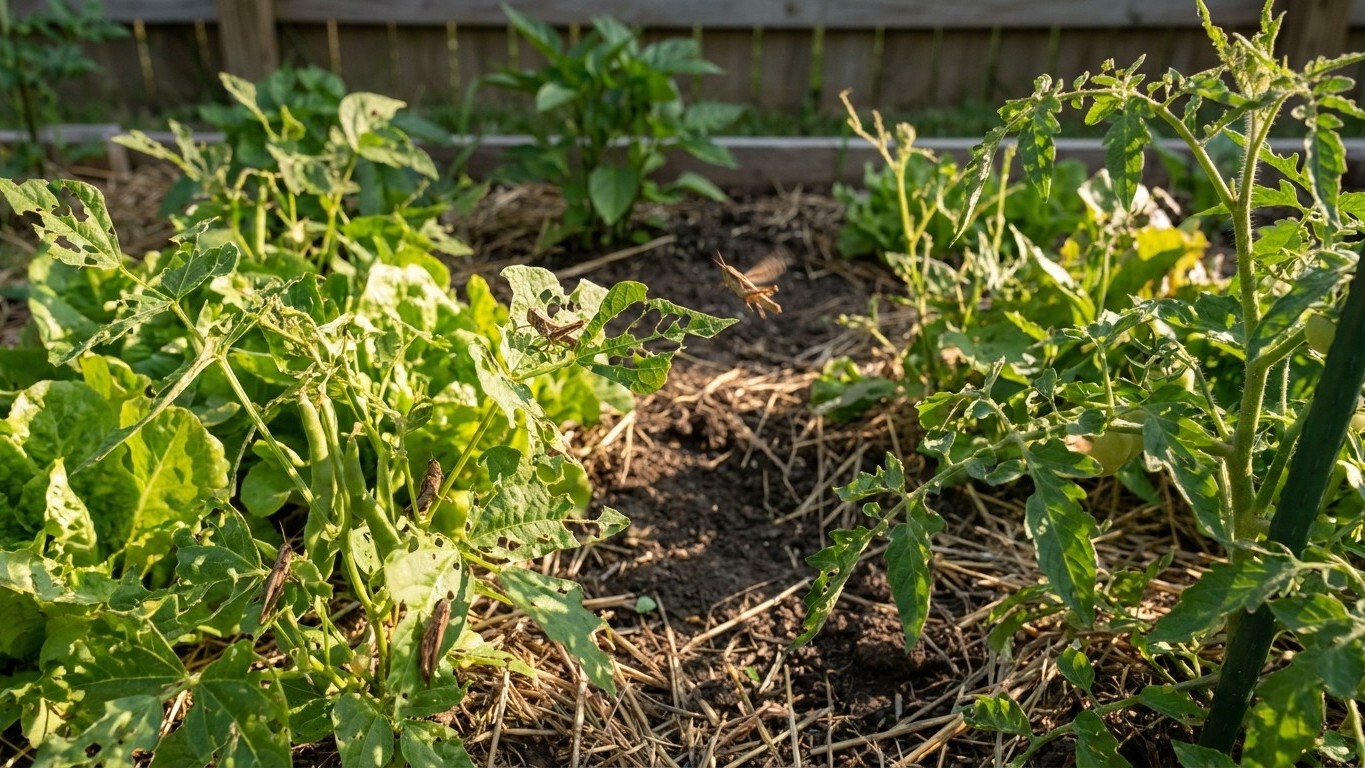

A grasshopper problem rarely announces itself with a single bite mark. It shows up as bare patches spreading across a bed, ragged leaf edges on plants that looked fine a week earlier, and, on close inspection, insects that jump rather than fly away when disturbed. The damage often looks worse than it is because grasshoppers feed in groups and move as conditions push them, which is the first clue to how you confirm what you’re seeing.
What the damage looks like
Grasshoppers (Melanoplus spp. is the genus behind most outbreaks in North America) are generalist feeders. In a dry year, that generalism is the whole story: when native rangeland grasses dry up early, grasshoppers move into gardens, ornamentals, and field crops because that’s where the green tissue still is. This is why the damage pattern tracks the weather more than it tracks any single plant you’re growing. A garden that’s never had an insect problem can suddenly show heavy feeding in a hot, dry summer, then go years without a repeat.
From across the yard
The first sign is usually visual and happens at a distance. Entire rows or beds look thin, almost see-through, with leaf tissue missing rather than discolored. Unlike disease, which spreads in blotches or rings, grasshopper damage tends to start at the edges of a property, closest to grassy margins, ditches, or vacant lots, and move inward as the insects exhaust the vegetation behind them. Lawns rarely show much damage since grasshoppers strongly prefer broadleaf plants and grain crops over turfgrass, though heavily infested turf edges can thin out too.
Close up on the plant
Get closer and the feeding pattern gets specific. Leaves show irregular, ragged holes with chewed margins, not the smooth circular holes typical of some beetles. On thin-leaved plants like beans or lettuce, grasshoppers can skeletonize a leaf down to the veins. On tougher plants, they notch the edges instead, leaving a scalloped outline. Stems and even flower buds get attacked when leaf tissue runs short, which is unusual for most chewing insects and a useful tell. Vegetable crops with thin, tender leaves (beans, lettuce, sweet corn seedlings) show damage fastest; corn, wheat, and other cereal grains show chewed leaf margins and sometimes damage to the developing ear or head. You may also notice dark, cylindrical droppings scattered on leaves and soil beneath the plant, larger and more visible than the frass left by smaller caterpillars.
What it is confused with
Grasshopper damage gets misread more often than you’d expect, partly because several other insects chew leaf margins in a similar ragged style. Misidentifying the culprit usually means reaching for a control timed to the wrong life cycle or the wrong feeding window, which wastes effort and sometimes money on a product that never had a target.
| Look-alike | How to tell them apart | Why it matters |
|---|---|---|
| Katydids | Similar chewing pattern, but katydids are usually solitary, greener, and active mainly at night; you’ll rarely see the daytime swarming behavior grasshoppers show | Katydid damage is typically isolated to one or two plants, not the sweeping garden-wide pattern grasshoppers leave |
| Crickets | Crickets chew similarly but favor soil-level damage on seedlings and stems, and are heard (chirping) more than seen during the day | Confusing the two can lead to soil-drench treatments aimed at crickets that do nothing for an above-ground grasshopper population |
| Caterpillars (armyworms, cutworms) | Caterpillar damage leaves smaller, softer frass and the larvae themselves are soft-bodied and slow-moving, not jumping insects | This is the most common wrong diagnosis: caterpillar-timed products applied for what is actually a grasshopper outbreak miss the pest entirely, since the life stages and behavior don’t overlap |
| Leaf-footed bugs and other true bugs | True bugs pierce and suck rather than chew, leaving stippled or discolored spots rather than missing leaf tissue | The damage looks superficially similar from a distance but the feeding mechanism is different, which matters for any biological control decision |
The armyworm mix-up is the one worth remembering. Gardeners who see stripped leaves in late summer often assume caterpillars are at work and apply a product timed for larval feeding windows, only to find the insects doing the damage are grasshopper nymphs that were never affected by that application. Confirming which insect you’re actually looking at, before deciding on any response, is the step that saves the second trip to the garden center.
Where to look to confirm
Confirming a grasshopper problem means becoming a careful observer for a few minutes rather than guessing from the damage alone. Timing and location both matter, because grasshoppers are not equally visible all day.
When to check
Grasshoppers are cold-blooded and their activity tracks temperature closely. On warm, sunny days they feed most actively in the late morning through mid-afternoon, when body temperature and sunlight are highest. Early morning and dusk, when temperatures drop, they tend to be still and tucked low in vegetation, which is actually the easier time to spot and count them since they aren’t jumping away the moment you approach. If you check only during the hottest part of the afternoon, you’ll see plenty of movement but have a harder time getting a close look at any individual insect.
Where to check
Start at the edges of the affected area, since that’s usually where the population is heaviest and where it’s moving in from. Look low, in the grass and weedy margins bordering the garden or field, before checking the crop itself; that border vegetation is where nymphs concentrate early in the season before spreading. On the plant itself, check the undersides and margins of the youngest, most tender leaves first, since that’s where feeding usually starts. Look for the insects themselves, not just the damage: grasshopper nymphs are smaller, wingless versions of the adult, uniformly colored and quick to hop when disturbed, while adults show fully formed wings and are often larger and more strongly marked. Finding a mix of nymphs and adults in the same area tells you the population has been building for a while, not that it just arrived.
Exact counts and action thresholds are set by each state’s extension service based on local research and current-season conditions, so this page won’t hand you a number to compare against. What you can confirm on your own is presence, life stage, and direction of movement, which is enough to decide your next step.
What to do once you are sure
Once you’ve confirmed grasshoppers rather than a look-alike, the next decisions depend on timing and on what actually keeps populations in check. Biological control matters more here than with many pests, because grasshoppers have natural enemies that can meaningfully limit outbreaks when they’re left undisturbed. Blister beetle larvae feed on grasshopper egg pods in the soil, reducing the following year’s hatch. Certain parasitic flies (Sarcophaga species) lay eggs on adult grasshoppers, and a naturally occurring fungal pathogen, Entomophaga grylli, can cause die-offs during humid stretches, sometimes leaving dead grasshoppers clinging visibly to plant stems. Broad-spectrum insecticide use tends to knock back these natural enemies along with the target pest, which is one reason outbreaks can come back stronger the following season in gardens that spray heavily every year.
Timing is everything with grasshoppers because they’re far easier to manage as small nymphs in field margins than as fully winged, mobile adults spread across a property. For the specifics of egg hatch, nymph stages, and when populations become harder to control, the life-cycle page lays out the full sequence. For what actually works at each of those stages, including the role of barriers, timing of any treatment, and how to protect the natural enemies described above, the control page covers the practical options.
Because emergence dates, degree-day thresholds, and locally recommended action levels vary by state and by season, the most useful next step is checking the guidance specific to where you live. This site maintains a page for your territory that names your state’s extension service directly, with a link to their current guidance rather than a generic national number.
Common questions
Do grasshoppers damage lawns the way they damage gardens?
Rarely to the same degree. Grasshoppers strongly prefer broadleaf plants and grain crops, and turfgrass is a secondary food source at best. Heavy infestations can thin grass at lawn edges bordering fields or vacant lots, but widespread lawn damage on its own is more likely another pest.
Can grasshopper damage kill an established plant?
Established woody plants and mature perennials usually recover from defoliation, since they have stored energy reserves. Seedlings and young transplants are far more vulnerable, since repeated feeding on the same small number of leaves can outpace the plant’s ability to regrow.
Why did grasshoppers suddenly show up in a garden that’s never had them?
Outbreaks follow drought and heat far more than they follow anything specific to a garden. When surrounding rangeland or field vegetation dries out early, grasshoppers move toward whatever green tissue is still available, which is often a well-watered garden or landscape bed nearby.
Does seeing a few grasshoppers mean I have an infestation?
Not necessarily. A handful of grasshoppers is normal background activity in most regions. What matters is whether you’re seeing a mix of nymphs and adults concentrated in one area with visible feeding damage, which points to a building population rather than incidental visitors.