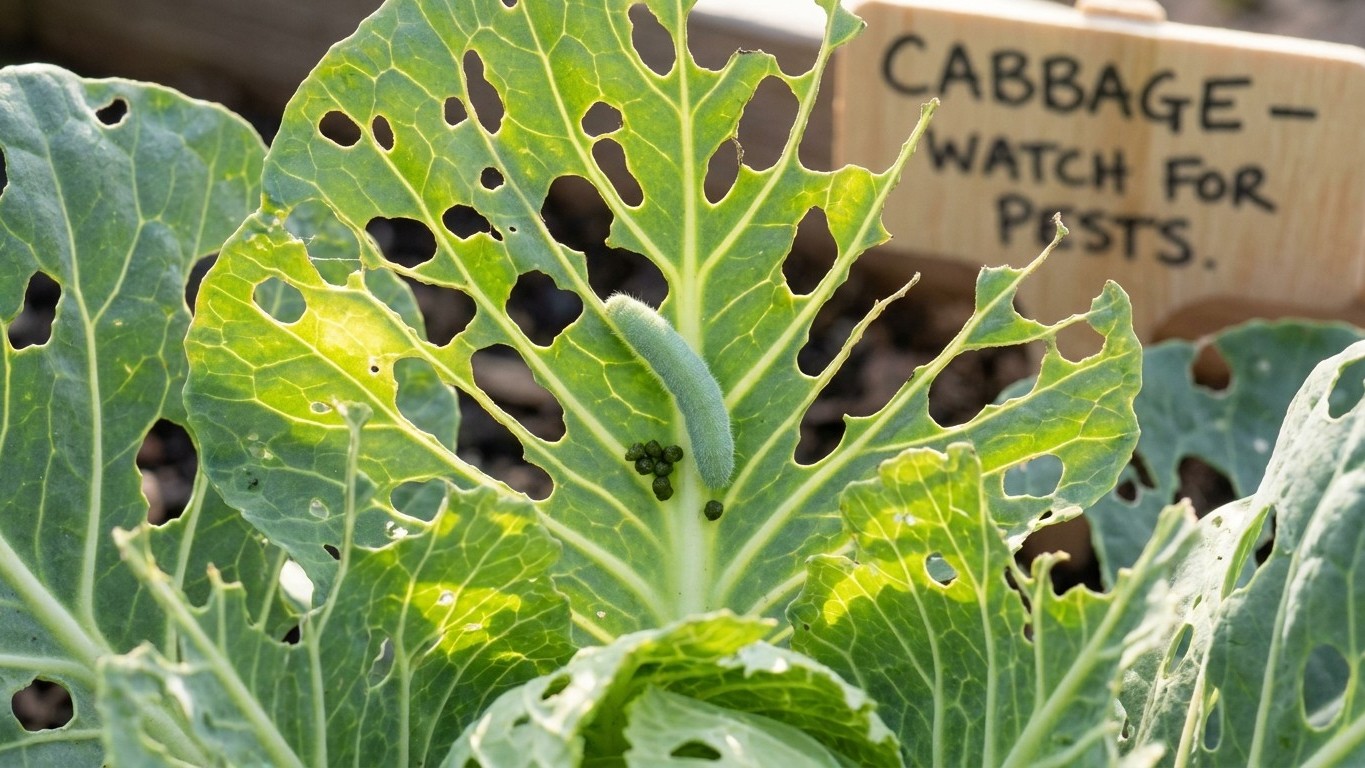

Imported cabbageworm damage shows up as ragged, irregular holes chewed through leaves, worst on the outer foliage and often boring straight into the developing head of cabbage, kale or broccoli. Look closer and you’ll find pale green, watery droppings stuck to the leaf surface and a soft, velvety green caterpillar tucked along the midrib. That caterpillar is the larva of Pieris rapae, the same insect whose white adult butterfly flits harmlessly over the same bed.
What the damage looks like
From a few steps back, a plant under attack looks moth-eaten. Leaves have chunks missing, not tidy circles but jagged bites of every size, sometimes leaving nothing but the tougher veins standing like a skeleton. Growth looks stunted on younger plants because the caterpillars target the newest, tenderest tissue first, and a bed that looked fine last week can look shredded within days once the population builds.
Step closer and the pattern gets more specific. Holes cluster on outer leaves at first, then move inward as the caterpillars grow and the plant’s tender core becomes the prize. On cabbage, that means damage inside the forming head itself, not just on the wrapper leaves, which is what turns a cosmetic problem into a market-loss problem for anyone growing to sell or can. Kale and collards show damage spread across the whole leaf surface since there’s no head to protect, while broccoli often shows the worst feeding right where the florets are forming, hidden from a casual glance.
On the leaf itself
Get down to the leaf and the signature details appear. The caterpillar is velvety green, faintly fuzzy, with a thin yellow stripe running down its back, and it grows from barely visible to over an inch long over several weeks. It sits still along a vein or leaf fold, matching the color so closely that people often see the frass before they see the insect responsible for it. That frass is soft, greenish, and slightly wet, distinct from the drier, darker pellets other leaf-feeders leave behind. Where feeding is heavy, the underside of the leaf often shows a thin, papery layer left behind, a sign the caterpillar chewed through the surface tissue but not the tougher membrane beneath, at least in the earliest stages of feeding before it grows large enough to eat clean through.
What it is confused with
Several other cabbage-family feeders produce similar-looking chewed leaves, and mixing them up is the most common reason a treatment fails. A gardener who assumes every green caterpillar on a cole crop is the same pest may reach for a control method timed for the wrong life stage, or miss a completely different insect causing the real damage.
| Could be confused with | How to tell them apart | Why it matters |
|---|---|---|
| Cabbage looper | Looper caterpillars are pale green with faint white stripes and move by arching their back into a loop, since they lack the middle set of prolegs. Imported cabbageworm crawls smoothly instead. | Loopers often feed at different times and depths in the canopy, so a control timed for cabbageworm larvae can miss the looper generation entirely. |
| Diamondback moth larva | Much smaller, thinner, and wriggles violently or drops on a silk thread when disturbed. Feeding leaves tiny “windowpane” patches rather than large ragged holes. | Diamondback populations can build resistance to certain treatments faster, so treating it as ordinary cabbageworm damage risks under-managing a tougher problem. |
| Cross-striped cabbageworm | Has distinct black and white bands across a bluish-gray body, easy to spot once you look closely, and tends to feed in small clusters rather than alone. | Cluster feeding means a single missed group can cause damage that looks disproportionate to the number of insects present. |
| Flea beetle damage | Beetles leave tiny round “shot holes,” not ragged chewed patches, and you’ll see small dark jumping beetles rather than any caterpillar. | This is a common wrong diagnosis: gardeners see holey leaves, assume cabbageworm, and skip checking for beetles, which need an entirely different response. |
The frass and the smooth green body are the two fastest checks in the field. If the caterpillar loops when it moves, or the body is banded rather than plain green, the plan needs to change before any control step gets applied.
Where to look to confirm
Confirmation means turning over leaves, not just scanning the top surface where damage is easiest to see but where the insect itself often isn’t. Check the undersides of the outer leaves first, since female butterflies lay single, tiny, bullet-shaped yellow eggs there, standing upright and easy to miss unless you’re looking directly at the leaf surface in decent light.
Morning is the better time to scout. Caterpillars that fed overnight are still visible and sluggish, while the adult butterflies, which are more active at midday, aren’t around to distract from what’s happening at the larval stage. Work from the outer leaves toward the center of the plant, since that’s the direction feeding tends to progress as larvae mature, and check the base of the head or the crown of broccoli where florets are forming, a spot damage-prone but often overlooked because it’s out of the direct eyeline.
What stage you’ll find and when
Early in an infestation, expect eggs and very small, pale larvae that are easy to mistake for leaf texture. As the season progresses, larger caterpillars near full size become more visible and cause the bulk of visible damage in a short window. Because timing and thresholds for treatment differ by state and by growing season, this page won’t give a specific count or calendar date to act on. Your state’s extension service tracks regional emergence and sets the action levels that actually apply to your garden, and that guidance changes from year to year based on weather and pest pressure.
Two natural enemies are worth knowing before any other decision gets made. Parasitic wasps in the genus Cotesia lay eggs inside young cabbageworm larvae, and an infested caterpillar will eventually be surrounded by small yellow silk cocoons, a sign the population is already being controlled biologically. Avoiding broad-spectrum treatments when these cocoons are present preserves that control for the rest of the season.
What to do once you are sure
Once the identification lines up (smooth green caterpillar, yellow racing stripe, watery green frass, single upright eggs on the leaf underside) the next two questions are timing and method, and both depend on where you garden. For a full picture of how many generations occur in a season and when populations typically peak, the imported cabbageworm life cycle page lays out the stages from egg to adult butterfly and how quickly the insect can cycle through them under warm conditions.
For the actual response, whether that means hand-picking, encouraging the parasitic wasps already established in the garden, using row covers to block egg-laying, or another method suited to the scale of the planting, the control options page walks through what actually reduces damage without wiping out the natural enemies doing part of the work already.
Because effective timing is set locally, not nationally, the most useful next step for many gardeners is checking the territory-specific page for their own state, where the relevant extension service is named directly along with the guidance that office publishes for that region’s growing season. Degree-day models, regional emergence windows, and locally tested action thresholds live there, not here, because a single number applied nationwide would be wrong for most gardens most years.
Common questions
Does seeing white butterflies mean my plants already have damage?
Not necessarily. The adult butterfly is harmless and only lays eggs; damage comes from the larval stage that follows, so seeing adults is a warning to start checking leaf undersides, not proof of existing feeding.
Can imported cabbageworm damage a plant badly enough to kill it?
Heavy, repeated feeding can stunt young plants severely and ruin the marketable head on cabbage or broccoli, though established plants with some maturity usually survive even significant leaf loss.
Is the green caterpillar dangerous to touch or handle?
No. It has no stinging hairs or venom and is commonly removed by hand as part of low-intervention control in home gardens.
Why do I see damage on kale but not much on nearby tomatoes?
Imported cabbageworm feeds specifically on cabbage-family crops like kale, cabbage, and broccoli, not on unrelated vegetables, which is one more clue when confirming identification against other leaf-feeding insects in a mixed garden.