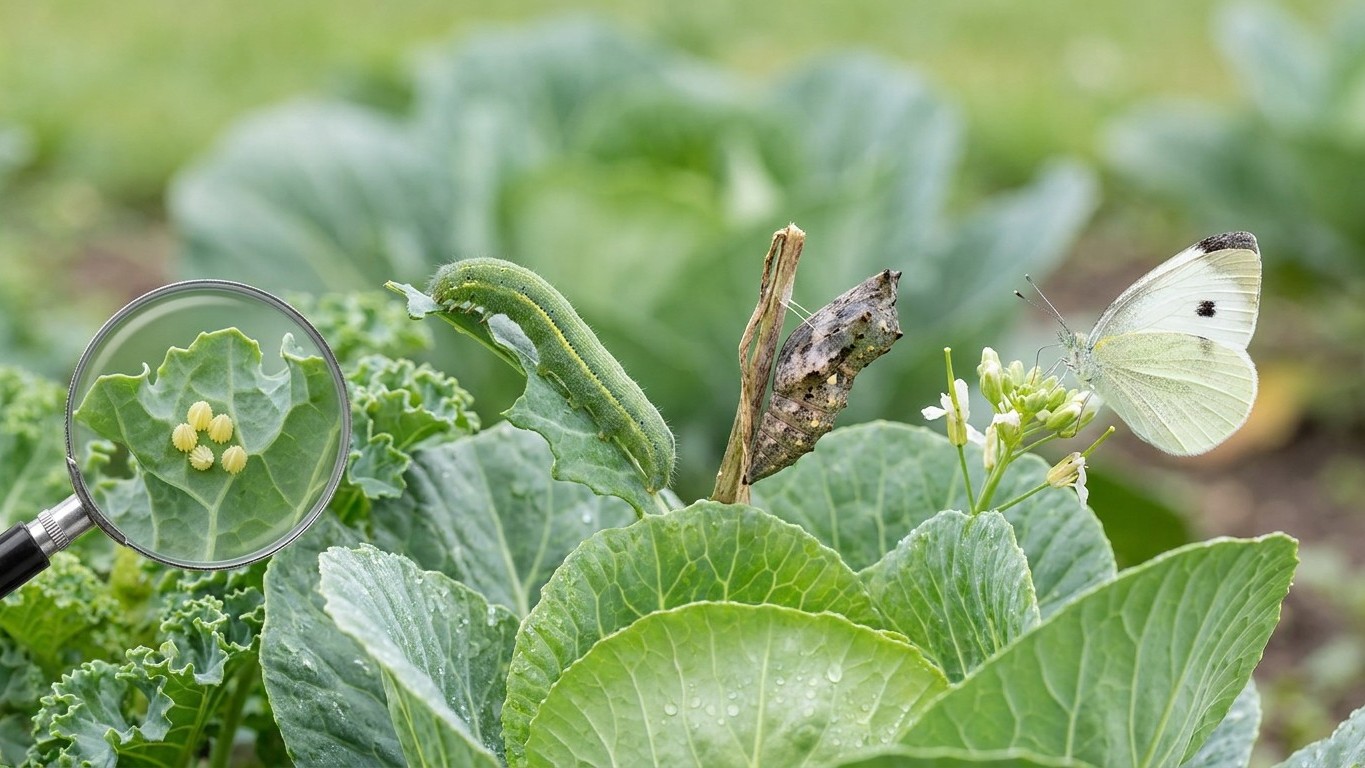

Imported cabbageworm goes through four stages: egg, larva, pupa, and adult. The larva, a velvety green caterpillar, is the only stage that damages plants. Emergence timing follows accumulated warmth rather than a fixed date, so it shows up weeks apart between southern and northern gardens. The species produces several overlapping generations each season and overwinters as a pupa near its host plants, not as an egg or an adult.
The stages, in order
Everything about this pest traces back to one fact: only one of its four life stages actually eats your cabbage, broccoli, or kale. The rest just get it there.
The cycle starts with the egg. Pieris rapae females lay them singly, not in clusters, on the underside of leaves. Each egg is tiny, ridged, and pale yellow, fading to a dull cream as it nears hatching. A single female can lay several hundred over her lifetime, scattering them across a garden bed rather than concentrating damage in one spot.
Next comes the larva, and this is the stage every gardener eventually meets. The caterpillar is velvety green, blends almost perfectly with brassica foliage, and carries a faint yellow stripe down its back. It molts through several growth stages, called instars, getting larger and hungrier each time. Early instars nibble small, ragged holes; late instars can skeletonize a leaf or bore into a developing head of broccoli or cabbage. This is the destructive phase, full stop.
After feeding is done, the larva pupates. The chrysalis is mottled green, brown, or gray, shaped like a small angular shell, and usually attached to the underside of a leaf, a stem, a fence rail, or some other nearby surface. Inside, the insect reorganizes itself completely. This stage does no feeding and causes no damage, which is exactly why most gardeners never notice it.
The adult emerges as the familiar white butterfly, wings marked with one or two black spots depending on sex. It’s the stage most people actually enjoy watching, drifting over flower beds and garden rows. Adults feed on nectar, not foliage, and their only real job in the garden is mating and laying the next batch of eggs. So the identification split is simple: the butterfly is the one you see and admire, the caterpillar is the one you see and curse, and the egg and pupa mostly pass unnoticed unless you’re deliberately checking leaf undersides.
When it appears, and why that varies
Gardeners want a date. Insects don’t work on dates.
Imported cabbageworm development is driven by accumulated heat, tracked by entomologists as degree-days, not by a page on a calendar. A pupa that overwintered in New England needs a certain amount of warmth to trigger the biochemical changes that lead to adult emergence, and that warmth accumulates at a completely different pace than it does in coastal Georgia or the Central Valley of California. The result is emergence dates that can differ by a month or more across the country in a given year, and by a week or two in the same location from one year to the next, depending on how mild or cold the spring turned out to be.
This is also why “first appearance” isn’t a single moment. Overwintering pupae don’t all wake up on the same day. Some sit in slightly warmer microclimates, tucked against a south-facing wall or under thicker mulch, and emerge earlier than pupae in more exposed spots a few yards away. Early emergers start laying eggs while later ones are still developing, which smears the start of the season out over a stretch of days or weeks rather than a clean starting line.
Why the threshold isn’t printed here
Every state’s cooperative extension service tracks degree-day accumulation and regional emergence patterns for the pests that matter most to that state’s growers, and imported cabbageworm is high on that list almost everywhere brassicas are grown. Those numbers change with soil temperature data, local weather stations, and the season itself, which is exactly why a national date or degree-day figure would be misleading no matter how it was worded. The accurate move is to check your own territory’s extension pest page, which is built and updated by the researchers actually monitoring your region’s traps and temperature logs. This site’s own territory pages link out to those official sources so you’re working from the number that applies to your yard, not a guess that applies to nowhere in particular.
What you can rely on everywhere: warmer springs pull emergence earlier, cooler springs push it later, and the trigger is heat accumulation, not the flip of a page on the wall calendar.
One generation or several
This is the detail that changes how long you need to pay attention. Imported cabbageworm is not a one-and-done pest. It’s multivoltine, meaning it completes several full generations, egg through adult, in a single growing season. Depending on regional climate and how long the warm season runs, gardeners commonly deal with three to five overlapping generations between spring and fall.
That overlap matters more than the raw generation count. Because early emergers and late emergers don’t stay synchronized, by midsummer a garden can host eggs, small larvae, large larvae, pupae, and adult butterflies all at the same time. There’s no clean gap between “generation one is over” and “generation two begins.” It’s closer to a rolling wave than a series of separate storms.
The practical consequence: this isn’t a pest you can watch for during one two-week window and then forget. Monitoring needs to continue from the first butterflies of spring through the last warm days of fall, because a garden that looks clean in June can have a fresh crop of egg-laying adults by August. Brassica crops planted for a fall harvest, timed to dodge early-season pressure, often run straight into a later generation instead.
Where natural enemies fit into a multi-generation pest
The upside of a pest that sticks around all season is that its natural enemies do too, and for imported cabbageworm those enemies do real work. The parasitic wasp Cotesia glomerata lays its eggs inside cabbageworm larvae, and the wasp larvae eventually kill the caterpillar from within, a control mechanism that plays out quietly and repeatedly across a season without any spraying at all. Generalist predators, ground beetles, lacewings, and several bird species that pick caterpillars off foliage, also chip away at each generation before it can lay the next batch of eggs.
Preserving that biological control mainly means avoiding broad-spectrum insecticide use that kills the parasitic wasps along with the caterpillars, and keeping some flowering plants nearby that support adult parasitoids. A pest with several generations per year gives beneficial insects several chances per year to do their job too.
Where it spends the winter
Every spring’s first butterflies came from somewhere, and for imported cabbageworm, that somewhere is almost always close to home.
The species overwinters as a pupa, not as an egg, a larva, or an adult. As days shorten and temperatures drop in fall, the final generation’s larvae finish feeding, pupate, and then simply stay in that state through the cold months rather than continuing development. Those pupal cases attach to whatever solid surface was nearby when the caterpillar stopped feeding, which frequently means leftover brassica plant debris left standing in the garden, fallen leaves, fence posts, garden stakes, the undersides of raised bed frames, or even siding and outbuildings close to where the crop grew.
This is exactly why fall garden cleanup isn’t just tidiness. Pulling and destroying old cabbage, broccoli, and kale plants after harvest, rather than leaving them to break down in place over winter, removes a meaningful number of overwintering pupae before they get the chance to emerge next spring right on top of the new crop. It won’t eliminate the pest entirely, since adult butterflies are strong flyers capable of moving in from neighboring properties, wild mustard patches, or untended lots, but reducing the local overwintering population lowers the pressure on next year’s planting from day one.
It’s worth being clear that this species is not confined to any one region. Wherever brassica crops are grown in the United States, imported cabbageworm populations persist locally through winter in pupal form, ready to respond to the first sustained stretch of spring warmth. That predictability is actually useful: it means the single most effective piece of prevention available to a home gardener, clearing old brassica debris before winter sets in, is also the simplest one, and it pays off specifically because of where and how this insect chooses to spend the cold months.
Common questions
Is the white butterfly in my garden the same insect eating my cabbage?
Yes, in the sense that it’s the adult stage of the same species. The butterfly itself doesn’t chew leaves, but it’s the parent of the caterpillars doing the damage, and every butterfly you see is potential eggs on the way.
How many caterpillars can one butterfly produce?
A single female can lay several hundred eggs over her lifetime, spread out singly across many plants rather than in one concentrated batch, which is part of why an infestation can seem to appear from nowhere.
Does cold weather kill off the population each winter?
Not entirely. The pupal stage is built to survive cold, tucked into plant debris or nearby structures, so a hard winter reduces but doesn’t eliminate the local population going into spring.
If I only see damage once, will it come back later in the season?
Almost certainly, since this species completes multiple generations per year with overlapping stages. A garden that looks clear after the first wave should still be checked regularly through the rest of the growing season.