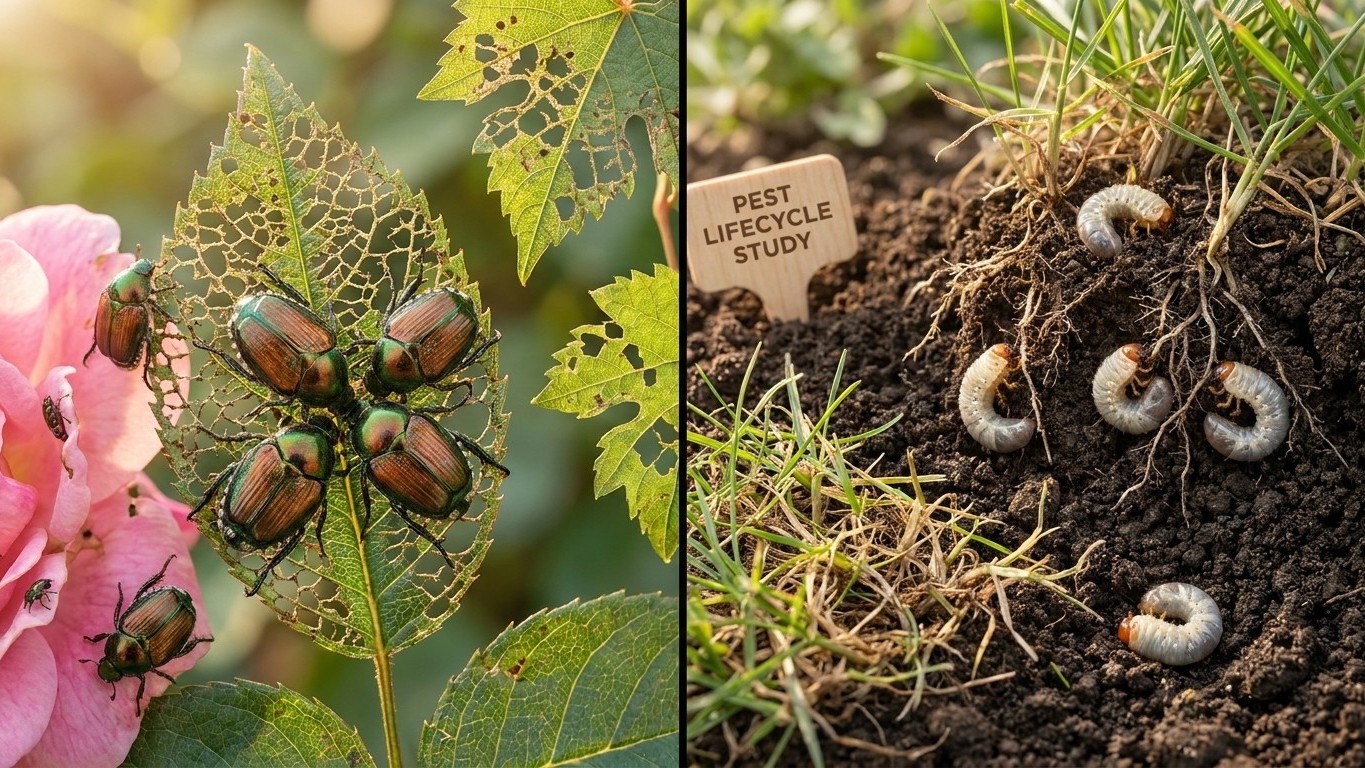

Japanese beetle (Popillia japonica) damage shows up as lace-like skeletonized leaves on roses, grapes, linden, and dozens of other plants, usually starting in early-to-mid summer. The beetles themselves are unmistakable: a metallic green thorax, coppery-brown wing covers, and small tufts of white hair along the abdomen. Control only works if it matches what’s actually happening below and above ground at that moment, because this insect runs two separate operations at once.
Timing beats product
Adult Japanese beetles feed in groups on foliage and flowers, chewing between the veins so leaves end up looking like window screens. Meanwhile, their larvae, C-shaped white grubs, are underground chewing through turfgrass roots. These are not two pests. They’re one life cycle split into stages that live in different places, eat different things, and respond to completely different interventions. A treatment aimed at grubs in the soil will do nothing to stop adults from stripping a rose bush in July. A spray timed for adult feeding won’t touch grubs weakening a lawn’s root system in August or September.
This is where most homeowner frustration comes from. Someone applies a lawn grub product in spring, still sees beetles devastating the garden in summer, and concludes nothing works. The product may have worked exactly as designed, just against the wrong target at the wrong time. Grub-stage treatments need to hit young larvae before they’ve grown large and hardy. Adult-stage interventions need to align with the weeks when beetles are actively emerging and feeding, a window that shifts by region and by year depending on soil temperature and rainfall.
Because emergence dates, degree-day thresholds, and grub development stages vary by state and by season, guessing at timing is close to useless. The Japanese beetle life-cycle page lays out exactly what’s happening at each stage, month by month, so an intervention lines up with biology instead of a calendar habit. Read that first. Everything below, from hand-picking to soil products, only works if it’s timed to the stage actually causing the damage in front of you.
What works without a product
Several methods reduce beetle damage without any label to read, though none of them are effortless.
Physical exclusion and removal
- Row covers and fine mesh netting, installed before adults begin emerging and feeding, physically block beetles from reaching vulnerable plants. Once beetles are already established on a plant, covering it traps them inside instead of keeping them out.
- Hand removal works best in early morning, when beetles are sluggish from cooler temperatures and slower to fly off. Knocking them into a bucket of soapy water kills them without any spray. It’s tedious on a large planting, but on roses, a few fruit trees, or a small vegetable patch, it’s genuinely effective if done daily during peak feeding weeks.
- Cleanup of overripe or fallen fruit removes a feeding and breeding draw that keeps beetle populations concentrated in one area of the yard.
Planting choices and timing
Trap crops, sacrificial plants that beetles strongly prefer, can pull feeding pressure away from more valued plants, but only if placed and monitored before the main infestation builds, otherwise the trap crop just becomes an additional breeding ground. Adjusting planting schedules so the most attractive, vulnerable growth stage doesn’t coincide with peak adult activity reduces exposure too, though this requires knowing local emergence timing rather than a fixed date.
None of these methods eliminate a beetle population on their own. They reduce damage on specific plants or in specific windows, and they work best layered together rather than relied on individually.
The allies you already have
Japanese beetle populations already have natural enemies working against them, and preserving those allies matters more than most homeowners realize. Istocheta aldrichi, sometimes called the winsome fly, is a tachinid fly that parasitizes adult beetles directly, laying eggs on the beetle’s thorax that develop into larvae feeding on the beetle from inside. Two parasitic wasp species, Tiphia vernalis and Tiphia popilliavora, target the grub stage underground, laying eggs on larvae that the wasp larvae then consume. Birds, particularly species that forage on lawns, and other ground-foraging predators also take a steady toll on grubs turned up near the soil surface.
These natural enemies don’t eliminate a beetle population either, but they suppress it season over season, which matters because Japanese beetle numbers tend to build gradually in a landscape rather than appearing at full force in year one.
A broad-spectrum insecticide applied without regard to timing or target kills adult beetles, sure, but it kills the tachinid flies and parasitic wasps working the same yard at the same time. The following season, with natural predation weakened and beetle populations rebounding from surrounding, untreated areas, the pressure often comes back worse, not better. This is one of the more overlooked reasons a “beetle problem” turns into a recurring, escalating one: the intervention removed the insect’s natural checks along with the insect.
When a product is the answer
There’s an honest case for product-based treatment, and it applies when grub damage is already weakening a lawn’s root structure to the point of dieback, or when adult feeding pressure threatens high-value plants that hand removal and barriers can’t realistically protect. In those situations, a targeted product, applied at the correct life stage, is a legitimate tool rather than a last resort to feel guilty about.
The condition that makes or breaks this approach is stage-matching. A grub-targeted product has to reach young larvae while they’re still small and near the surface, feeding actively on roots, a window that closes as grubs mature and move deeper into the soil for winter. An adult-targeted approach has to align with the weeks beetles are actually present and feeding, not before emergence and not after the population has already moved on.
What’s permitted, and under what conditions, differs by state and changes from season to season as products are reviewed, restricted, or replaced. There is no single national answer here, and any source claiming otherwise is skipping the part that actually matters for a homeowner trying to act legally and effectively. The right move is checking with a state’s university extension service, which tracks current emergence dates, degree-day thresholds, and locally permitted options for Japanese beetle specifically. This site carries a dedicated page for finding that state-specific extension resource, including the direct link to the office covering a given territory, so the guidance applied is current rather than guessed at.
Common questions
Do Japanese beetles come back to the same plants every year?
Yes, often to the same yard and even the same plants, because adult beetles release aggregation pheromones that draw more beetles to a spot already under attack. A plant hit hard one season is likely to be a target again unless the surrounding conditions, including grub pressure in nearby turf, change.
Does killing adult beetles reduce next year’s grub problem?
Only partially. Adults present in a yard mate and lay eggs nearby, so reducing the adult population on-site does lower local egg-laying. But beetles fly in from surrounding properties too, so grub pressure the following year depends on the whole neighborhood’s beetle activity, not just one yard’s adult control.
Are Japanese beetle traps a good control method?
Pheromone traps attract beetles from a wide radius, often drawing in more beetles than would have otherwise found a yard, and studies from university extension programs have repeatedly found they can increase local damage when placed near vulnerable plants rather than well away from them.
How long does an adult Japanese beetle live and feed?
Adult beetles are active and feeding for roughly four to six weeks during their peak season, though exact emergence and decline dates shift by region and year. This is exactly why timing guidance needs to come from a state-specific extension source rather than a fixed calendar date.