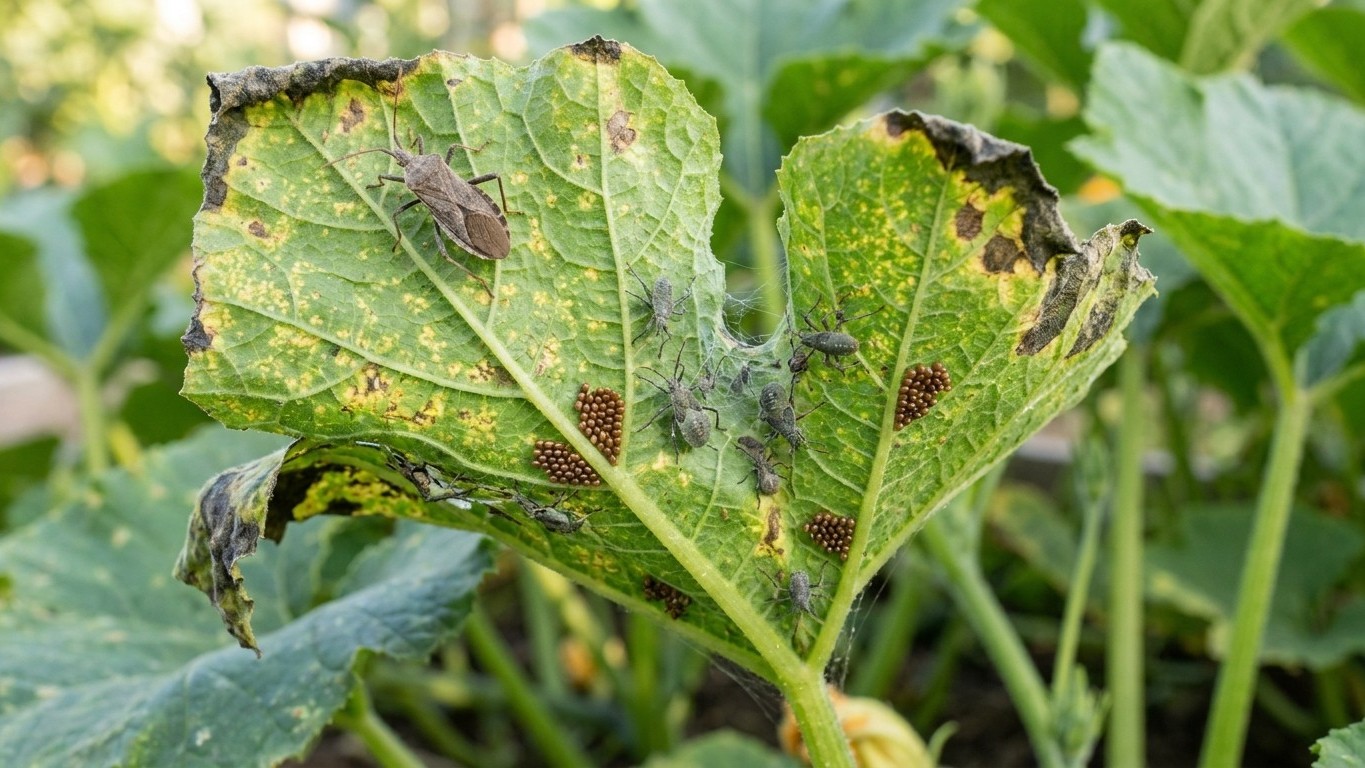

Squash bugs (Anasa tristis) show up as soon as vine crops put out their first true leaves, and they keep showing up in waves through late summer. The adults overwinter nearby and walk back into the garden the moment the soil warms, then spend the season laying eggs in batches that hatch into the nymphs actually responsible for wilted, blackened leaves. Knowing which stage you’re looking at, and when it’s due, is what separates a one-time squash bug problem from a season-long fight.
The stages, in order
A squash bug’s life runs through four stages, and only two of them are doing visible damage in your garden. The adult, a flat-backed, brownish-gray insect about five-eighths of an inch long, overwinters and then lays clusters of bronze-colored eggs on the undersides of squash and pumpkin leaves, usually wedged into the V formed by leaf veins. Those eggs hatch into nymphs, small and spider-legged, gray-green at first and darkening to gray as they grow. Nymphs pass through five instars before becoming adults, and it’s this nymph stage, along with the adults, that does the actual feeding damage: piercing leaf tissue and sucking out plant fluids, which causes the yellow speckling that turns brown and then collapses into the telltale wilted, blackened look people associate with squash bug damage.
Why it gets confused with stink bugs
Gardeners mix up squash bugs with stink bugs constantly, and the confusion matters because the two pests respond differently to timing and to natural predators. Squash bugs are narrower, more elongated, and specifically drawn to cucurbits (squash, pumpkins, cucumbers, melons), while stink bugs are broader-shouldered and feed on a much wider range of vegetables and fruit. Squash bug egg masses are also distinctive: tight, geometric clusters of bronze eggs, versus the more barrel-shaped, often lighter-colored eggs stink bugs lay. If you’re treating for one and seeing no results, the second thing to check is which insect you actually have.
What a gardener typically sees first isn’t the egg stage at all. Eggs are small, tucked on leaf undersides, and easy to miss until you’re specifically hunting for them. The stage that triggers most “what’s wrong with my squash” searches is the nymph, especially once they’re past the first instar and clustering in visible groups on stems and leaf undersides. Adults are seen too, usually hiding at the base of plants or under mulch during the heat of the day, but the population explosion that does the real damage comes from nymphs hatching in synchronized batches from those egg clusters.
When it appears, and why that varies
Squash bug emergence isn’t tied to a date on the calendar. It’s tied to accumulated warmth, the running total of heat units the soil and air have absorbed since late winter, sometimes tracked by extension services as degree-days. That’s why the same species can show up in a Gulf Coast garden weeks before it appears in a garden in the Upper Midwest, even though both gardeners are watching the same insect with the same biology. The mechanism is simple: overwintering adults are dormant until temperatures cross a threshold that tells their bodies it’s safe to become active, seek food, and start mating. Warm springs pull that threshold forward; cool, wet springs push it back, sometimes by two or three weeks in the same region from one year to the next.
This is also why national planting guides and generic pest calendars tend to disappoint gardeners who follow them literally. A guide written for a longer, warmer growing season will have the pest arriving well before local vine crops are even in the ground further north, while a guide calibrated for a short season will have gardeners on watch long after the real activity window has passed in warmer states. Degree-day thresholds and the calendar windows built from them are calculated and published at the state level, because soil temperature, spring rainfall, and the length of the previous winter all factor into when dormant adults break diapause.
The practical move is to stop looking for a single national date and start checking the threshold your own university extension service publishes for your county or region. Extension entomologists track regional degree-day accumulation specifically so gardeners don’t have to guess, and most cooperative extension offices update pest activity forecasts through the growing season. This site maintains a page for your territory with that guidance and a link to the relevant extension source, and that’s the number worth using instead of any generic date.
One generation or several
Squash bugs typically complete one to two generations per year depending on the length of the growing season, which puts them in an awkward middle ground between a single clean window and a pest that cycles continuously all summer. In shorter-season regions, one generation may be all that completes before fall temperatures shut activity down. In regions with a longer warm stretch, a second generation can build from mid-summer egg-laying, meaning the adults you knock back in June can be followed by a fresh wave of nymphs in August, right as fruit is sizing up.
That has a direct, practical consequence for how long a gardener needs to stay on watch. A strictly single-generation pest lets you relax once the first wave is controlled: check leaf undersides for a few weeks, manage what hatches, and move on. A pest that can run a second generation means the job isn’t done when the first nymphs mature into adults. Egg-laying can resume, and a garden that looked clean in July can show fresh damage in late August from a second cohort nobody was watching for.
The result is that squash bug scouting needs to continue through most of the active growing season in regions where two generations are possible, not just during the initial emergence window. Checking leaf undersides weekly for new egg clusters, even after an early infestation seems resolved, is the only way to catch a second generation before nymphs disperse and start feeding heavily on stems and fruit. Vine crops that are stressed by a first-generation infestation are also more vulnerable to damage from a second wave, since the plant has less reserve capacity to compensate for lost leaf tissue.
Where it spends the winter
Adult squash bugs overwinter in place rather than migrating any real distance, which is exactly why cleanup after harvest matters more for this pest than for many others. They tuck into leaf litter, garden debris, under boards or mulch, in crevices around the edges of the garden, and sometimes into cracks around building foundations close to where cucurbits were grown. They do not overwinter as eggs or nymphs; only the adult stage survives the cold, emerging the following spring once accumulated warmth crosses the local threshold discussed above.
That single fact is what makes fall garden cleanup genuinely effective against this species, rather than just tidy. Removing old squash and pumpkin vines, dead leaves, and any boards, pots, or mulch piled near where cucurbits grew eliminates a large share of the shelter adults rely on to survive winter in that spot. It won’t eliminate the population regionally since adults can also overwinter in nearby wooded edges, hedgerows, or unmanaged lots, but it measurably reduces the number of overwintering adults with a direct walking distance to next year’s plants.
Natural enemies worth protecting
Biological control matters more for squash bugs than for a lot of garden pests, because a parasitic fly, Trichopoda pennipes, specifically targets adult and late-stage nymph squash bugs, laying its eggs on the bug’s body and killing the host as its larva develops. Damsel bugs and certain predatory beetles also feed on squash bug eggs and young nymphs. None of these predators are things you buy and release; they build up naturally in a garden that isn’t routinely blanketed with broad-spectrum insecticide, which is one more reason overwintering habitat and general garden diversity matter as much as any direct intervention. A garden edge left a little wild, with some undisturbed leaf litter over winter that isn’t right against the vegetable bed, can support these predators without also sheltering large numbers of squash bugs.
Common questions
How can I tell squash bug eggs from other insect eggs on my plants?
Squash bug eggs are bronze to reddish-brown, laid in tight, organized clusters, usually in the angle where leaf veins meet on the underside of squash or pumpkin leaves. The geometric spacing and consistent color are the giveaway; most other common garden pest eggs are either more scattered or a different shape entirely.
Do squash bugs bite people or pets?
No. Squash bugs feed exclusively on plant sap from cucurbits and pose no direct threat to humans or animals. They can release a disagreeable odor when crushed or disturbed, which is where some of the stink bug confusion comes from, but they don’t bite or sting.
Will squash bugs go after other vegetables in my garden?
They’re specialists on cucurbits: squash, pumpkins, cucumbers, and melons. Tomatoes, peppers, beans, and other common garden vegetables aren’t part of their feeding range, so an infestation on your zucchini generally won’t spread to unrelated crops nearby.
Why did my squash bug problem come back after I thought I’d cleared it?
In regions where a second generation completes, adults that survive early-season control can lay a fresh round of eggs by mid-summer. Continued weekly checks of leaf undersides through the season, rather than a single treatment pass, catch this second wave before nymphs mature and disperse.