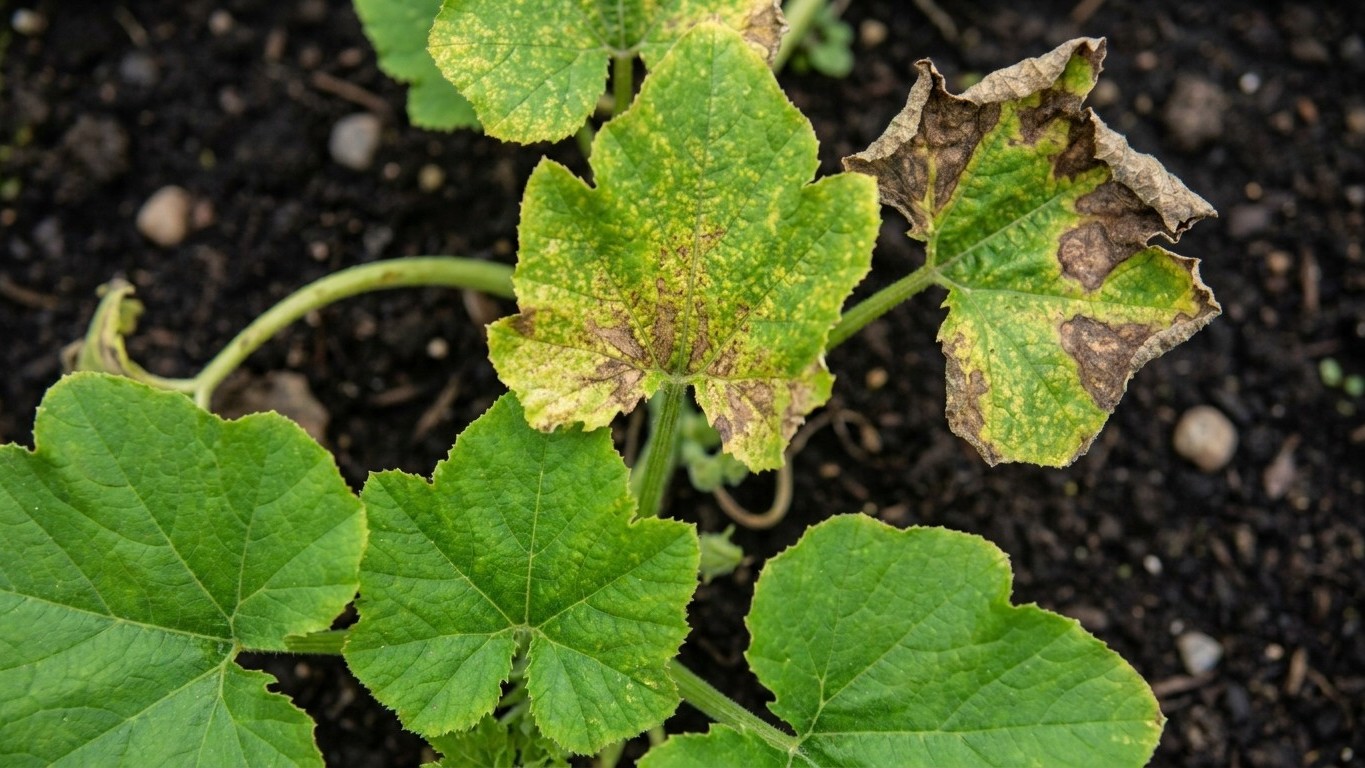

Wilting vines that don’t recover after watering, leaves that turn black and papery almost overnight, and pale corky scars on the fruit itself: that’s squash bug damage. It comes from Anasa tristis, a piercing-sucking insect that feeds on squash and pumpkin plants and injects a toxin as it feeds, collapsing the plant’s tissue from the inside out. The tricky part isn’t the damage itself, it’s that stink bugs leave almost identical marks, and the two require different responses.
What the damage looks like
From across the garden, the first sign is usually a single plant, or a section of one sprawling vine, that looks droopy even though the soil is moist and nothing else nearby is struggling. Gardeners often blame the weather or assume they missed a watering. That assumption costs time, because the damage is already spreading while the plant gets watered instead of inspected.
Move closer and the leaves tell a different story. Instead of the even, uniform green of a healthy squash leaf, you’ll notice yellow flecking or a stippled, mottled look concentrated near the veins and the base of the leaf. Within a few days, those yellow patches darken to brown, then to a dry, almost blackened crisp that crumbles if you touch it. This pattern usually starts near the crown of the plant, where the main leaf stalks meet the base, and works its way outward along each vine.
What happens at the feeding site
Squash bugs feed with a needle-like mouthpart, piercing the leaf or stem and removing sap while introducing compounds that damage the surrounding plant cells. That’s why the injury looks less like a chewed hole and more like a chemical scorch. Where feeding is heavy at a leaf’s base or along a runner, the tissue beyond that point loses its ability to move water, so entire sections of vine wilt and die even though the roots are perfectly fine. On a bad infestation, this shows up as one runner going from healthy to black and dead in a matter of days while the rest of the plant looks untouched, at least for now.
The fruit itself isn’t spared. On young fruit, feeding leaves small sunken, discolored spots that can scar over as the squash or pumpkin grows. On winter squash headed for storage, those feeding scars often turn into soft, rotten patches weeks later, long after the insects are gone. That delayed damage is one reason growers who store squash for winter take squash bug feeding on the fruit itself more seriously than a few damaged leaves.
What it is confused with
Squash bug damage gets misdiagnosed more often than almost any other cucurbit pest problem, mostly because several very different insects and one non-insect cause produce a similar wilting, spotting, or speckled look. Treating the wrong problem doesn’t just waste effort, it lets the actual culprit keep feeding.
| Could be mistaken for | How to tell them apart | Why the mix-up matters |
|---|---|---|
| Stink bug feeding | Stink bugs are broader and more rounded, often shield-shaped with a greenish or mottled brown color, and lay barrel-shaped egg clusters rather than the neat, tightly packed rows squash bugs use. Stink bugs also feed on a much wider range of crops, including tomatoes and beans. | Some management steps overlap, but stink bugs are far less specialized on cucurbits, so a control plan built around squash bug biology (like trap boards near the vine base) does little against a general stink bug population. |
| Cucumber beetle feeding | Cucumber beetles chew visible holes in leaves, flowers, and fruit rind rather than causing the yellow stippling and blackened wilt typical of sap-sucking damage. | Cucumber beetles are also known vectors of a bacterial wilt disease in cucurbits. Mistaking their chewing damage for squash bug feeding delays the earlier intervention that bacterial wilt prevention usually calls for. |
| Squash vine borer | The wilting looks similar, but there’s no external speckling. Instead, look for a small hole near the base of the stem with sawdust-like frass pushed out of it, the sign of a larva tunneling inside. | A foliar treatment aimed at squash bugs on the leaf surface never reaches a borer larva feeding inside the stem, so the plant keeps declining even after “treatment.” |
| Drought or nutrient stress | No insects, no eggs, and no feeding marks anywhere on the plant; wilting tends to be uniform rather than starting at one point and spreading. | Watering a plant that’s actually hosting a growing squash bug population buys the insects more time while the real cause goes unaddressed. |
The pattern worth remembering: chewed holes point to a beetle, a tunnel with frass points to a borer, and uniform stress without any insect life points to the soil or the weather. Speckled yellowing that darkens into a black, crisp wilt starting near the base of a leaf or runner points back to squash bugs or their close look-alike, the stink bug.
Where to look to confirm
Confirming squash bug damage means finding the insect, not just the injury. These are shy feeders during the heat of the day, so timing the search matters as much as knowing where to look.
Best time to check
Early morning or the cooler part of the evening is when adults and nymphs are out feeding in the open on leaf surfaces. During the hottest hours, they retreat, tucking themselves under leaves, down at the base of the plant, or underneath any mulch, boards, or plant debris lying nearby. If you search only at midday and find nothing, that doesn’t mean they’re absent, it usually means you’re looking at the wrong hour.
Where on the plant
Start on the underside of leaves close to the crown of the plant, where the main stem meets the first set of true leaves. That’s where egg-laying tends to concentrate. Squash bug eggs are small, bronze to copper-colored, and laid in tight, orderly clusters, often in a rough V-shape following the angle of the leaf veins, which is one of the most reliable identifying signs available to a home gardener. Also check the leaf axils, the tight junction where a leaf stalk meets the main vine, since both eggs and young nymphs cluster there.
Look for insects at different life stages rather than one uniform bug. Newly hatched nymphs are tiny and pale greenish-gray, clustering tightly together in a group of similar-sized individuals on a single leaf underside. As they mature through several molts, nymphs turn a dustier gray with darker legs, still often found in loose groups rather than alone. Adults are elongated, roughly five-eighths of an inch long, brownish-gray, and fly off or scurry for cover quickly once disturbed, which is itself a useful clue: an insect that bolts the moment a leaf is turned over behaves differently than a slower-moving beetle.
Resist the urge to compare what you find against a specific number of bugs per plant as a trigger for action. Those action levels, along with the degree-day windows extension entomologists use to time scouting, are set state by state and adjusted as conditions change from one growing season to the next. Confirming the insect is present is the job here; deciding whether the population justifies a response is a question for your local extension service, and this site’s guide for your territory names that office directly.
What to do once you are sure
Once eggs, nymphs, or adults are confirmed on the plant, timing decides how effective any response will be. Squash bugs overwinter as adults, emerge in spring, and lay eggs over an extended window that varies by region and by year, which is exactly the kind of detail covered on this site’s squash bug life cycle page. Matching a control step to the right stage in that cycle, egg scraping while clusters are still fresh, or trapping adults before they lay a second round of eggs, makes far more difference than the specific method chosen.
What actually helps
Hand removal of eggs and clustered nymphs, along with simple trap boards or shingles laid near the base of plants overnight, remain some of the most consistently effective tools available to a home gardener, since squash bugs seek shelter under flat debris during the day and can be collected and destroyed each morning. Row covers timed to keep adults off young plants during the peak egg-laying window work well too, provided they come off once flowering starts so pollinators can reach the blossoms. The specifics on what to use, and when a spray application is actually warranted, are covered on this site’s squash bug control page, along with the reminder that any product applied should be one labeled for the crop and pest, following the guidance of your local extension office rather than a generic online recommendation.
Biological control is worth protecting rather than working around. The tachinid fly Trichopoda pennipes parasitizes squash bug adults and late-stage nymphs, laying a small, pale, oval egg visibly attached near the base of the bug’s body. A parasitized bug still moves around the garden for a while, but it won’t reproduce, and over a season this fly can meaningfully reduce a local population on its own. Certain small wasps also parasitize squash bug eggs in some regions, cutting hatch rates before nymphs even appear. Both of these natural enemies are knocked back hard by broad-spectrum insecticide use, so the gardeners who rely least on spraying tend to see the most benefit from them building up over successive seasons.
For guidance specific to where you garden, including the extension service that sets local timing and action levels, this site keeps a dedicated page by state; starting there before choosing a control method avoids applying a rule that was written for a different climate.
Common questions
Can squash bug damage kill a healthy plant?
Yes. A heavy population feeding on a young plant can collapse an entire vine within days by cutting off water movement at the feeding site, even when the roots and soil are perfectly healthy.
Does squash bug damage affect the fruit or just the leaves?
Both. Leaves show the yellow speckling and blackened wilt, while fruit develops sunken, discolored feeding scars that can turn into rot spots later, especially on winter squash held in storage.
How fast does squash bug damage spread through a garden?
It can move quickly once egg clusters hatch, since nymphs feed in tight groups on the same leaves and nearby plants. A vine that looked fine a week earlier can show significant blackened wilt by the next check.
Is squash bug damage the same on all cucurbits (squash, pumpkin, cucumber)?
Squash and pumpkin are the preferred hosts and typically show the most severe damage. Cucumbers and melons can be fed on too, but injury there tends to be lighter, since squash bugs are drawn most strongly to squash and pumpkin foliage.