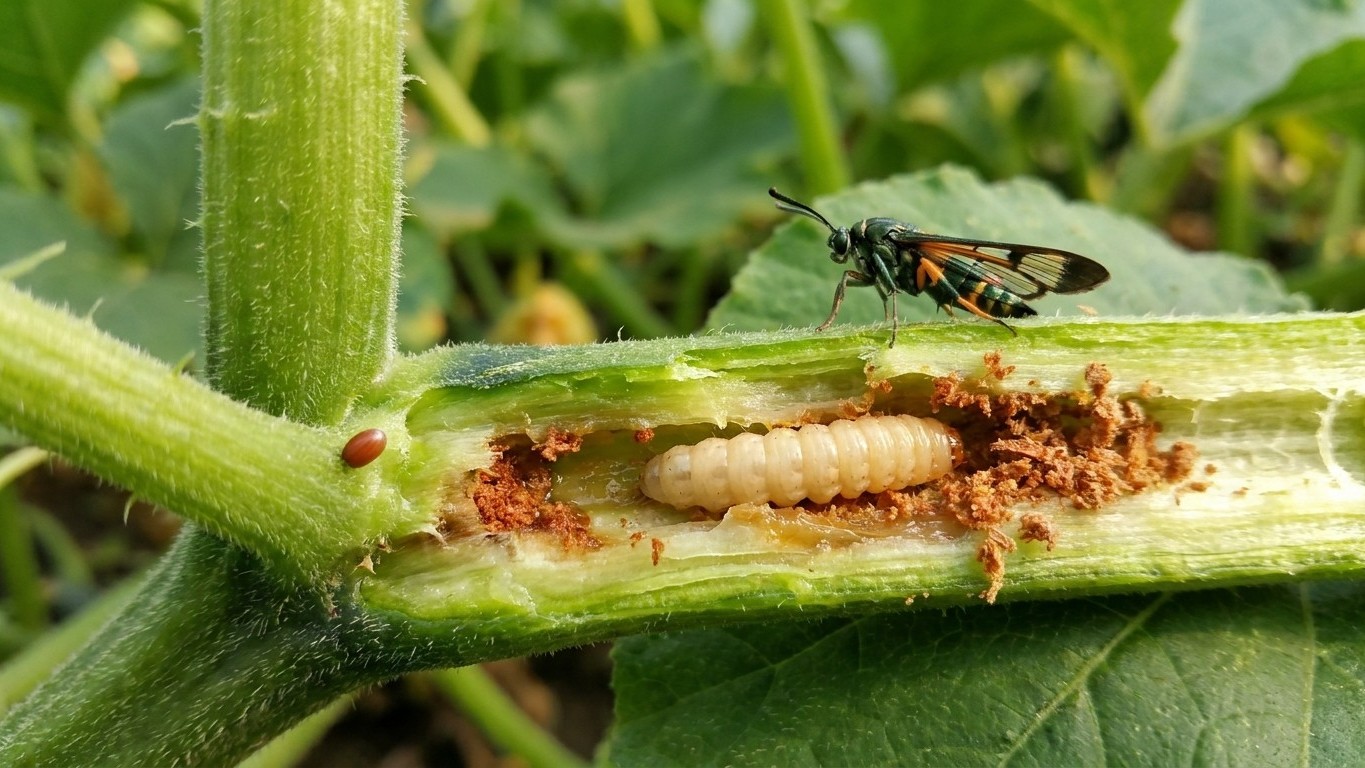

A squash vine borer moves through four fixed stages: egg, larva, pupa, adult moth. The larva is the one doing damage, tunneling inside the stem where no spray or inspection catches it early. Gardeners typically see the moth flying at dusk or the wilted leaves days later, never the worm itself until they slit the stem open. Emergence timing shifts by region because it tracks accumulated warmth, not a fixed date on the calendar.
The stages, in order
Everything about this pest, Melittia cucurbitae, traces back to where each stage lives. The adult is a moth, often mistaken for a wasp because of its orange hind legs and metallic greenish-black wings. She lays eggs, usually singly, at the base of squash and pumpkin stems, sometimes on the leaf stalks nearby. Those eggs are small, reddish-brown, and nearly impossible to spot without deliberately checking the stem base every few days during flight season.
Egg to larva: the point of no return
Once an egg hatches, the larva does something no other stage does: it bores directly into the stem within hours. From that moment, it lives entirely inside plant tissue, feeding on the pith and hollowing out the vine as it grows. This is the stage responsible for every symptom a gardener actually notices, the sudden wilting of a vine that looked fine the day before, sawdust-like frass pushed out through a small hole near the base, a stem that collapses when touched. The larva can reach close to an inch long before it’s done feeding, cream-colored with a brown head, and it stays hidden the entire time.
Pupa to adult: the transformation nobody sees
When the larva finishes feeding, it leaves the stem and burrows into the soil, usually within a few inches of the base, to pupate inside a silk-lined cocoon coated in soil particles. This pupal stage is the second one a gardener almost never encounters, since it happens underground and looks like nothing more than a clump of dirt. The adult moth that eventually emerges is the only stage anyone reliably sees in the open, and even then usually only in flight near dusk. So the practical takeaway is blunt: the damage is done by a stage you can’t see, inside tissue you can’t inspect without cutting the plant open.
When it appears, and why that varies
Adult moths don’t emerge on a schedule tied to the month. They emerge once the soil and air have accumulated enough warmth, a measure entomologists track as degree-days rather than calendar dates. That’s why a gardener in the Deep South can see moths flying weeks before a gardener in the upper Midwest even plants squash. The same species, the same biology, but a completely different local clock.
Why one yard differs from the next
Degree-day accumulation depends on daily high and low temperatures added up over the season, which means a warm spring pushes emergence earlier and a cool, wet spring delays it, sometimes by two or three weeks in the same county from one year to the next. Microclimate matters too: soil that warms faster near a south-facing wall or a raised bed can trigger pupal development ahead of an open field a few hundred feet away. This is also why relying on a neighbor’s timeline, or a date printed in a general gardening article, tends to backfire. The moth doesn’t read a calendar, and neither should the person trying to catch it before it lays eggs.
Who actually tracks this
University extension services monitor degree-day accumulation and published emergence windows for their own states, often updating action thresholds through the growing season using local trap and pheromone data. Those thresholds change year to year and state to state, which is exactly why no single national date works for this pest. The most reliable approach is checking the emergence guidance published for your own territory rather than assuming a fixed week applies everywhere. This site carries a page for that lookup by territory, with the relevant extension source linked directly on it.
One generation or several
This is the fact that changes how long a gardener actually has to stay alert. Some vine-boring pests complete a single generation per year, meaning one narrow window of adult flight and one window of vulnerability for the crop. Others cycle through multiple generations in a single season, which means the threat doesn’t end after the first wave of moths disappears.
What this species actually does
The squash vine borer typically completes one generation per year across cooler northern growing regions, where a single flight period in early to mid-summer accounts for essentially all the damage that season. In warmer southern regions with a longer frost-free stretch, a partial or full second generation can develop later in the summer, extending the risk period into early fall. That regional split matters for planning: a northern gardener who successfully protects plants through the one flight window has largely cleared the threat for the year, while a southern gardener needs to keep checking stem bases into late summer even after an apparently clean first round.
What this means for scouting
Practically, this argues against treating vine borer watch as a one-time task. Even where a single generation is the norm, that generation’s flight period can stretch over several weeks as moths emerge unevenly, so a single inspection early in the season isn’t enough. Checking stem bases every few days through the local flight window, and continuing into late summer in warmer regions, catches eggs and newly hatched larvae before they’ve tunneled deep enough to matter. Skipping that second check in southern zones is one of the more common reasons a garden that seemed fine in July collapses in September.
Where it spends the winter
Winter survival is what makes next year’s infestation predictable, and it’s also why fall cleanup isn’t just tidiness. Squash vine borer overwinters as a full-grown larva or as a pupa inside a cocoon buried an inch or two below the soil surface, typically right where the previous season’s vine was growing. It stays there through the cold months and emerges as an adult moth once the following season’s warmth accumulates enough to trigger development.
Why the soil matters more than the plant
Because overwintering happens underground rather than on plant debris left standing, simply pulling up dead vines in fall removes the visible mess but does nothing to disturb the cocoons already buried nearby. Tilling that soil, or at least disturbing the top few inches around where squash and pumpkins grew, exposes cocoons to weather and to predators that would otherwise leave them undisturbed until spring. Rotating cucurbit crops to a different bed the following year also reduces the odds that emerging moths find a host plant within easy flying distance of where they overwintered.
Natural enemies worth protecting
Biological control does play a real role here, more than most gardeners assume. Parasitic wasps, including several braconid species, attack vine borer eggs and young larvae before they’ve done serious damage, and ground beetles feeding in garden soil consume larvae and pupae during the underground stages. None of that protection survives broad-spectrum insecticide use, which kills these natural enemies along with the target pest and often leaves a garden more vulnerable the following season once the beneficial population has been wiped out. Leaving some undisturbed soil and reducing unnecessary spraying does more for long-term control than most single treatments.
Common questions
Can I see squash vine borer eggs before they hatch?
Yes, but only with deliberate checking. The eggs are small and reddish-brown, laid singly at the stem base or on nearby leaf stalks, and easy to miss unless you’re specifically running a finger along the lower stem every few days during the local flight period.
Does one generation mean the threat ends after the first wave of moths?
In cooler northern regions, largely yes, since only one generation typically completes there. In warmer southern regions, a second generation can develop later in summer, so scouting needs to continue into early fall rather than stopping after the first flight window closes.
Why do the leaves look healthy while the vine wilts?
Because the larva feeds inside the stem, cutting off the plant’s ability to move water and nutrients, while the leaf tissue itself isn’t being eaten directly. That mismatch, healthy-looking leaves on a collapsing vine, is one of the clearest identification clues for this specific pest.
Does tilling in fall actually reduce next year’s population?
It can help meaningfully, since overwintering cocoons sit just below the surface where the vine grew. Disturbing that soil exposes cocoons to weather and predators, and rotating cucurbit crops to a new bed the following season reduces how easily emerging moths find a host plant nearby.