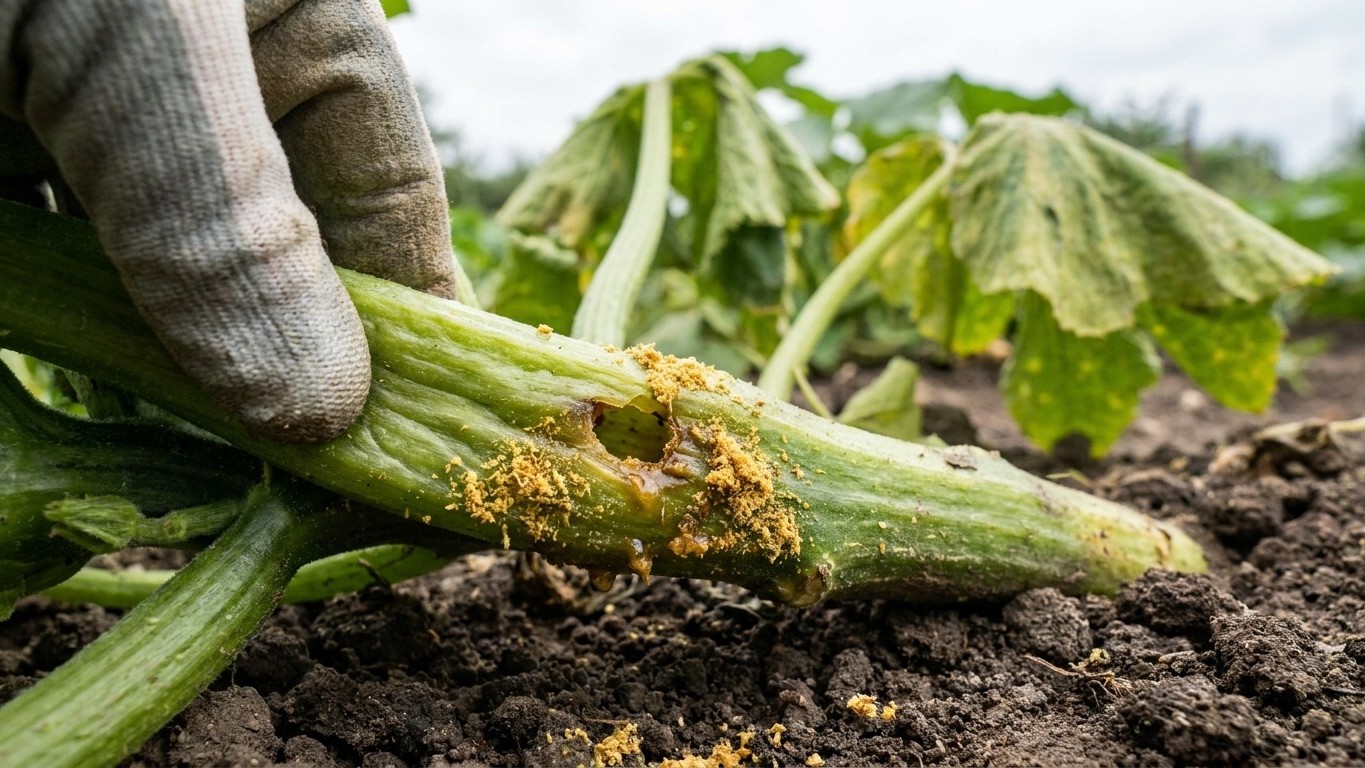

A squash plant that wilts overnight while its leaves still look green and healthy is the first red flag for squash vine borer damage. The insect responsible, Melittia cucurbitae, feeds inside the stem rather than on the surface, which is why the damage looks strange at first: nothing eaten, nothing chewed, just a plant collapsing from within.
What the damage looks like
From a few feet away, the first sign is usually one runner or one whole plant sagging in the middle of the day, even after a good watering the night before. Gardeners often blame heat stress or a missed irrigation cycle, because the leaves themselves show no chewing, no spots, no discoloration. That mismatch, a wilted plant with otherwise perfect foliage, is the detail that should send you closer for a look.
Up close, the base of the stem near the soil line tells the real story. You will typically find a small, ragged hole in the stem, often with a wet, yellow-green frass pushed out around the opening. This frass looks a bit like coarse sawdust mixed with wet sand, and it collects in a small pile at the base of the plant or clings to the stem itself. Squeeze the stem gently near that hole and it may feel soft, hollowed, or mushy compared to a firm, healthy section just a few inches away.
Inside the stem itself
Slit the stem open lengthwise at the damaged spot, and the internal picture becomes unmistakable. The core is tunneled and packed with the same moist, greenish-yellow frass found outside. Somewhere in that tunnel, usually within the lower foot of stem, you will often find the larva responsible: a white to cream-colored grub with a brown head, thick-bodied, curled inside its feeding channel. This larva is the stage actually causing the wilt, since it destroys the vascular tissue that carries water up through the vine.
One detail that separates squash vine borer damage from almost every other squash problem: a single tunneled stem can take down an entire plant, even a large, established one, within days. The damage does not spread leaf by leaf like a foliar disease. It happens at one chokepoint, and everything past that point on the vine loses its water supply at once. If you catch a plant early enough, sometimes only one runner has collapsed while the rest of the plant still looks fine, at least for now.
Later in the season, especially on plants that were not checked regularly, you may find several entry holes along the same main stem, each with its own frass pile, sometimes producing more than one larva per plant. By that stage the vine is usually beyond saving, but the pattern of multiple holes with frass is still useful confirmation that this is squash vine borer and not something else entirely.
What it is confused with
Squash vine borer damage gets misdiagnosed constantly, partly because “the squash plant is wilting” describes at least four completely different problems in the vegetable garden, each needing a completely different response. Treating a wilted plant for the wrong cause wastes time the plant does not have.
| Look-alike problem | How to tell it apart | Why the mix-up matters |
|---|---|---|
| Bacterial wilt (spread by cucumber beetles) | No frass, no entry hole at the base; cut the stem and press it, and a milky, stringy ooze appears. No larva inside. | Gardeners spray for borers when the real target should be the cucumber beetles carrying the bacteria; the borer treatment does nothing here. |
| Squash bug feeding damage | Squash bugs feed on leaves and cause yellow speckling then browning of foliage; the stem base is intact, with no frass or tunneling. | People sometimes cut into a healthy stem looking for a borer larva that never existed, damaging a plant that was otherwise fine. |
| Drought stress or transplant shock | Whole plant wilts evenly, recovers with watering, and the stem base shows no holes or frass at all. | Growers assume borers and dig around the root zone, disturbing roots on a plant that only needed water. |
| Root rot from waterlogged soil | Wilting is gradual and plant-wide, roots look dark and mushy when pulled, but the stem above soil line is clean. | No pest is present at all here, so any insect treatment is a wasted effort while the actual drainage problem continues. |
The bacterial wilt mix-up is the one worth remembering most, since it sends the most gardeners toward the wrong shelf at the garden center. If the stem oozes but shows no tunnel and no frass, the borer is not your problem, the beetle population feeding earlier in the season is. That distinction changes everything about the plan for the rest of the season, since one calls for stem inspection and vine management, and the other calls for early-season beetle control.
Where to look to confirm
Confirming squash vine borer damage means checking one specific zone on the plant, not scanning the whole vine. The lower 12 to 18 inches of the main stem, right where it meets the soil, is where the larva feeds and where every visible clue accumulates. Squash and pumpkin vines can run several feet across a garden bed, but the borer’s damage is concentrated at the base, so that is where your eyes and hands should go first, every time.
Morning is the best time to look, before the day heats up and before any wilting from heat stress muddies the picture. A plant that is already wilted at 7 or 8 a.m., before the sun has had a chance to stress it, is telling you something structural is wrong at the stem, not something related to soil moisture. Gently part the leaves at the crown of the plant and follow each main stem down to where it disappears into the soil, since borers sometimes tunnel just at or slightly below the surface.
What you are actually looking for
Run a finger along that lower stem section, feeling for soft or hollow spots rather than relying on sight alone, since early entry holes can be tiny. Once you find a soft spot, look for the small ragged hole and the greenish-yellow, sawdust-like frass either sitting in the hole or piled at the base of the plant. If frass is present, split the stem open lengthwise with a clean knife right at that spot. Finding the cream-colored, brown-headed larva inside confirms the diagnosis beyond doubt.
Because emergence timing, the number of generations per season, and the point at which a state extension service considers a garden worth treating all vary by region and by year, this page will not give you a date or a count to watch for. Your state’s own extension service tracks that timing locally and adjusts it season to season, which is exactly the kind of number that goes stale fast if it’s printed as a fixed rule. What stays constant everywhere is the search pattern: base of the stem, morning inspection, feel for soft spots, confirm with frass and a look inside.
What to do once you are sure
Once frass, a tunnel, and a larva confirm squash vine borer, the timing of any response depends on where that larva sits in its life cycle, and that is a separate question from identification. This site’s squash vine borer life cycle page lays out the stages, from egg to adult moth, and explains why the window for stopping damage narrows fast once the larva is established inside the stem.
For what actually works once damage is confirmed, from removing the larva by hand to protecting remaining runners, the details belong on this site’s squash vine borer control page, since control decisions depend on how far the damage has already progressed and how many vines are affected.
Biological control worth protecting
Squash vine borer populations are held in check to some degree by natural enemies already present in most gardens, particularly small parasitic wasps that attack the eggs before they hatch, and general predators such as ground beetles that feed on larvae once they leave the stem to pupate in the soil. Broad, routine insecticide use in the garden tends to knock back these natural enemies along with the pest, which is one reason gardeners who spray heavily every season sometimes see borer damage return just as bad the following year. Leaving some undisturbed soil and mulch near the garden bed, where ground beetles shelter, supports this natural pressure without any product involved.
Timing and regional emergence data are set by each state’s cooperative extension service, since squash vine borer activity shifts with local climate and can change from one growing season to the next. This site’s guide for your own territory names the extension service covering your state and links directly to its current guidance, which is the source to check before making any timing decision.
Common questions
Can a squash plant survive after a squash vine borer has tunneled into the stem?
Some plants survive if only one runner is affected and the plant has rooted at additional nodes along the vine, since those secondary root points can keep feeding the rest of the plant even after the main stem is compromised. A plant with a single main stem and no secondary rooting is far less likely to recover once the tunnel is established.
Does squash vine borer damage always show frass at the base of the stem?
In almost every confirmed case, yes, though the amount can be small and easy to miss on a plant with dense foliage covering the crown. If a wilting plant shows absolutely no frass or hole after a thorough check of the lower stem, another cause is more likely.
Is squash vine borer damage worse on certain squash varieties?
Vining types with a single main stem, including many pumpkin and winter squash varieties, tend to show more severe collapse than bush-type summer squash, simply because bush varieties often have multiple stems and more root contact points along the ground.
Will the plant recover on its own if I just wait?
No. Because the larva is actively feeding inside the stem and destroying tissue that carries water to the rest of the plant, the damage does not stop or reverse without some form of intervention, and waiting generally means losing more of the plant the longer the larva stays inside.