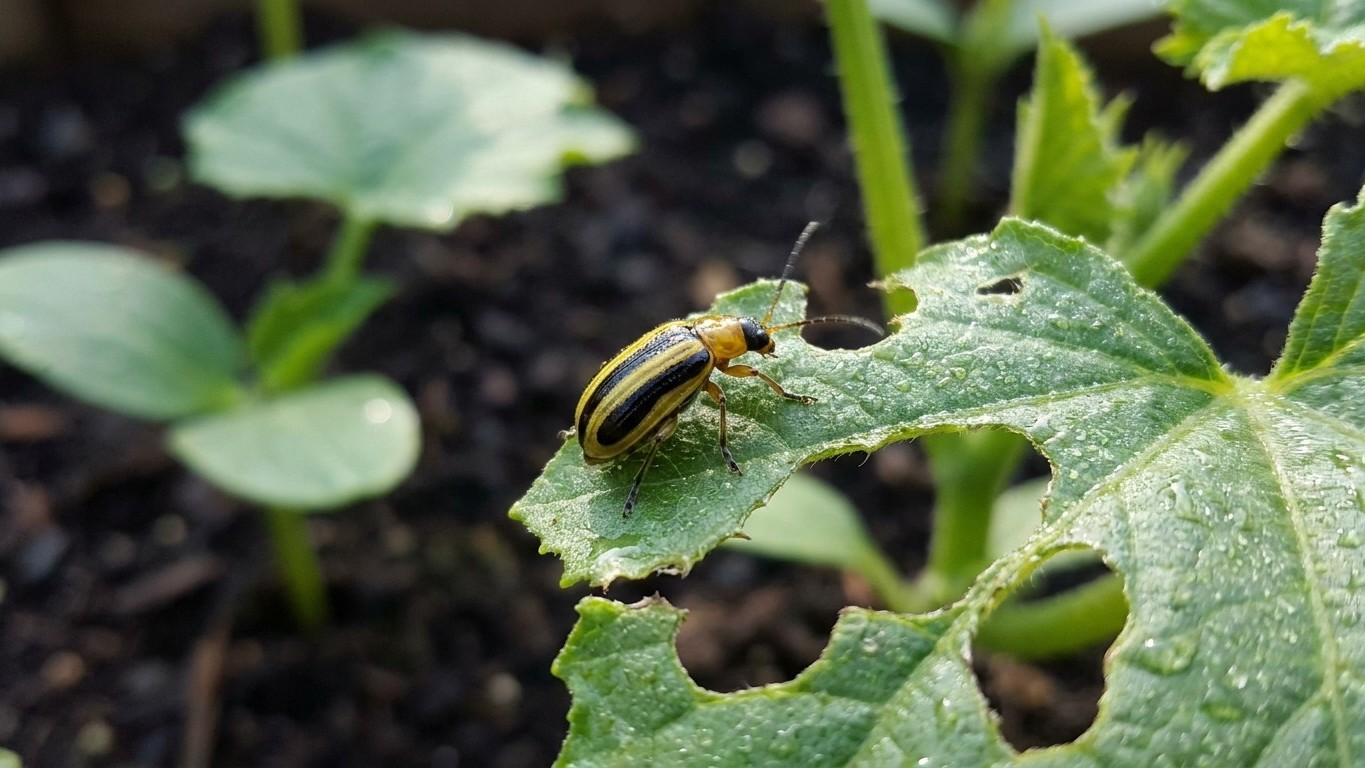

A gardener who spots small, yellow-and-black striped beetles chewing on cucumber or squash leaves in late spring is looking at the adult stage of Acalymma vittatum, the striped cucumber beetle. That adult is only one piece of a four-stage life cycle that runs from egg to larva to pupa to adult, and the timing of that cycle shifts by region because it tracks accumulated warmth, not a fixed date on the wall.
The stages, in order
The striped cucumber beetle’s life cycle has four distinct stages, and each one occupies a different part of the garden. Adult females lay small, oval, orange-yellow eggs in clusters at the base of cucurbit plants, tucking them into cracks in the soil or right against the stem. Those eggs hatch into slender white larvae with brown heads that burrow down and feed on roots and the lower stem, entirely out of sight. After several weeks underground, the larva pupates in the soil, then emerges as the striped adult beetle that most gardeners actually recognize.
Here’s the split that matters for anyone trying to manage this pest: the larval stage does relatively minor physical damage. Root-feeding can stunt a young plant or make it wobble in loose soil, but a healthy, established cucurbit generally tolerates it. The real threat comes from the adult stage, and not primarily from its chewing. Adult beetles carry the bacterium Erwinia tracheiphila in their gut and mouthparts, picked up from feeding on infected plants, and they inject it into healthy plants as they feed. That bacterium causes bacterial wilt, a disease that can collapse an entire cucumber or muskmelon vine within days once it takes hold in the vascular system. Squash and pumpkin varieties tend to be less susceptible, but cucumbers and melons are highly vulnerable.
This means the visible chewing damage on a seedling’s cotyledons, the stage every gardener notices first, is really a warning sign for something the eye can’t see. A few beetle bites on a leaf are cosmetic. The bacteria those same mouthparts may have deposited are the reason a vine that looked fine on Monday can be wilted and dead by Friday.
Gardeners almost never see the egg or pupal stages directly, since both happen in or right at the soil surface near the plant base. The larva is occasionally uncovered when someone digs around a struggling seedling. The stage everyone deals with, for better or worse, is the adult.
When it appears, and why that varies
Striped cucumber beetle adults don’t wake up on a set calendar date. Their emergence from overwintering sites is driven by accumulated soil and air warmth over the course of spring, a process entomologists track using degree-day models rather than fixed dates. That’s why the same species can show up chewing on seedlings in one state while gardeners three states north are still waiting for their soil to warm past the point where the beetles become active.
The mechanism is straightforward even if the numbers aren’t universal. Overwintered adults sit dormant through the cold months, and as temperatures climb in spring, their metabolism ramps up in step with cumulative heat exposure. Once a regional threshold of accumulated warmth is crossed, adults become active, start moving, and begin searching for the first tender cucurbit growth of the season, whether that’s a transplant just set out or direct-seeded cucumbers pushing through the soil.
This is also why a warm spring can pull emergence forward by two or three weeks compared to a cool, wet one in the same location, and why a gardener 200 miles south of another gardener might see beetles a full month earlier. Elevation matters too. A valley floor warms faster than a hillside a few hundred feet up, even within the same county.
Because the actual degree-day thresholds and typical emergence windows are worked out and published by university extension services for their own growing regions, this is the point where a general life-cycle explanation has to hand off to local data. Extension entomologists monitor beetle activity every season and issue updated guidance specific to their state’s climate zones. Anyone who wants an actual expected window, rather than a mechanism, should check the extension resource for their territory, since a threshold that’s accurate for one region can be meaningless, or misleading, in another.
What stays true everywhere is the trigger: watch soil warmth and early cucurbit growth stages together, not the date on the calendar.
One generation or several
This is the fact that reshapes how long a gardener needs to stay alert. The striped cucumber beetle generally completes one generation per year across the cooler parts of its range, meaning the overwintered adults that show up in spring lay the eggs that become the larvae, pupae, and new adults that emerge later in the same season, and those new adults are the ones that go on to overwinter for the following year. In warmer regions with a longer growing season, a partial or full second generation can occur, producing a second wave of adult activity later in summer.
That distinction changes the whole management mindset. A strictly single-generation pest is, in practical terms, a one-window problem: knock back the spring population, protect seedlings through their most vulnerable early weeks, and the pressure for the rest of the season comes only from beetles that migrated in from elsewhere, not from a fresh batch hatching in the same bed. A multi-generation pest is a different story entirely. It means a garden that looked clean in July can see a new flush of adults in August, right as melons and winter squash are sizing up and just as susceptible to bacterial wilt transmission as the spring seedlings were.
For most home gardeners, this translates into a practical takeaway: don’t assume the threat ends once the first wave of spring beetles fades. Depending on region and season length, that lull can be temporary rather than final. Checking plants periodically through midsummer, not just during the seedling stage, catches a second generation before it establishes a foothold on plants that are otherwise thriving.
It also explains why advice on this pest sometimes seems to conflict between sources. A gardening guide written with a short, cool growing season in mind may treat the beetle as a spring-only concern, while one written for a longer, warmer season treats it as a full-season pest. Both can be correct for their own region. That’s exactly why local extension guidance, tuned to a specific climate zone and season length, tends to be more useful than a single national rule of thumb for this species.
Where it spends the winter
Overwintering is the part of the life cycle that makes next spring predictable, and it’s why what happens in the garden this fall matters more than most people realize. Adult striped cucumber beetles are the stage that survives winter, not the egg, larva, or pupa. They tuck themselves into protected spots as temperatures drop: leaf litter and plant debris at field edges, loose soil, grass clumps, and wooded or brushy areas bordering the garden. Some also shelter in mulch, under boards or rocks, or in other undisturbed organic material close to where cucurbits grew.
This is precisely why fall cleanup isn’t just tidiness. Removing spent cucurbit vines, fallen fruit, and plant debris at the end of the season strips away a huge share of the sheltered microhabitats these beetles rely on to survive winter. A garden bed cleared down to bare soil, or planted with a cover crop and turned under, offers far fewer hiding spots than one left with a thick mat of dead vines through the cold months. It won’t eliminate the population, since nearby woodlots and hedgerows serve as reservoirs too, but it reduces the number of adults tucked in right where next year’s seedlings will go.
Biological control plays a real role here as well, and it’s worth more attention than it usually gets. Natural enemies of the striped cucumber beetle include parasitic wasps and tachinid flies that attack adults, along with ground beetles, spiders, and other general predators that pick off eggs and larvae in and around the soil surface. Entomopathogenic nematodes and soil fungi also attack the larval stage underground, where sprays can’t reach anyway. None of these predators and pathogens work as a fast fix, but they build up over seasons in gardens where broad-spectrum insecticide use is limited and where some undisturbed soil and plant cover is left for beneficial insects to persist through the year.
Come spring, those overwintered adults emerge from exactly the kind of sheltered spots described above, and the cycle that started with a fall cleanup decision restarts with them searching out the first cucurbit seedlings of the new season.
Common questions
How long does it take a striped cucumber beetle to complete its life cycle?
The full cycle from egg to adult typically spans several weeks to a couple of months, depending on temperature, since warmer conditions speed development at every stage. Exact durations vary by region and season, which is another reason local extension data is more precise than a single national figure.
Can striped cucumber beetle larvae hurt my plants even if I never see adults?
Yes, though larval root feeding is usually less damaging than adult feeding combined with bacterial wilt transmission. A plant can show stunted growth or wilting from root damage alone, but widespread rapid collapse of a cucumber or melon vine points more strongly toward bacterial wilt introduced by adult beetles.
Does killing adult beetles in spring stop the whole season’s problem?
It helps a great deal in regions where this species completes only one generation, since spring adults are the ones laying eggs for the year. In warmer regions with a partial second generation, reducing spring numbers still lowers overall pressure but won’t necessarily prevent a second wave of adults later in summer.
Why do some gardeners see this beetle every year while others rarely do?
Proximity to overwintering habitat matters a lot. Gardens near woodlots, hedgerows, or areas with leftover plant debris tend to host larger overwintering populations nearby, while gardens surrounded by cleared land or separated from wild host plants by distance tend to see lighter, less consistent pressure.