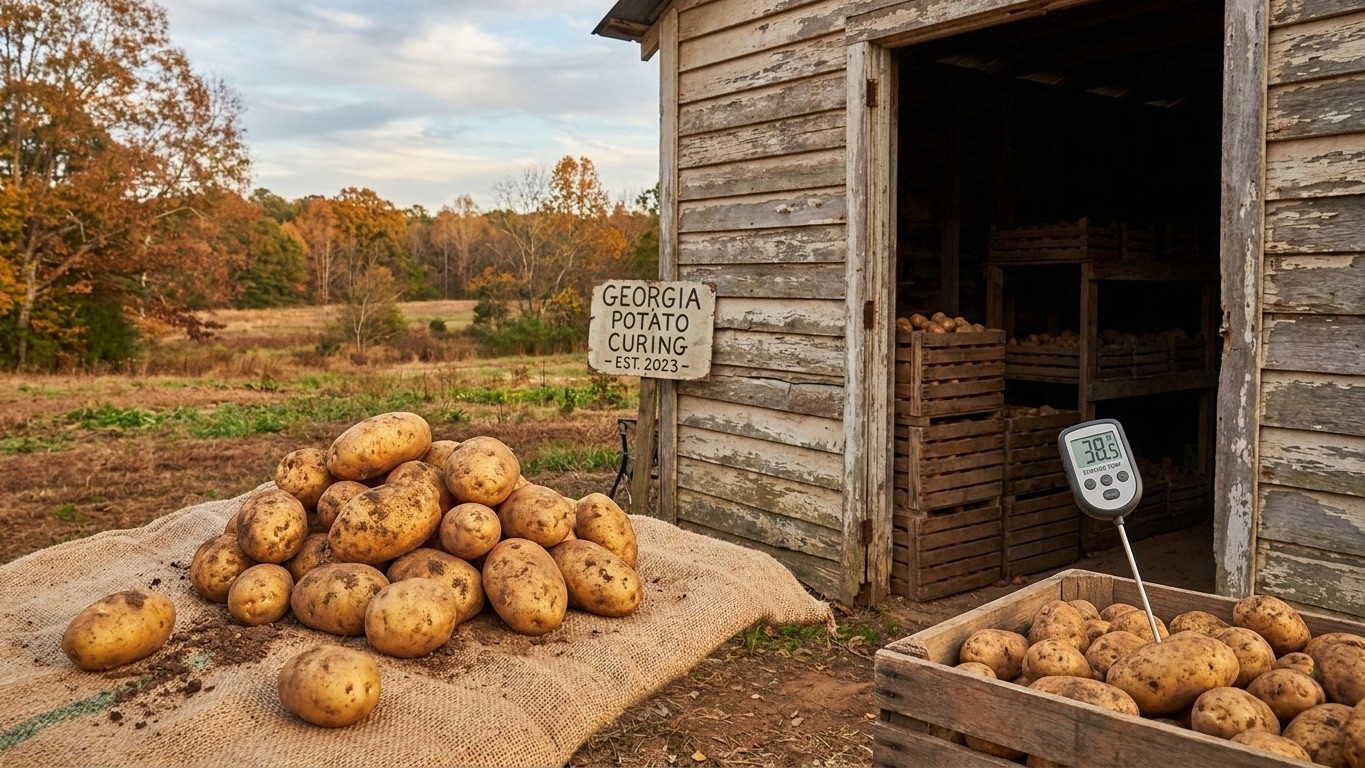

Georgia’s potato harvest usually finishes well before the first fall frost, which lands between November 13 and December 1 in the Atlanta area (NOAA NCEI, 1991-2020 Climate Normals). The bigger question is storage. With the coldest month averaging a mean minimum of just 35.6°F, an unheated space here rarely freezes solid, but it also rarely holds the 40-45°F potatoes actually need. That gap between “won’t freeze” and “cold enough” is what makes storage in this state trickier than it looks.
The short answer
Start with the two numbers that matter. The frost window, November 13 to December 1, tells you almost nothing about when to dig potatoes, because potatoes are a cool-season crop and most Georgia gardeners pull them out of the ground long before autumn cold arrives at all. What that frost date does tell you is when the outdoor curing window closes for good, and when any potatoes still in the ground need to come out no matter what. The second figure, a 35.6°F mean minimum in the coldest month, is the one that actually decides whether your storage plan works.
Here’s the mechanism. A mean minimum of 35.6°F means that on an average night in the coldest month, an unheated outbuilding tracking outdoor lows will bottom out just above freezing, then climb through the day. It won’t hard-freeze most nights, but it also won’t sit in the 40-45°F range that Utah State University Extension recommends for storage. A detached, uninsulated garage or shed in Georgia is more likely to swing from the high 30s overnight to the 50s or 60s by afternoon than it is to hold a steady storage temperature. That swing is the real enemy, not a single killing frost.
One caution worth repeating here: the 35.6°F figure and the frost date range both come from the Atlanta reference station, which sits in an urban heat island. North Georgia and the mountains typically freeze several weeks earlier in the fall than Atlanta does, and their winter minimums run colder still. The coastal plain runs the other direction, staying milder through the same stretch of winter. If you garden well outside metro Atlanta, treat these numbers as a starting point, not a forecast for your own yard.
So does an unheated Georgia space hold 40-45°F through the winter, or does it freeze? Mostly neither. It runs a little cool and a little warm by turns, which means the fix isn’t insulation against freezing, it’s buffering against temperature swings and picking a location with more thermal mass than a garden shed offers.
Curing, and where
Curing wants 55-60°F and high humidity held for two to three weeks, according to Utah State University Extension. That range doesn’t occur naturally outdoors in Georgia at harvest time. Most gardeners are digging potatoes during the hottest stretch of the growing season, when ambient temperatures run well above 60°F even in the shade, and a garage or shed baking in summer sun can easily hit 90°F or more inside. The places that come close to the target here are basements, interior closets away from exterior walls, or a shaded, well-ventilated porch on a mild day. An attic, an unshaded shed, or a car-holding garage in July or August is the wrong choice almost every time.
- Dig on a dry day, once the soil has had a chance to firm up, and shake off loose dirt without washing the tubers.
- Move them out of direct sunlight immediately. Sun exposure in a Georgia summer will overheat and green the skins within an hour.
- Choose the coolest indoor space available: a basement, an interior room away from HVAC vents, or a shaded porch on a mild day when outdoor temperatures cooperate.
- Spread the potatoes in a single layer rather than piling them, so air can move around each tuber.
- Keep humidity high with a damp burlap covering or a loosely closed box, checking that condensation isn’t pooling on the tubers themselves.
- Hold this setup for two to three weeks, per Utah State University Extension, before moving the crop into longer-term storage.
- Check the skins before moving on. They should resist light rubbing rather than sloughing off, a sign the curing period has done its job.
Storing through this winter
Once curing is done, the target shifts. Storage wants dark conditions and 40-45°F according to Utah State University Extension, or 38°F at 95 percent humidity according to the University of Maine Cooperative Extension. Neither of those numbers matches what a typical unconditioned Georgia space delivers through the winter. Set against a coldest-month mean minimum of 35.6°F, most detached storage spots here will run warmer than ideal for a good portion of the season, not colder. That’s a different failure mode than gardeners in harder-winter states deal with, and it calls for a different fix.
A basement, especially one that stays a few degrees below the rest of the house, is usually the best option available in this climate. It buffers against the daily swings that an aboveground structure can’t avoid, and it tends to sit closer to the 40-45°F window through most of the winter than a garage does. An insulated garage is the next-best option, particularly if the potatoes are kept in a box lined with newspaper or straw, since that extra layer slows both overheating on warm afternoons and any brief chill during a cold snap. A crawlspace can work too, provided it stays dry.
What doesn’t work as well here is anything exposed to direct sun or attached to a heated living space. An attached garage that shares a wall with a heated kitchen or laundry room often runs too warm for storage even in January, encouraging sprouting well before the potatoes would naturally decline. On the other end, a detached, uninsulated structure on the coldest nights of the year can dip close to or even below freezing for a few hours at a time, which is enough to damage tubers stored near an exterior wall or on a concrete floor without any insulating layer beneath them. The fix in both cases is monitoring: keep an actual thermometer in the storage space rather than assuming, and shift the containers to a more stable location, like a basement, if a garage runs consistently warmer than the mid-40s or spikes near 32°F during a cold outbreak.
- Curing in a hot garage or shed: summer heat pushes these spaces well above the 55-60°F range Utah State University Extension recommends, which can shrivel skins or invite rot instead of setting them. Move curing indoors to a basement or shaded interior room instead.
- Storage that runs too warm: an attached garage or a space near heating ducts often sits above 45°F through much of a mild Georgia winter, encouraging early sprouting. Relocate to the coolest available interior space and check the temperature with a thermometer rather than guessing.
- A cold snap catching an unheated shed off guard: even with a mean minimum of 35.6°F in the coldest month, individual cold outbreaks can push an uninsulated structure toward freezing for a few hours. Insulate storage boxes with straw or newspaper, or move the crop indoors when a hard freeze is forecast.
- Low humidity in a heated basement: basements attached to heated homes can dry out in winter, working against the high humidity that both Utah State University Extension and the University of Maine Cooperative Extension call for. A loosely covered container or a pan of water nearby helps hold moisture in the air.
- Rot from digging after wet weather: Georgia’s late-summer storms can leave soil damp right when potatoes are ready to come out. Wait for a dry stretch before digging, since tubers pulled from wet ground cure poorly and store worse.
Common questions
When should I harvest potatoes in Georgia?
The frost date range published for this state, November 13 to December 1 (NOAA NCEI), marks the outer limit for anything still in the ground, not the target harvest date. Because potatoes are a cool-season crop, most gardeners dig well before fall frost arrives, once the foliage has died back on its own.
Can I store potatoes in an unheated garage in Georgia?
It depends on the garage and the winter. With a coldest-month mean minimum of 35.6°F, a detached garage is more likely to run too warm than to freeze, though a hard cold snap can still push it close to 32°F for a few hours. Insulating the storage container and checking temperatures directly is safer than assuming either extreme.
How long do cured potatoes last in storage?
A specific shelf-life figure isn’t published in the sources used for this page. What is published is the target environment: dark conditions at 40-45°F (Utah State University Extension) or 38°F at 95 percent humidity (University of Maine Cooperative Extension). Holding those conditions consistently is what determines how well a batch keeps.
Does Georgia get cold enough to store potatoes outdoors in a clamp?
That’s not something the frost date and coldest-month figures here can answer directly, and no separate outdoor storage threshold is published in these sources. Given a coldest-month mean minimum of 35.6°F, outdoor ground temperatures in most of Georgia likely stay milder than what colder-climate states rely on for clamp storage, but that comparison isn’t confirmed by the data cited on this page.