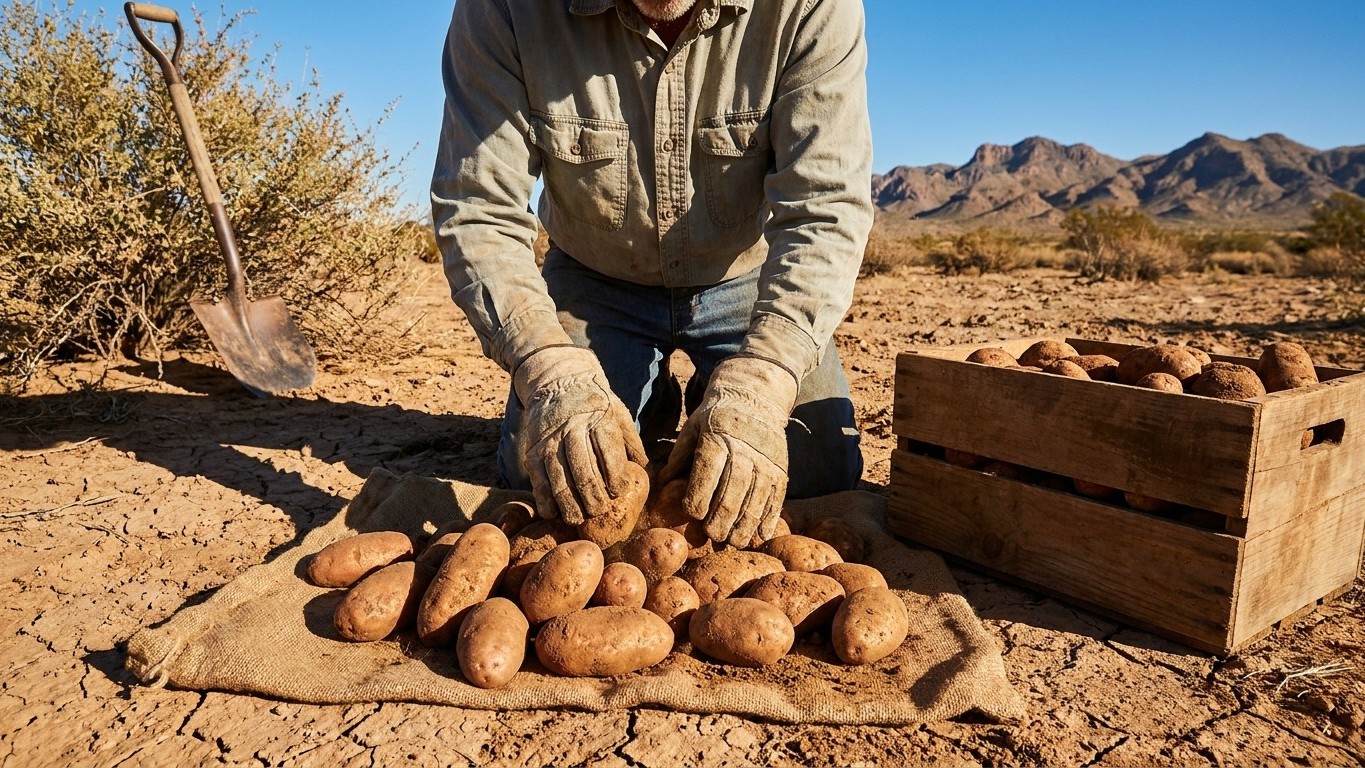

In low-desert Arizona, potatoes come out of the ground in late spring, before summer heat shuts the plant down, not in fall after a frost. Storage is the harder problem: an unheated shed or garage here rarely drops cold enough to freeze the crop, but it also won’t hold the 40-45 F range potatoes need. It runs too warm, not too cold.
The short answer
Two numbers explain why Arizona’s potato calendar looks nothing like a Midwest or Northeast garden guide. At the reference station in Phoenix, NOAA’s 1991-2020 Climate Normals list no reliable fall freeze at all, with a frost-free season of 365 days. Across 30 spring seasons, the temperature dropped to 32 F on only 6 of them. That’s not a fluke reading, it’s the climate. There simply isn’t a frost date to plant around in the low desert, so a planting calendar built on “days before first frost” doesn’t apply here the way it does almost everywhere else potatoes get grown.
What replaces frost as the limiting factor is heat. Potato foliage stalls and tubers stop bulking once soil and air temperatures climb into the range low-desert Arizona reaches by early summer. That’s why growers here plant in winter, not spring, and dig the crop in late spring or early summer, ahead of the heat rather than after a cold snap. The harvest window is set by rising temperatures, not falling ones.
The second figure matters just as much once the crop is out of the ground. The mean minimum of Phoenix’s coldest month is 45.3 F. That’s an average overnight low, not a record and not a daytime reading, and it sits right at the bottom edge of the 40-45 F range Utah State University Extension recommends for storage. In practice, a garage or shed here won’t freeze potatoes in winter. It also won’t reliably hold the low 40s, because daytime temperatures in the same weeks routinely climb well above that overnight minimum. An unheated space in low-desert Arizona tends to run warmer than potatoes want, not colder, and that difference drives most of the storage decisions below.
None of this applies to Arizona’s high country. Flagstaff and the surrounding mountain communities sit in a genuinely different climate, one that freezes hard and on a schedule closer to a Rocky Mountain garden than a Sonoran Desert one. Published normals for those stations aren’t part of the dataset behind this article, so no frost date or coldest-month figure for the high country is given here. Anyone gardening in that part of the state should treat the low-desert figures above as irrelevant to their own conditions and look for data specific to their elevation.
Curing, and where
Utah State University Extension recommends curing freshly dug potatoes at 55-60 F with high humidity for two to three weeks before they go into long-term storage. That window firms the skin and closes small wounds from digging, and skipping it is one of the fastest ways to lose stored potatoes to rot. The challenge in low-desert Arizona is that harvest happens right as the state is warming toward summer, so the outdoor air at digging time is often already past the top of that range, and shade alone may not bring it back down.
- Dig on a morning before the day heats up, and get the potatoes out of direct sun immediately. Sonoran Desert sun on exposed tubers within minutes can do more damage than a few extra days left in the ground.
- Move the crop to the coolest sheltered spot available: a shaded, covered porch, an interior room away from windows, or a garage that isn’t yet baking in afternoon heat. A basement isn’t a realistic option for most Arizona homes, since they’re uncommon in a state where the water table and building practices favor slab foundations.
- Spread the potatoes in a single layer, not a pile, so air reaches all sides and any cut or bruised skin can dry evenly.
- Check the space with an actual thermometer rather than a guess. If it’s tracking above 60 F by mid-morning, the potatoes need to move to a cooler interior room for the rest of the curing period, even if that means less airflow.
- Hold them there for the full two to three weeks USU recommends before sorting for storage. Cutting curing short to free up space is a common shortcut, and it shows up later as soft spots in storage.
Storing through this winter
Once cured, potatoes want a dark space at 40-45 F, according to Utah State University Extension, or 38 F at 95 percent humidity, according to the University of Maine Cooperative Extension. Both sources agree on the essentials: cold, dark, and humid enough that the skins don’t shrivel. The trouble in low-desert Arizona isn’t matching that humidity, since the region’s dryness is a known issue addressed below, it’s the temperature side of the equation.
With a coldest-month mean minimum of 45.3 F, an unheated Phoenix-area garage or shed sits, on its coldest overnight hours, right at the top edge of the recommended range at best. During the day, when the sun heats a garage roof or a shed’s metal walls, that same space can run 15 to 20 degrees warmer without much trouble. Freezing is a non-issue for potato storage in this climate; the six-frosts-in-30-springs record makes that clear. But holding a steady 40-45 F, let alone Maine’s 38 F, through an entire winter in an uninsulated space simply isn’t something the ambient climate here will do on its own.
That gap is why most successful winter storage in low-desert Arizona leans on some form of mechanical cooling rather than passive space alone: an interior closet on the north side of the house, insulated further with blankets or foam board, or a dedicated appliance such as a spare refrigerator’s crisper drawer set to the warmer end of its range. A wine fridge or beverage cooler, if one is on hand, can also land in the right window when tuned correctly. Whatever the space, potatoes need darkness in addition to the right temperature, since light exposure turns skins green and bitter regardless of how well the temperature is managed. A cardboard box or paper bag inside the cooling space handles that part cheaply.
What goes wrong here
- Digging too late. Waiting even a couple of extra weeks past the recommended spring harvest window in low-desert Arizona means digging into rising soil temperatures, which stresses tubers and shortens their storage life before they’ve even been cured. Watch the calendar for this region rather than waiting for foliage to die back the way a cooler-climate guide might suggest.
- Curing in a space that’s already too warm. A shaded porch that reads 70 F by 10 a.m. isn’t doing the job USU describes. Move the crop indoors to a cooler room rather than assuming shade alone solves the problem.
- Storage space running warm instead of cold. Because this climate’s coldest-month minimum sits at the low edge of the storage target and daytime heat pushes well past it, an unmonitored garage or shed will often run too warm all winter, encouraging sprouting rather than dormancy. A thermometer left in the storage space for a few days before committing the crop to it catches this early.
- Low humidity shriveling the skins. Arizona’s dry air works against the high humidity both USU and the University of Maine call for. A loosely closed container, a damp (not wet) towel nearby, or a humidity-controlled drawer helps close that gap.
- Treating frost risk as real when it isn’t. Insulating heavily against cold that essentially never arrives, given only 6 frosts in 30 recorded springs at the reference station, while ignoring heat management, is a mismatch of effort. The energy spent on frost protection in low-desert Arizona is better spent keeping the storage space cool and dark.
- Applying disease or pest treatments without matching the problem. When rot or insect damage shows up in stored potatoes, an appropriate fungicide or appropriate insecticide, applied to address the specific issue rather than as a blanket precaution, is what USU and University of Maine guidance point toward, not a one-size-fits-all product.
Common questions
Can potatoes freeze in storage in low-desert Arizona?
It’s unlikely based on the climate data available for this region. With a coldest-month mean minimum of 45.3 F and only 6 spring frosts recorded across 30 years at the reference station, an unheated indoor storage space here almost never drops into freezing territory. The more common failure is the opposite: storage running too warm to keep potatoes dormant.
Is there a frost date to plan the harvest around?
No. NOAA’s Climate Normals for the Phoenix reference station list no reliable fall freeze and a 365-day frost-free season. Harvest timing in low-desert Arizona is set by rising spring and early-summer heat, not by a frost date, which is the opposite of how most planting calendars work.
Does Arizona’s high country follow the same schedule?
No, and this article doesn’t cover it in detail. Flagstaff and the surrounding mountain areas sit in a much colder climate that does freeze hard, but published normals for those stations aren’t part of the data used here, so no specific frost date or coldest-month figure is given for that part of the state.
Where should potatoes be cured after digging in this climate?
Utah State University Extension’s target is 55-60 F with high humidity for two to three weeks. In low-desert Arizona, that usually means a shaded porch only in the earliest morning hours, with a shift to a cooler interior room, such as an inside closet or unused bathroom, once daytime heat pushes past that range.