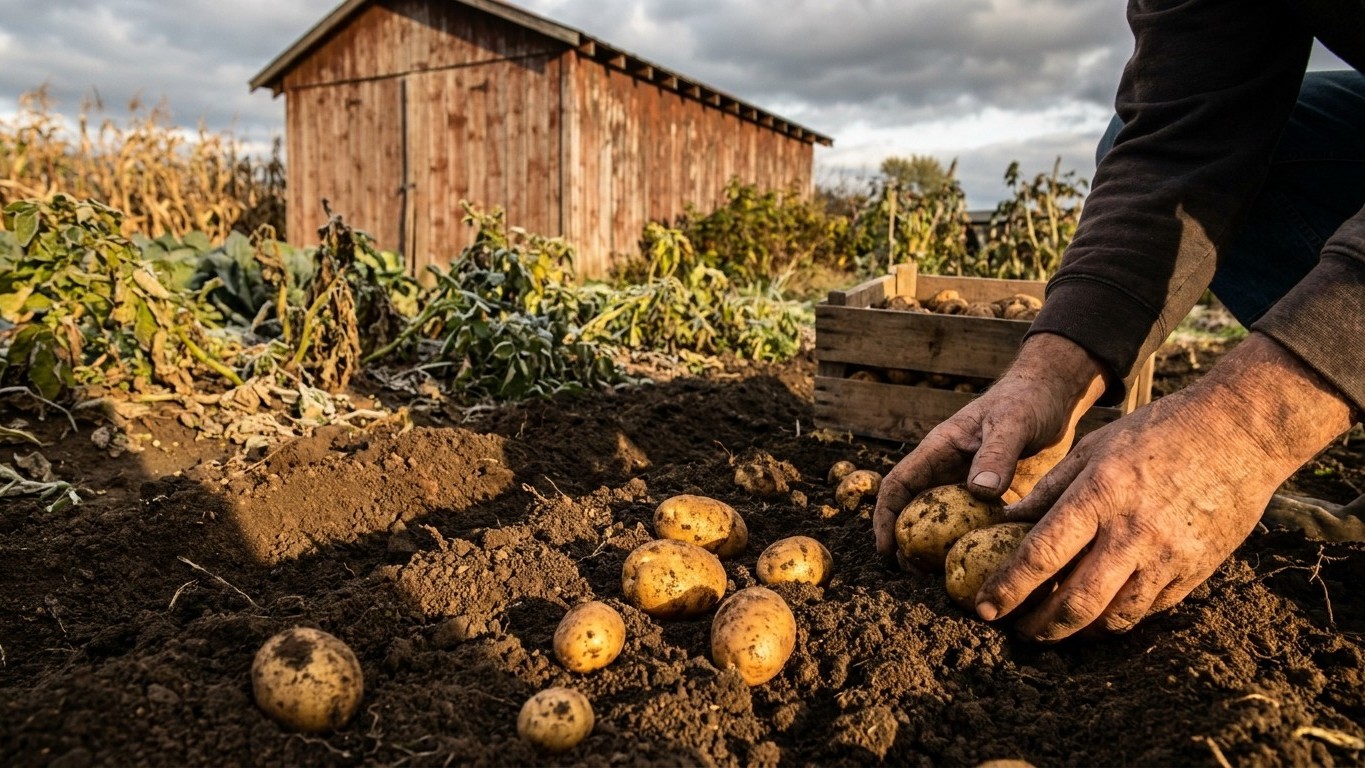

In central Ohio, potatoes typically need to come out of the ground before the first fall frost hits between October 5 and October 15, in the state’s zone 6a window (Ohio State University Extension). Once dug, tubers cure best at 55-60 F, then move to storage that holds 40-45 F (Utah State University Extension) or 38 F at 95 percent humidity (University of Maine Cooperative Extension). The catch: the Columbus area averages a coldest-month low of 22 F (NOAA NCEI, 1991-2020), cold enough to freeze an uninsulated storage space solid for weeks at a stretch.
The short answer
Two numbers set the whole calendar. The first is the frost window itself, October 5 to October 15, which marks zone 6a and tells a grower roughly when the foliage above ground will blacken and die back. That dieback is the practical harvest signal for a crop grown for storage rather than fresh eating: once the vines have collapsed, the tubers below have usually finished sizing and their skins have started to toughen, which matters more for how well they keep than for how big they got.
Soil, unlike air, does not cool on the same schedule. A hard frost can blacken the tops on a clear October night while the ground eight inches down stays well above freezing for another week or two. That lag is the reason growers in this part of Ohio usually have a short buffer after the frost date to finish digging rather than a hard deadline on the frost date itself. Waiting too long past that buffer risks a harder freeze reaching the tubers directly, especially in a year when the first frost lands on the early side of the window.
The second number, 22 F, answers a different question: not when to dig, but where the crop can safely spend January. That figure is the mean daily minimum for the coldest month at the Columbus reference station, not a record low and not a monthly average. It describes an ordinary cold night in the dead of winter, the kind that repeats for weeks, not a rare cold snap. Held against a 40-45 F storage target, the gap is stark. A detached, uninsulated garage or a garden shed with no heat source will spend a good part of the coldest month sitting at or below 22 F, which is well past the point where potato tissue freezes and turns to mush on thawing.
That gap is what actually decides the storage plan in Ohio. An attached garage that shares a wall with a heated house, a basement corner, or a true root cellar dug partly into the ground can plausibly stay in the 40-45 F range all winter. A freestanding, unheated outbuilding cannot, not in a climate where the ordinary January low sits ten to twenty degrees below the target. The frost date tells a grower when to dig. The 22 F figure tells that same grower which building on the property is actually usable once the digging is done.
Curing, and where
Curing is the two-to-three-week window right after digging when cut and bruised skin heals over, according to Utah State University Extension, which recommends 55-60 F with high humidity for that period. In an Ohio October, following the frost window of October 5 to October 15, outdoor air swings too widely overnight to hold that range on its own, so the location matters as much as the timing.
- Stop watering the bed roughly two weeks before digging, so the skins have already started to set before the tubers come out of the soil.
- Dig on a dry day if at all possible. Wet soil clings to the skin, slows drying, and makes early rot harder to spot before storage.
- Brush off loose soil by hand rather than washing the tubers. Water at this stage works against curing rather than for it.
- Move the crop straight to a spot that can hold 55-60 F for the full two to three weeks: a basement corner away from a furnace, an unheated back room, or a partly below-grade root cellar. A shaded porch or an open garage in Ohio in October often drops into the 40s overnight, well under the target, and swings too far for the skins to heal evenly.
- Keep humidity high without soaking the tubers, using a layer of damp burlap or a loosely closed cardboard box rather than plastic, which traps moisture against the skin and invites rot.
- Check a few tubers for healed, firm skin before the crop moves to its winter storage spot. Skin that still tears easily under a thumbnail needs more time at 55-60 F before the temperature drops any further.
A basement tends to be the most reliable option in this climate because it holds a narrower range through the day than any space with outside walls or windows, and it does so without any active heating or cooling. A detached garage can work for the earliest part of the curing window, while October days are still mild, but it becomes less dependable as the month goes on and nights start tracking toward the coldest-month numbers that follow later in the winter.
Storing through this winter
Once cured, the target shifts down to 40-45 F in the dark, per Utah State University Extension, or as low as 38 F at 95 percent humidity according to the University of Maine Cooperative Extension. Both figures describe a narrow band, and both sit a long way from what an unheated Ohio outbuilding actually does across the coldest month, when the mean daily minimum runs 22 F.
That gap plays out differently depending on the building. A basement, especially one below the frost line and away from ductwork or a furnace, tends to sit naturally in the mid-40s to low 50s all winter without any adjustment, which lands close to the USU range and comfortably above the Maine figure. A root cellar dug into a slope, insulated by the surrounding earth, behaves the same way for the same reason: soil several feet down barely tracks the swings in outdoor air at all, let alone a single cold night at 22 F.
An attached garage is the harder case to call without checking it directly. One that shares a wall with heated living space and has no direct line to outside air can sometimes hold close to 40 F through an ordinary Ohio winter, but a detached garage or a garden shed with the same construction will not. Those structures track outdoor air closely, and when the coldest month is averaging a nightly minimum of 22 F, an unheated freestanding building will spend a meaningful stretch of the winter below freezing, not just brushing against it on the coldest single night of the season.
The practical move in a climate with this profile is to treat the basement, or a genuine part-underground root cellar, as the default storage location rather than the fallback, and to reserve an unheated garage or shed for short-term curing earlier in the fall when temperatures are still well above the coldest-month range. Wherever the crop ends up, darkness matters as much as temperature, since light exposure greens the skin and pushes the tubers toward the higher end of USU’s range faster than a dark space would.
What goes wrong here
- Digging after a harder freeze reaches the soil. Waiting past the October 5-15 frost window without a plan lets a second, deeper freeze follow the first, damaging tubers still in the ground. Dig within the days after the vines blacken rather than leaving the crop in place through a second cold snap.
- Wet fall soil at digging time. An October rain right before harvest leaves tubers coated in mud that traps moisture against the skin, encouraging rot before curing even starts. Wait for a dry day, or let the surface dry for a day before digging if rain has just passed.
- Curing in a space that swings too cold at night. A porch or open garage in late October regularly drops well below the 55-60 F range USU recommends, especially overnight, slowing the skin-healing process and leaving tubers more vulnerable in storage. Move curing indoors to a basement or similar steady space.
- Storing in an unheated, detached building through the coldest month. With a mean minimum of 22 F, a freestanding garage or shed will freeze stored potatoes at some point in January, not just on an unusually cold night. Shift winter storage to a basement or root cellar before the coldest month arrives.
- Storage that runs too warm instead of too cold. A basement corner too close to a furnace or water heater can climb well above the 40-45 F target, encouraging sprouting over the winter even though the space never freezes. Check a thermometer in the actual storage spot rather than assuming a basement is uniformly cool.
Common questions
When should potatoes be dug in Ohio?
Around the first fall frost, which falls between October 5 and October 15 in the state’s zone 6a, according to Ohio State University Extension. Vines blackened by that frost are the usual sign the crop is ready to come out of the ground.
Can potatoes be stored in an unheated Ohio garage all winter?
Not reliably in a detached, uninsulated one. The coldest month averages a nightly minimum of 22 F at the Columbus reference station (NOAA NCEI), well below the 40-45 F range Utah State University Extension recommends for storage, so a freestanding garage will likely freeze the crop at some point in the winter.
How long does curing take before storage?
Two to three weeks at 55-60 F with high humidity, per Utah State University Extension. In Ohio’s October climate, that window is easiest to hold indoors, in a basement or similar steady space, rather than in an outbuilding exposed to swinging night temperatures.
What temperature should a home storage spot actually hold?
Utah State University Extension recommends 40-45 F in the dark, while the University of Maine Cooperative Extension gives 38 F at 95 percent humidity as an alternative target. Either range points toward a basement or root cellar in Ohio rather than an unheated shed, given how far outdoor buildings drop during the coldest month.