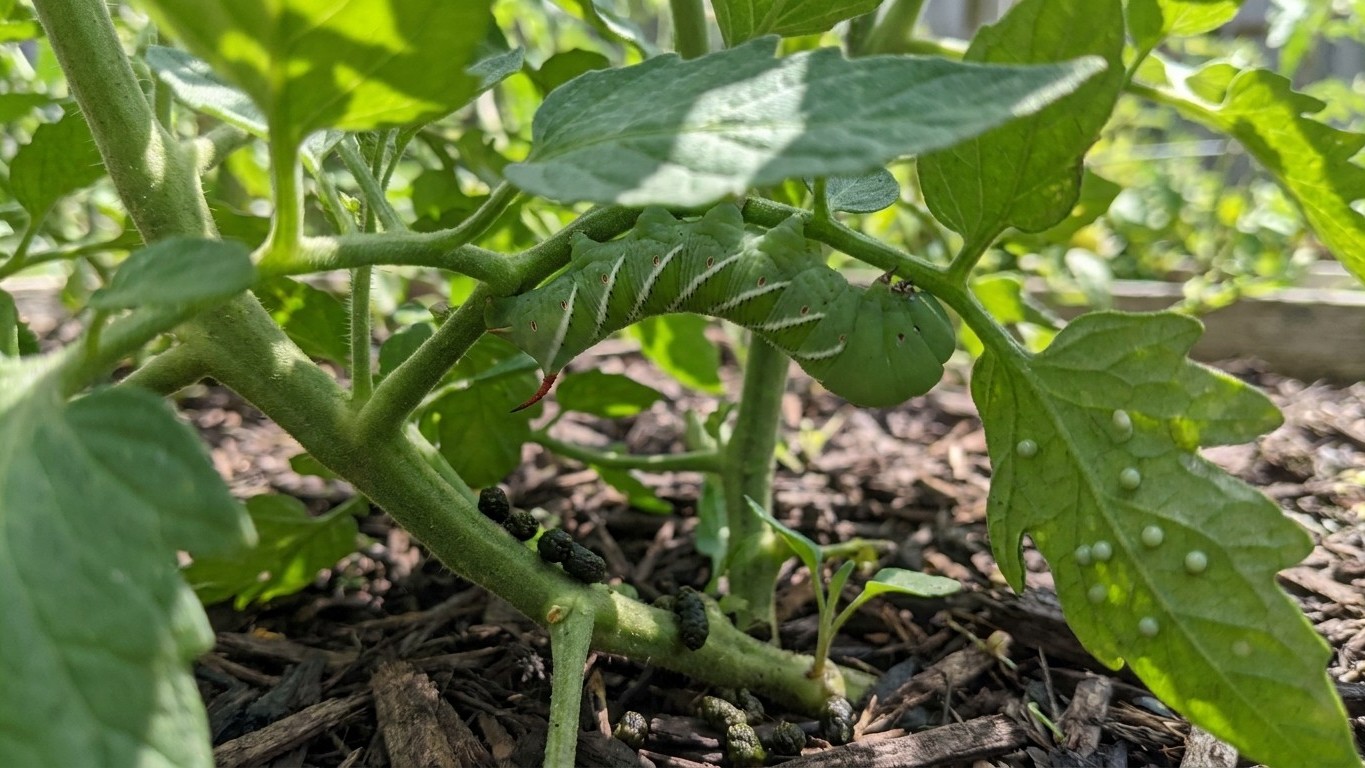

Tomato hornworm control works when the method matches the insect’s stage: eggs and tiny larvae respond to scouting and hand removal, mid-size larvae respond to barriers and trap crops, and only a heavy, late-season infestation justifies a targeted product. Spraying on a schedule, or spraying because you saw damage last week, usually misses the window and kills the wasps already doing the job for you.
Timing beats product
The single biggest reason tomato hornworm control fails isn’t the wrong spray. It’s the right spray, or the right hand-picking session, aimed at the wrong week. This insect, Manduca quinquemaculata, spends most of its life invisible to a homeowner walking the garden at a normal pace. The moth lays pale green eggs on the undersides of leaves, singly, and those eggs hatch into larvae smaller than a grain of rice. At that size, a hornworm does almost no visible damage and blends into the leaf vein pattern almost perfectly.
By the time most gardeners notice something’s wrong, stripped stems, dark pellet droppings on the mulch, the culprit has usually molted several times and can be three to four inches long. That’s the paradox: the hornworm is enormous and still hard to see, because its green body and diagonal white stripes mimic the tomato foliage it’s sitting on almost exactly. People walk past a caterpillar the size of a finger a dozen times before spotting it.
This is why intervention timing matters more than product choice. A treatment aimed at the egg stage does nothing to a four-inch larva already past its last molt, and a treatment aimed at a near-mature larva is often pointless anyway, since the insect is about to stop feeding and burrow into the soil to pupate. Worse, spraying at that late stage can also wipe out parasitic wasps that may already be handling the problem for you, a caterpillar covered in small white cocoons is a hornworm that’s already been neutralized biologically, and killing it at that point removes next month’s wasp generation along with it.
Before deciding on any control method, the more useful first step is figuring out exactly which stage you’re looking at and what typically comes next for it. This site’s life-cycle page for tomato hornworm breaks down egg, larval instar, pupal, and adult moth stages with what to look for at each one, and that identification step determines everything that follows here, whether hand removal is still realistic, whether a trap crop still has time to work, or whether the infestation has moved past the point where anything but a targeted product will help.
What works without a product
Several tomato hornworm control methods need no label and no purchase, but each one only works if it’s timed to a specific window in the season.
Barriers, hand removal, and trap crops
- Row covers block the adult moth from laying eggs in the first place, but they only work if installed before moths are active in your area and removed once tomatoes need pollinator access, a cover left on too long defeats itself.
- Hand removal is the most direct method and remains effective at almost any larval stage, but it’s laborious: hornworms rest low on the plant during the day and feed at dusk and dawn, so evening scouting with a flashlight finds far more than a daytime walk-through. Gardeners who check twice a week catch small larvae before they do real damage; those who check once a month often find full-grown ones instead.
- Trap crops, dill, and other members of the carrot family are sometimes used to draw egg-laying moths away from tomatoes, since the moths are also attracted to related host plants. This only works if the trap crop is established and flowering before the tomato planting matures, planted at the same time or later and it offers no head start.
- Planting timing itself is a control tool: shifting transplant dates relative to your local moth emergence window (which varies by state and season) can mean your tomatoes are past their most vulnerable early growth stage when moths are laying.
- Fall and winter cleanup, tilling soil after harvest, disrupts overwintering pupae, which sit a few inches underground. This step happens months after the visible damage, which is exactly why gardeners skip it, but it’s the one method that reduces next year’s population rather than this year’s.
None of these methods are fast fixes for an active, large-larva outbreak. They’re strongest as prevention and early intervention, which loops back to the same point as the timing section above: identification first, method second.
The allies you already have
Tomato hornworm has natural enemies that do real work, and the most visible one is a parasitic braconid wasp in the genus Cotesia. These wasps lay eggs inside a living hornworm larva, and the wasp larvae later emerge through the caterpillar’s skin to spin small white cocoons on its back, dozens of them, giving the hornworm a fuzzy, rice-covered look. A hornworm carrying these cocoons is still alive but is finished as a pest; it will stop feeding and die once the wasps complete development, and the wasps that emerge go on to parasitize more hornworms.
Beyond that specialist, general predators help keep hornworm numbers down before they reach that stage. Lady beetles and lacewings feed on hornworm eggs when they find them. Paper wasps and other predatory wasps carry off small larvae to feed their own young. Birds, particularly ground-feeding species, will pick off larvae that have dropped or are moving between plants. None of these predators eliminate a hornworm population alone, but together they explain why many gardens never see a serious outbreak even without any active control.
The plain warning here is unavoidable: a broad-spectrum insecticide, one that isn’t targeted to caterpillars specifically, kills the Cotesia wasps, the lacewings, and the lady beetles right along with the hornworm. Broad-spectrum products don’t distinguish between a pest and the insect eating that pest. That’s how a manageable hornworm problem turns into a worse one within a few weeks: the spray removes the natural predator population, and the next generation of hornworm larvae (or an entirely different pest that the wasps were also keeping in check) arrives with nothing left to slow it down.
If you spot a hornworm covered in white cocoons, the useful action is to leave it in place rather than removing it. It looks alarming, but it’s a wasp nursery finishing its job, and killing that caterpillar interrupts the exact biological control that would otherwise reduce your hornworm population going forward.
When a product is the answer
There’s an honest case for a targeted product, and it applies to a narrower situation than most gardeners assume: a heavy infestation of small to mid-size larvae, found through active scouting, on plants where hand removal and barriers haven’t kept pace and where no visible parasitism is present. Products aimed at caterpillars specifically, rather than broad-spectrum insecticides, are the relevant category here, and they work best against younger larvae; they lose effectiveness against larvae that are already near full size and close to burrowing to pupate.
That timing detail matters as much as the choice of product itself. A treatment applied to a population of large, nearly mature larvae is often too late to prevent the feeding damage that’s already visible, and the caterpillars may pupate and leave the plant regardless. The window where a product makes a real difference is earlier than most people reach for one, which circles back to why scouting and staging identification (covered on the life-cycle page) has to come before any product decision, not after.
What this page won’t do is name a specific product, brand, or rate, and that’s deliberate rather than an oversight. Which products are labeled for use on tomatoes, what’s permitted in a home garden versus a commercial planting, and what application guidance applies all differ by state and change from season to season as labels and regulations are updated. A product legal and recommended in one state may be restricted or handled differently in another, and a state’s cooperative extension service is the authority that tracks those changes in real time.
The practical next step is your local extension service, not a generic national list. This site maintains a territory-specific page for tomato hornworm control that names the extension service for your state and links directly to its current guidance, including what’s permitted and how it’s timed to your local moth emergence window. That’s the source built for your specific growing conditions, not a one-size answer that may already be outdated by the time you read it.
Common questions
How do I tell tomato hornworm from tobacco hornworm?
Both feed on tomato plants and look similar at a glance. Tomato hornworm (Manduca quinquemaculata) has a V-shaped white marking on each side and a black or dark blue horn near the tail; tobacco hornworm has diagonal white stripes and a red horn. Both respond to the same control approach, so misidentifying between the two doesn’t change your plan.
Will hand-picking really keep up with an infestation?
For a small home garden with a handful of plants checked regularly, yes, it’s one of the most effective methods available. For a larger planting or for a gardener who can only check once every week or two, larvae will outgrow the plant’s tolerance faster than hand removal can keep pace, which is when barriers or targeted products become more realistic.
Is it safe to leave a parasitized hornworm on the plant?
Yes. A hornworm covered in the small white cocoons of a parasitic wasp has already stopped being a meaningful threat to the plant and will die once the wasp larvae complete development. Leaving it in place lets the next generation of wasps emerge and go on to parasitize more hornworms nearby.
Why did my hornworm problem come back worse after I sprayed?
A broad-spectrum insecticide typically kills the parasitic wasps, lady beetles, and lacewings along with the hornworms present at the time, removing the natural predator population that would otherwise have suppressed the next generation. Without those predators, subsequent larvae, or other pests entirely, face far less resistance.